



Gaming
Esports
Quickshot on how far European League of Legends has come
Trevor ‘Quickshot’ Henry has been at the forefront of pro European League of Legends for the past six years – we caught up with him to discuss how much it’s changed and what’s in store for 2019.
Professional European League of Legends has changed a lot over the past six years, and very few people have been around backstage all of that time to see it evolve. Trevor Henry, better known as Quickshot, is one of those people. As a veteran caster in the EU LCS and now the LEC, he has watched the league surpass expectations and the teams grow to the globally recognised organisations they are today.
“I’ve been with the LCS and the LEC since it started in 2013,” Quickshot tells us during the first week of LEC competition. “But I’ve been involved in esports as a fan, a competitor, and some of my first jobs were working in the esports market. My very first was in South Africa at a retail chain in a high end gaming and esports marketing and sales position.
“That’s 12 years ago, and the reason I give that context is because it’s important to know that the entire industry has grown, every game, every market, every console. Investments have gone up, mindsets and mentalities have changed. When I was a teenager, if you played video games, you were the scum of the earth. Now it’s cool, and livings can be made from them.
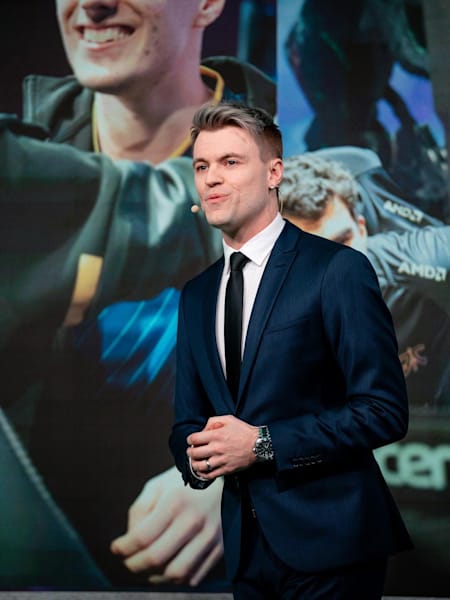
Quickshot has been around to see the changes in EU LoL
© Riot Games Flickr
“So, it’s really exciting and empowering that a product like the LCS and LEC continues to get investment, support from the company, and continues to get belief and trust and buy-in. When you look at the cost of the studio, the maintenance, the staffing, the broadcasting technology, we’re on the cutting edge of television.”
So what has changed over the years in terms of the broadcast? For those who have been watching from the start, it can be hard to notice the changes that come about every now and then. But if you go back and look at early broadcasts of the EU LCS now, it’s easy to see the differences. Plus, it’s only in the past couple of years that Europe’s top LoL broadcast has been fully autonomous.
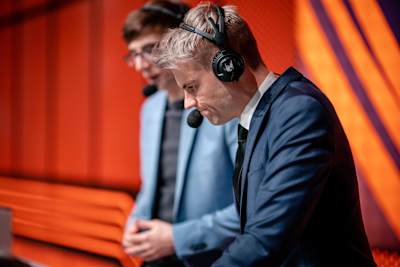
“Since 2013 to 2019, every year or two we’ve made major upgrades in our tech,” Quickshot tells us. “In our inaugural years, we piggybacked off North America. We had a very well equipped control room, and we actually broadcasted our show from Santa Monica, from their broadcasting office. We had a North American production team that would be working nine hours behind ours, we would pipe them our camera feeds and in-game feeds, and they would mix it all together and push it online. We only severed that tie around 2016-17 and took complete control. Astute viewers will notice our tone shift, the additional content segments, the additional resources we have now.”
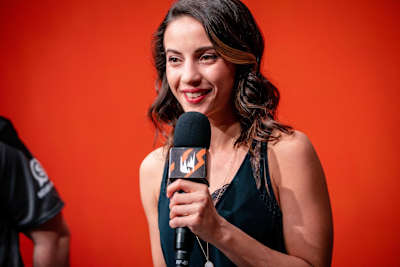
Laure Valée is an LEC interviewer
© Riot Games Flickr
Additional resources means additional talent, and in recent times not only has Quickshot been one of the most popular casters, he’s also taken on more roles backstage. As the On-Air Talent Manager, the people you watch on LEC broadcasts are his responsibility now.
“I’m directly responsible for hiring, performance management, and rotating guests. We have a dedicated part of the budget carved out for me to use to bring in new voices to mix the show up. When you have a 22 week season, having extra voices like Dan ‘Foxdrop’ Wyatt or Maurice ‘Amazing’ Stückenschneider gives the show a different flavour. Laure [Valée] for the interviews and Foxdrop were my biggest wins of 2018, and I want to build upon them for 2019.”
The newest addition for 2019 is Indiana ‘Froskurinn’ Black, who has made the move over from casting the League of Legends Pro League (LPL) in China. She is someone Quickshot is very excited about working with, and is already looking to be a pretty big win for 2019.
“I actually wanted Frosk for 2018,” Quickshot remembers. “I lobbied real hard for her to come to Europe. I see so much talent in her, she’s got such a unique style and when I was visualising what my ideal on-air talent team looked like, her perspective and voice was something that was very enticing to me. Fortunately for me she was interested in Europe and we managed to pick her up.”
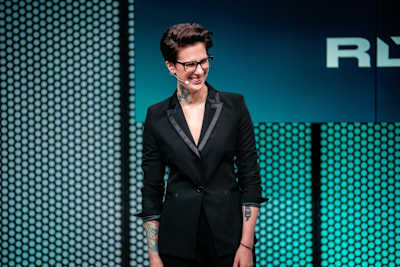
Froskurinn is one of Quickshot’s new additions
© Riot Games Flickr
That’s how the broadcast team has changed over the years, but what about the teams? Up until now, Quickshot thinks it’s been a mixed bag, but now that the LEC’s long term partnership model is here, he’s excited for what the future holds.
“In the EU LCS, there were teams that really grabbed opportunities and success. G2 Esports are a prime example. They took three or four attempts to qualify for the EU LCS, and they were borderline generating a meme that they were never going to be successful. Then they won four titles consecutively, and now G2 is one of the most dominant organisations arguably on the planet. Europe for sure.
“I think there are teams that really excelled, and there are teams that could’ve done more. The long term partnership model forces team to have a business plan and a strategy, because you have to present that to the LEC. So now I’m much more confident looking forward that we’ll see progression for a wider number of teams.”
Finally, since he’s someone who’s been around and seen it all, we asked Quickshot to reminisce on some of his fondest memories for a bit of nostalgia before the EU LCS becomes a distant memory.
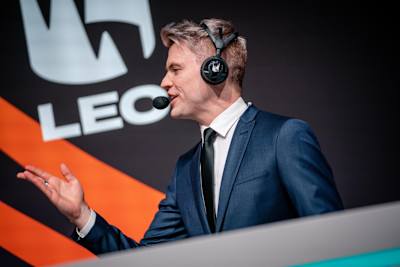
Quickshot looks back fondly on the EU LCS
© Riot Games Flickr
“One of my fondest memories was having to step out of a best of five,” he says. “It was a Gambit playoff series around the quarter-finals, and unfortunately there was a family emergency in the NA LCS casting squad. They said ‘Look we need you to fly out.’
“The reason this is one of my fondest memories, not only because I got to cast EU LCS and NA LCS in the same 36 hour period, but I got to cast two pentakills in the Gambit series, landed, casted a Team SoloMid series, and I distinctly remember Søren ‘Bjergsen’ Bjerg getting a pentakill on Karma. There was a little meme that I was the pentakill fairy.
“Another was my first Gamescom in 2013; my first year as a full time Riot Games shoutcaster. It fell over my birthday, and as a South African, going to Gamescom in Germany to work backstage alongside Leigh ‘Deman’ Smith, Joe Miller and Sam ‘Kobe’ Hartman-Kenzler... I just couldn’t believe what was happening. I broke down, cried my eyes out, and I had to get my makeup redone. I just got so overwhelmed that this had become my job.
“The last one is game three of Samsung versus SK Telecom T1 in the Worlds finals in 2016. That was my first Worlds final as a caster. In game three, it was looking like a 3-0 SKT win, but Samsung managed to pull off this insane Elder Dragon steal, which led to a throw in mid and then Baron. We ended up having a five game series, and it’s the best World final we’ve ever had. I was so lucky to be the guy making the calls.”
European League of Legends has come a long way since 2013, and so has the man from South Africa; he’s had an amazing career so far, and you can expect to listen to Quickshot making the calls for some time to come.
