

Skateboarding
Skateboarding
Behind the Scenes: Crafting the Red Bull Spot Check Melbourne Build
Go behind the scenes of the Red Bull Spot Check Melbourne build. Pro skater and chippy Jack Kirk reveals the tight crew, late nights, and technical blueprints behind the custom street obstacles.
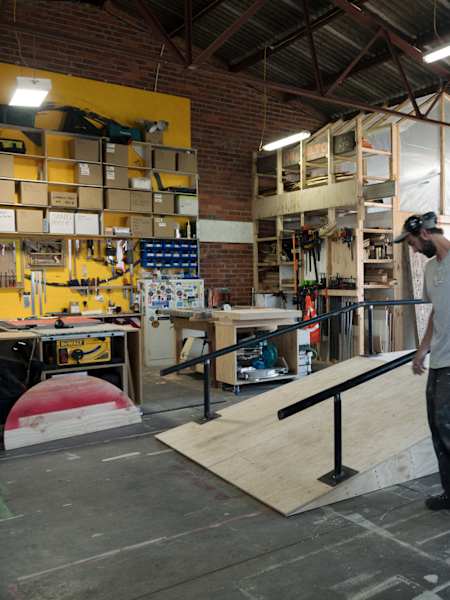
The late-night air in Melbourne is heavy with fresh sawdust, wet paint, and the sharp tang of a welding torch. Inside a cramped Coburg workshop, Jack Kirk is racing against the clock to finish a custom street-course build for the upcoming Red Bull Spot Check Melbourne event. He is a newly qualified carpenter - just over a year into his trade - but he is also a pro skater. He designs every ramp, rail, and ledge through the hyper-specific lens of someone who actually skates them.
"I tried to make it as, you know, street vibe as possible," Jack says, reflecting on the design process with Red Bull’s team. The build directly answers the raw, anti-competition philosophy of the event series. As the official event manifesto promises, this isn't a traditional stadium contest: "No contest runs. No grandstands. Just good spots, good people and a day built around skating." For Jack, translating Melbourne’s iconic, gritty street architecture into skateable timber and steel meant building for a session that mirrors a real day in the city - devoid of judges, scores, or heats.
"I tried to make it as, you know, street vibe as possible"
Designing the Architectural Chaos
The course blueprint reads like a love letter to Melbourne’s most infamous spots. Instead of sterile, standard skatepark obstacles, Jack focused on replicating the exact textures and obstacles that local crews look for when they are out stacking clips and feeding off the energy of the local scene.
The centrepiece features a meticulous recreation of a classic Melbourne city bench, complete with its signature green shape - though reimagined in a fresh colourway with a grinding rail fixed to the top. Alongside it sits a replica Triton barrier, heavily graffiti-tagged, and a fully functional street fire hydrant complete with custom details. Every angle requires careful planning.
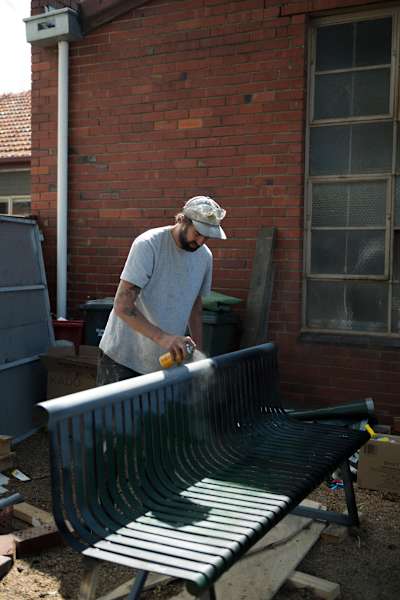
Jack Kirk paints the chair rail for Red Bull Spot Check Melbourne Naarm
© Bryce Golder
Jack and his crew fabricated a series of separate, specialised kickers, calculating the pitch perfectly so skaters could comfortably clear a car or launch themselves onto the barriers. To complete the aesthetic, they mounted authentic Melbourne street signs directly to the flatbars. "I was pretty hyped that it worked out, to be honest," Jack admits. "They look really good."
The Midnight Grind
Pulling off a build at this scale requires a massive graveyard-shift effort. Jack admits his own limitations with a laugh: "I can weld, but I'm fucking dog shit at it." Because of that, the project quickly became a community rescue mission, fueled by a tight-knit crew of local skate legends and tradesmen who understand exactly how a heavy impact should feel. Jack relies heavily on his "subbies" - a team of friends who happen to be incredibly talented skaters and makers:
- Mitch, a gun welder and OG skater, fabricated architectural-grade rails that looked incredibly "schmick".
- Benny Dove handed over his essential workshop space in Coburg.
- Toddy (from Todd Furniture) lent his carpentry expertise.
- Red Dog provided his technical expertise and guidance, playing a critical role in bringing the layout together in the warehouse space.
- Leo Carroll Cap, a local Melbourne filming and skating legend, supported the crew with authentic skate insight on the ground.
- Nick Boserio acted as the on-call muscle, showing up at any hour of the night to move heavy transitions.
"Everyone who’s helped skates," Jack explains, emphasising the crew's shared DNA. "I wouldn't have done it without them."
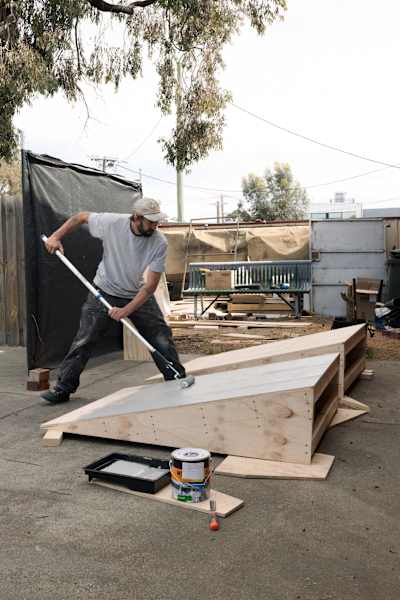
Jack Kirk paints one of the kickers for Red Bull Spot Check Melbourne Naarm
© Bryce Golder
The final weeks of construction became a blur of sleepless nights, squeezed entirely into the exhausted hours after regular day jobs. Fresh back from a high-energy filming trip to New York with Hoddle Skateboards along side a Bunt Live session, Jack found himself running on fumes. "Working quite late," he says, offering a weary apology to his family for the ghost hours spent in the shop. "Sorry, Bridget and Daisy."
Visualising the Session
For Jack, the gruelling physical labour is vindicated by a mental projection of how the course will eventually be torn apart. While hammering down sheets of ply, he is constantly visualising the exact tricks the international and local riders will pull.
"100%," Jack says when asked if he builds with specific skaters in mind. "I already pictured Zion doing a gap kicky back lip, 1st shot at Argyle Square... Foy, obviously the front crook." He crafted the rails knowing heavyweights like Jamie Foy, Ryan Shekler, and Zion Wright would be dropping in alongside local amateurs during the open "Best Trick Jam session." "Actually, I do also want to see just like a classic back noseblunt on the Triton barrier."
"I already pictured Zion doing a gap kicky back lip, 1st shot at Argyle Square... Foy, obviously the front crook."
That intersection of design and muscle memory highlights Jack’s favourite milestone as a craftsman - the exact moment when his identity as a skater and his evolving skills as a "chippy" finally locked into place.
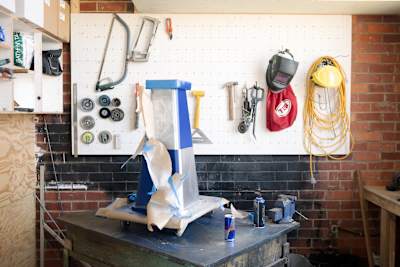
The Red Bull Hydrant for Red Bull Spot Check Melbourne Naarm
© Bryce Golder
"I used to always stress out. I would be trying to do stuff, sweating," Jack recalls. "Then one day you just kind of like... it doesn't all click at once, but certain things click, and you realise, you walk off, and then you're like, oh, I just made that without really thinking too much about it."
With the tools finally packed away and the event looming on Friday, the heavy raw materials have become a skateable tribute to Melbourne's streets. For Jack, seeing it all standing together inside the massive warehouse space makes the late nights worth it. "To look at it all once it was set up... it was pretty epic."
"To look at it all once it was set up... it was pretty epic."
The Blueprint: Technical Fabrication Specs
To turn a rough concept into a high-impact course that can handle international heavyweights, Jack traded raw intuition for precise carpentry, math, and structural engineering. Building for a casual cruise is one thing; building for heavy landing impacts requires industrial-grade reinforcement.
Check out a breakdown below how each piece came together.
The Melbourne City Bench & Integrated Coping
- The Structural Skeleton: The bench profile was cut from multiple sheets of 18mm structural CD-plywood, laminated with premium construction adhesive and countersunk timber screws to form rigid, 54mm-thick end walls. These walls were tied together with 90x45mm treated pine studs spaced closely at 200mm centres to ensure the flat seat would never sag under heavy impact.
- The Skate Surface: The top and sides were sheeted with a 9mm ply base layer, followed by a dense 6mm oil-tempered Masonite finish layer. This gave it a slick, durable surface that holds wax well.
- The Metalwork: Instead of a standard angle-iron edge, Mitch fabricated a custom 50mm heavy-wall round steel coping. This was pre-drilled and secured from the underside using countersunk sleeve anchors, leaving a completely flush grinding edge on top of the bench.
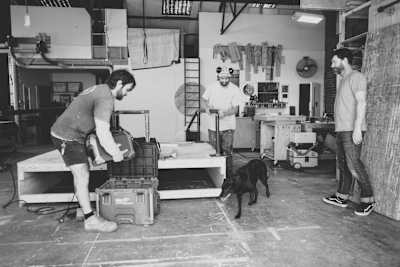
Jack Kirk works on rail for Red Bull Spot Check Melbourne Naarm
© Bryce Golder
The Triton Barrier Replica & Launch Kickers
- The Barrier Frame: To replicate the thick, hollow plastic look of a water-filled road barrier while keeping it structurally sound, Jack built a hollow timber box using an interlocking 70x45mm pine sub-frame. The exterior was skinned in 12mm structural ply, which was then heavily primed and finished with bright, high-vis orange exterior acrylic paint before the local graffiti writers took over.
- The Car-Clearance Kickers: These wedge-style ramps required an aggressive but smooth transition. Jack cut the side strings with a mild 6-foot radius curve. The internal framing used 90x45mm framing timber backed by solid timber blocking at the peak where the compression forces are highest.
- The Layering Recipe: To withstand high-speed approaches, the kickers were double-sheeted: a flexible 9mm structural ply base layer for strength, topped with a premium 6mm Baltic Birch plywood sheet for flexibility and speed.
- The Ground Transition: At the foot of the ramp, Mitch cut and ground a 4 mm-thick mild steel toe plate, countersunk flush into the timber so skate wheels glide smoothly from the concrete onto the ramp without catching on a lip.
The Street Fire Hydrant & Radius Pocket
- The Structural Core: A real cast-iron hydrant would damage boards and floors, so Benny and Jack fabricated a replica. They formed the central stand from a combination of metal and wood, anchored to a thick 25mm Marine Ply base plate bolted through the course subfloor.
- The Detail Work: Todd from Todd Furniture meticulously shaped the top cap and walls. They glued and dowelled them into the frame, then coated them in textured blue-and-silver industrial enamel paint to give it a convincing metallic feel.
- The Pocket Transition: Around the hydrant, Jack built a tight, custom radius pocket ramp for stability and smoothness.
The Melbourne Flatbars & Custom Sign Mounts
- The Steel Selection: Mitch the welder used 50mm x 50mm square hollow section (SHS) mild steel with a 4mm wall thickness for the flatbars. This heavy gauge ensures the rail won't flex, bounce, or vibrate when a skater lands a heavy frontside boardslide mid-session.
- The Base Plates: To keep the rails stable without anchoring them directly to the floor, Mitch welded the uprights to massive 300mm x 300mm square, 10mm-thick steel base plates. The bottom of the plates was lined with 3mm industrial rubber insertion sheets to stop the rails from sliding or shifting on the concrete.
- The Sign Attachments: To mount the authentic Melbourne street signs to the sides of the flatbars, Jack and Mitch avoided exposed bolts that could catch a truck. Mitch welded 3 mm-thick steel tab brackets under the rail, letting Jack bolt the signs flush against the metal framework from behind, completely protected from the grind zone.
Want to see it all go down? Be sure to head to Red Bull Spot Check Friday September 25th and watch some of the worlds best Red Bull skaters session iconic Melbourne spots.
Check out as the crew has landed and already shredding Melbourne/Naarm.
