
Rally Raid
Cyril Despres on how the modern-day Dakar Rally compares to the original
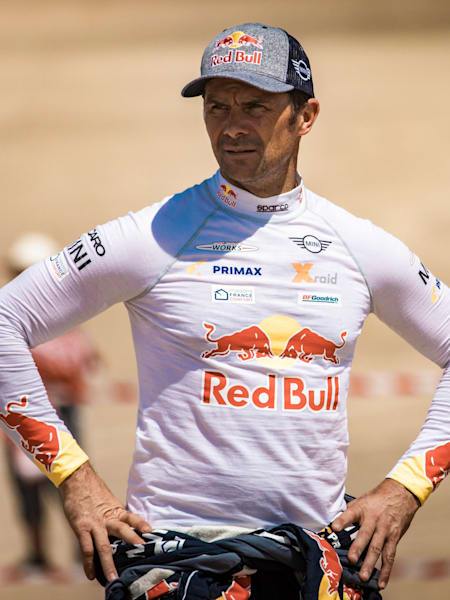
The five-time Dakar champion has been an ever-present at the event since 2000. He's perfectly placed, then, to compare the original African event with the current rally raid in South America.


Cyril Despres first took part in the Dakar all the way back in 2000. That young, fresh-faced enduro motorcycle rider would eventually become a five-time champion and, nearly two decades later, the Frenchman remains an icon of rally raiding.
Despres will always be synonymous with KTM. His five podium-topping finishes are part of the team's ongoing run of 18 straight victories. There's no other rally raid manufacturer like them, he says.
“A small company like KTM can beat big companies because there’s a lot of passion," he says. "Every single person at KTM is passionate – the doctor, the mechanic, the truck driver, the guy in charge of the wheels, the engine engineer, the suspension guy. They all have as much passion as the rider. And they are a kind of family. Living 15 days all together, having the same goal.”

5 min
Dakar Road Ahead
KTM's Marc Coma, Jordi Viladoms and Heinz Kinigadner discuss where the Dakar is heading, from future champions to changing safety requirements.

Despres finally climbed off the saddle in 2014 and he’s been racing the Dakar in a car since 2015. But that’s not the only thing that's changed since his first Dakar appearance. Despres experienced first-hand the event's transition from Africa to South America in 2009.
Wherever the Dakar takes place in the future, Despres promises he’ll be there, just as he was again in 2019. "As the race will keep going, and [as long as] I'll have a good vehicle, I'll keep going wherever it goes. Because this is what I like the most.”
Before jetting off after his latest Dakar adventure for some down time ahead of the Abu Dhabi Desert Challenge (March 31 to April 4), we asked him how the Dakar Rally has changed down the years in terms of speed, terrain, altitude, adventure and navigation.
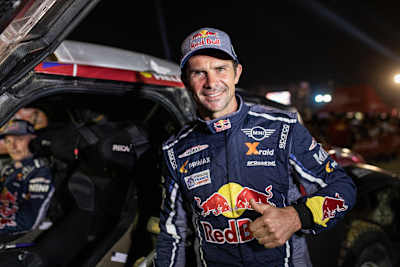
Cyril Despres at the end of the 2019 Dakar Rally
© Vytautas Dranginis/Red Bull Content Pool

Speed
“I’m still a motorcycle racer, and a motorcycle fan, and I talk with the guys in the bike category. They pretty much reach the same top speed, which is around 110-115mph [180kph]. This is what we were going in Africa. Our bike was maybe maximum 120mph [193kph] with a bigger engine, 700cc. It went down to 450cc a few years ago, but they go the same speed.
"Basically, the bike is lighter, they carry a less fuel. But from day one, I don’t think the Dakar changed much. Motorcycles are still a throttle, a handlebar, two foot pegs, a seat, two wheels, two tyres with knobs, and a lot of fuel. It’s still as hard as it was to cover the 5,000km of special stage.”
Terrain
“Technically, it’s much more demanding in South America, because in the same day you can start on the beach, go up mountains, go across dunes, go back to fast terrain, and finish in a canyon with rocks – and this is only one day.
"In Africa, it was the start in Europe, and then in Morocco. Rocky terrain, rocky track, which was fast, and as soon as you finish that, you went for maybe five or six days in Mauritania in a really big sand valley with dunes, and then the last part of the race was piste, and fast and dusty. In Africa, in the same day, you could not find so much different terrain.”
Altitude
“A hot day can be maybe 25°C in Africa, in Mauritania or in Senegal. In South America, the altitude plus also when it was really cold, below freezing, that was really hard for the body.
"But the next day you start at 4,000m altitude and then after three hours, you are maybe 200m and it’s really, really hot and it can reach 40°C. This is something we did not find in Africa. It’s tough for everybody, but even worse for the biker.”
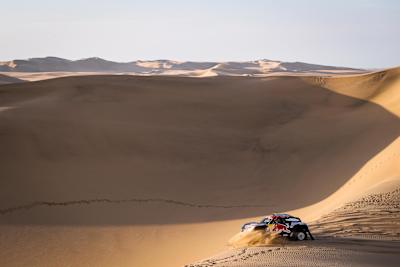
Cyril Despres tackles the dunes of Peru in his X-Raid Mini
© Frederic Le Floch/DPPI/Red Bull Content Pool
Adventure
“[In Africa] I remember leaving at six in the morning, and it’s off-road until 6pm. It was all off-road and you don’t meet anybody. The only people you see are other competitors or people from the organisation at the checkpoint or at the start or finish.
“In South America, people are coming to watch the race, some are on holiday and they come two, three days, to follow the race. They camp, they barbecue. You go around some villages in special stages and you’re never afraid to get lost. If you went 15 to 20 minutes in one direction, you'll maybe hit a piste, which goes to a road, and then the road goes to a village. You're never really lost somewhere in the desert.
“When you were in the middle of nowhere in Africa, and you have a broken engine at 200km, the people just said, ‘Okay, in more or less 12 hours, a truck could be here to pick you up.’ And you say, ‘12 hours? I’m in the middle of nowhere!’ People stay 12 hours by themselves, at night, sleeping close to their bike, and the next morning a truck picks you up and brings you to the next bivouac. When there were sandstorms, you can’t see a few hundred metres in front of you. That was a bit scary.
“It’s different when you start a race [in South America] and you know you'll never get lost and you won’t sleep outside because there's always someone to take care of you.”
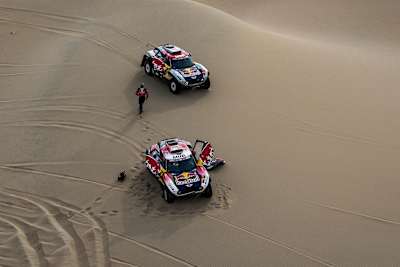
Despres lends a hand in the Peruvian desert
© Eric Vargiolu/DPPI/Red Bull Content Pool

Navigation
“In Africa, you had the start, you had the refuelling, sometimes you had the second refuelling, and then after, you have the finish. You had to reach a few waypoints, but the waypoint, at that time, was just to make sure that you are on the right path.
“Right now, of course, with the help of the map man and all the navigation possibilities, they can’t make it like this anymore. First of all, because the terrain isn't huge. And second, this is like a race, going to pick up every point. They try to put it on some tricky dune, some tricky valley, some higher dunes. In Africa, we could have made a total day with maybe 20 waypoints. And now, we have maybe 60?
“This is the new world of navigation. The most important thing was to reach the finish line. Now you have to get all these points. This year, it wasn't go from point A to B to C and finish. It was 5km and you have a waypoint, another 2km and another waypoint to cross the dunes, another 6km and another waypoint. That’s why it’s more technical and complicated. Compared to Africa, South America is much more demanding, physically.”
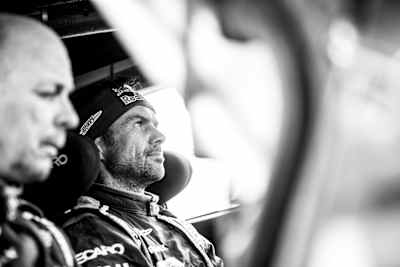
Cyril Despres and his Dakar co-driver Jean-Paul Cottret
© Flavien Duhamel/Red Bull Content Pool
