
Music
How Homebake set the standard for the locals-only festival
From 1996 to 2012, one Australian festival put local artists at front and centre. Eight years on from the final Homebake, its example is more relevant than ever.

Joe Segreto, the founder of eight-years-gone festival Homebake, is fielding a lot of queries right now. With the live music industry and overseas travel on indefinite hold, Homebake is back on radars. After all, the festival proudly pulled off all-Australian lineups (with a few Kiwi drop-ins) for well over a decade, proving you didn’t need international headliners to sell out.

In Facebook posts and online articles, fans are barracking for Homebake’s return. Segreto is also getting emails and calls seeking comment or a glimmer of hope. He’s mystified and a little overwhelmed by the renewed fervour. “I say I’ll bring Homebake back only if The Birthday Party re-forms,” Segreto tells Red Bull, pausing for effect. “Two of whom are dead.”
I’ll bring Homebake back only if The Birthday Party re-forms. Two of whom are dead.
You can’t fault punters for trying. At its peak, Homebake attracted a 20,000-strong crowd to The Domain in Sydney each December for a celebration of homegrown music, comedy and film. It stood apart amongst a raft of summer festivals warring for the biggest overseas talent.
Falls Festival has announced plans for an all-Australian lineup at its 2020/2021 edition -- an early indication of a likely trend. The question, then, is not so much whether Homebake can or should return (“I don’t think I could go through all that again,” Segreto adds), but how others can follow its example.
From Mudbake to the Domain
Homebake began on January 3, 1996 at Belongil Fields in Byron Bay, the future home of Splendour In The Grass. Moved ahead from December 1995, the inaugural edition featured Silverchair (the teenage trio released its debut album, Frogstomp, the previous March), Tumbleweed, Powderfinger and Grinspoon, the first band to win the triple j Unearthed competition. Tickets were an approachable $26, with no age restrictions. The site held 12,000 people. “Bizarrely and miraculously, it sold out,” Segreto recalls.
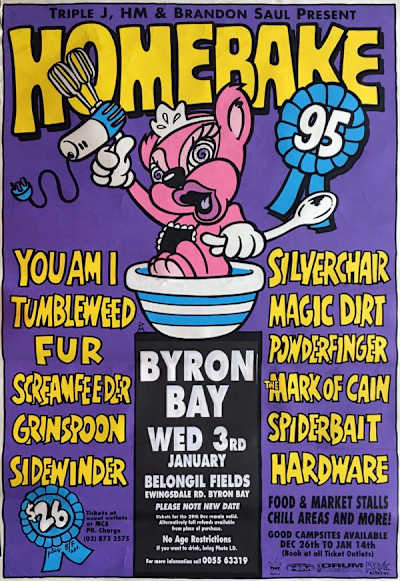
Homebake '95 poster
© Homebake
Torrential rain drenched Belongil Fields, with the ensuing morass earning the nickname ‘Mudbake’. Silverchair played a visceral set in the downpour, establishing the band’s deep bond to Homebake. (They returned in 1999 to cap off a gruelling Neon Ballroom tour, then again in 2006 ahead of Silverchair’s final album, Young Modern.) In 1996, the festival landscape was not yet crowded, with Big Day Out, Meredith Music Festival and Livid all on the ascent. Homebake was the maverick newcomer with impeccable timing.
After flirting with a multi-city format, Homebake became a Sydney-only event in 2000. With its lush grass and shady Moreton Bay figs, The Domain allowed for multiple stages, bars and market stalls.
From the start, its lineup was a multi-genre grab bag of Australian music. In 2000, Frenzal Rhomb, Spiderbait and The Living End played the main stage, while local hip-hop and electronic music took over The Big Top. The Hopetoun Stage, named after Surry Hills’ beloved (and now boarded-up) Hopetoun Hotel, featured up-and-coming acts. Over the years, Homebake caught Australian bands at their peak popularity, including Jet, The Vines and Eskimo Joe. But the festival also celebrated mercurial trailblazers: in 2011, following the death of post-punk original Rowland S. Howard, the Hopetoun Stage was renamed in his honour.
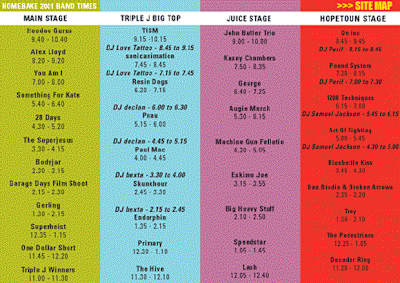
Homebake's 2001 set times
© Homebake
The Big Top Dance Crew
Located in the cityside corner of the site, The Big Top offered counter-programming to sweaty, beer-soaked moshing (although it had some of that too). For many a teenage punter, this writer included, The Big Top was a crash course in new, horizon-expanding sounds. From 2000 through to the final Homebake in 2012, its lineups were a microcosm of changing hip-hop and dance tastes.
In the beginning, the ravey sounds of sonicanimation, Bexta and Pnau intermingled with downtempo acts Wicked Beat Sound System, Endorphin and Salmonella Dub. On the beats and hip-hop tip, the early 2000s mixed in 1200 Techniques, Resin Dogs, Katalyst and The Avalanches member James De La Cruz. Bands that circled electronic music (Gerling, Regurgitator, TISM) and some that didn’t (Alex Lloyd, Something For Kate, Dirty Three) also mingled under the circus tent.
In the mid-2000s, Australia’s burgeoning Modular Records sound sidled in. In 2007, the run of acts from five p.m. was perfectly of its time: the Midnight Juggernauts to Muscles to Cut Copy to Muscles (again) to Architecture In Helsinki, before Pnau closed the show.
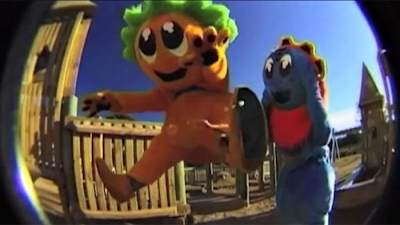
For sonicanimation, whose albums Orchid for the Underworld (1999) and Reality by Deception (2002) predated the social media feedback loop, Homebake was an eye-opener. In 1999, the group walked onstage to an overflowing tent. At the time, their live show featured two friends of the band in the Robert Rollie and Theophilus Thistler costumes from the ‘Theophilus Thistler’ video. At Homebake, the furry dancers, overheated and vision-impaired in their full-body suits, were dragged into the crowd by rowdy punters.
sonicanimation
© sonicanimation
Rupert Kellier, who formed sonicanimation with fellow producer Adrian Cartwright, remembers the scene in vivid detail. “I had a tug of war with the fans to drag the suits back on stage,” he tells Red Bull. “It was so jammed that we had to stop periodically during the set and ask people to move back, as the front row against the stage was getting crushed.” The melee was a kind of validation. “It was one of the first times it occurred to me that we were popular,” Kellier says. “We knew that our high rotation on triple j was a great thing, but until being face to face with an audience, we didn't know what to expect. It was crazy.”
No dance act played Homebake as often as Pnau. The duo of Nick Littlemore and Peter Mayes started as a bare-bones club act in the Big Top, before graduating to the main stage in 2008 with a fully-realised spectacle. That performance, which followed the career reinvention of Pnau’s self-titled album, saw Nick Littlemore and vocalist Holiday Sidewinder suspended on wires above the stage. “We were rigged up like Avengers, swinging wildly from side to side,” Littlemore recalls.
We loved every single Homebake. It felt like part of growing up.
2008 was Pnau’s biggest splash, but the early years were just as impactful. “The first show [there] felt about a million times bigger than anything else we’d played,” Littlemore says. “We loved every single Homebake. It felt like part of growing up, coming back each year and doing it all again.”
Hip-Hop, Headliners and Outsider Heroes
Segreto and the Homebake team didn’t believe in the concept of ‘headliners’. The main stage had a closing act, but it wasn’t the only draw. “I’d always be bailed up with the question, ‘Who’s headlining?’,” Segreto says. “I’d say, no one’s headlining. Because then it’s not about Homebake anymore: it’s about an artist at the top, and all the others supporting them.”
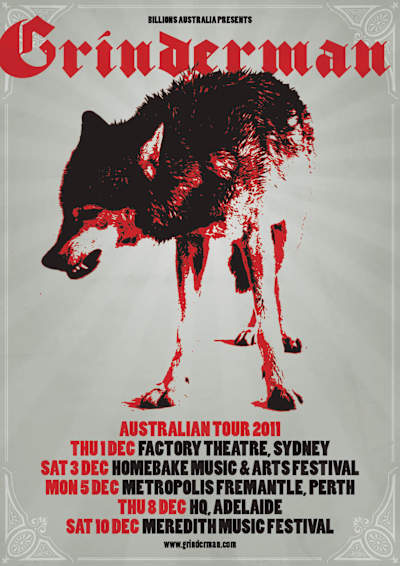
Often, the closing band was a clear-cut crowd-puller like Silverchair, Powderfinger, Jet or Crowded House. Other years -- like Nick Cave and the Bad Seeds in 2003 and Cave’s other outlet Grinderman in 2011 -- mirrored Segreto’s post-punk roots. Homebake even convinced the Divinyls to re-form for the 2007 show -- in what would be their final performance.
Grinderman 2011 tour poster
© None
Homebake became the place to see foundational Australian acts -- including The Triffids, Icehouse, The Church and The Saints -- among the triple j favourites of the day. “These weren’t what you’d deem geriatric or heritage acts, but the ones that set the path for where we are now,” Segreto says. The festival also caught future superstars on the way up, like Sia‘s third-billed slot on the Dome stage in 2009, RÜFÜS opening the Rowland S. Howard stage at midday in 2011 or Tame Impala with an early evening slot in 2012, years before they headlined Coachella.
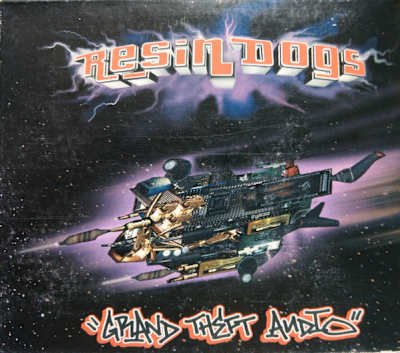
Hip-hop was also crucial to Homebake’s DNA. That started as early as 1999 with The Avalanches, on the cusp of the groundbreaking Since I Left You, and Brisbane beats collective Resin Dogs. The latter was a Big Top favourite in Homebake’s formative years. In 2000, the band played the main stage in the riotous company of Frenzal Rhomb, Spiderbait and Bodyjar. “The main stage was basically rock-orientated back then -- we were one of the first hip-hop or beats acts to do it,” recalls Resin Dogs founding member DJ Katch. “It was the same year that we signed our record deal with Virgin/EMI. Backstage just before the gig, I remember all the record label execs and lawyers dressed in their so-called casual attire.”
Resin Dogs album Grand Theft Auto
© Resin Dogs
Resin Dogs set a precedent for hip-hop evolving out of the Big Top. Hilltop Hoods first played the main stage in 2006 (alongside ‘Not Many’ hitmaker Scribe), followed in later years by the likes of Drapht, Funkoars, Seth Sentry and 360.
The Big Top gave a home to acts that didn’t fit any purist scene. This made for wild and exciting swings in tone and energy throughout the day. “Partly, I didn’t feel cool enough for the [dance] scene,” says sonicanimation’s Rupert Kellier. “Adrian and I were a little awkward and fumbled through our conversations with other artists. It might have had something to do with one of the Avalanches band members talking in an interview about sonicanimation and 'their fucking puppet show’.”
Onstage at Homebake, though, everything clicked. The same was true for Resin Dogs. “The band was never 100-percent hip-hop, and we did feel like outsiders,” DJ Katch says. “Quite a few embraced us, but a lot hated us.” The looseness of the Big Top suited them. “We were such a hybrid style band,” DJ Katch adds. “Yes, we were hip-hop, but we knew how to bring the rock and the dance.”
The Last Hurrah
For all the good feeling onstage, there was nothing breezy about putting on Homebake. Segreto and his festival partners toiled each year to assemble an eye-catching lineup. The all-local concept was both a blessing and an eternal challenge. Segreto sighs deeply at the memory. “That just made me physically sick every single year,” he says plainly. “I don’t want to make it sound too dramatic, but it’s something I really don’t miss.”
The festival welcomed a mix of genres and experience (“I didn’t want to become anything-centric,” Segreto says), but it also needed star power: “You had to look at how many tickets you need to sell to make this thing financially viable - which for Homebake, was between 90- to 100-percent of capacity.”
Like many Sydney festivals, Homebake faced increasing police presence, forcing its move to an over-18s policy. Homebake was driven out of the Domain after the ‘Global Edition’ with Blondie in 2012. For most of its run, the festival enjoyed a close and collaborative relationship with The Domain director Tim Entwisle. “He came to the show every year in shorts and backpack, then sent me a review of the bands the next week,” Segreto says. The relationship soured after Entwisle’s successors, described by Segreto as “two imbeciles”, started making changes.
Homebake announced a venue move to the Opera House steps for 2013, but ticket sales floundered. The festival was unceremoniously cancelled, leaving the team bruised. “We came to a grinding halt,” Segreto says. “Deciding to move to another location was the death-knell.”
Life After Homebake
Despite its bitter end, Homebake had undeniable highs. For Segreto personally, the festival fulfilled the impossible dreams of a post-punk-obsessed teenager.
“Suddenly these icons and heroes of your youth are at your show,” he marvels. “To get Nick Cave there, which I knew was a chore and a half because he hates festivals, was a miracle.” For the acts, it was a place to cap off the year in a relaxed, unpretentious setting. “All these artists watched each other, not waiting for the big US or UK act to perform,” says Pnau’s Nick Littlemore. “It created ley lines for all us locals to meet and collaborate.”
To get Nick Cave there, which I knew was a chore and a half because he hates festivals, was a miracle.
Homebake’s abrupt end meant many Australian acts missed their moment in The Domain. From big names like Flume, Courtney Barnett and Troye Sivan to the new class of G Flip, Kwame, Genesis Owusu and Baker Boy, a present-day lineup might look entirely different to the Homebakes of old. But drawing from a homegrown pool brings its own wrinkles. For Segreto, the challenge was weighing artist fees against a fair ticket price for a locals-only festival. “I remember battling with the ticketing companies, because I never wanted tickets to hit the $100 mark,” he says.
Once large groups can safely gather again in Australia, festivals would be wise to look at how Homebake did it. By necessity, local music is likely to take centre stage in the years ahead - and that’s something to celebrate.
“We have so many great artists in all different genres, so the format is still valid and could work again,” agrees sonicanimation’s Rupert Kellier. “With us as the headliner, though. Can you imagine? The kids would think, ‘Who the fuck are these guys?’”
Jack Tregoning is a freelance writer for Billboard, the Recording Academy/GRAMMYs and Red Bull Music. He tweets at @JackTregoning.

