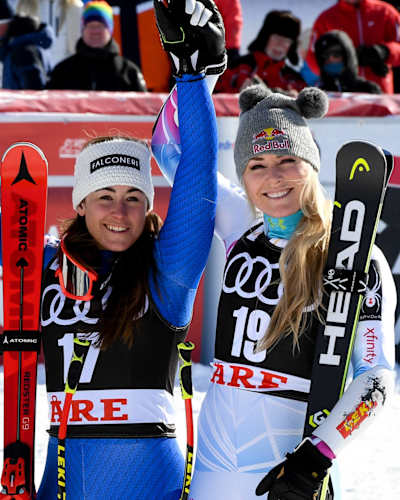
Ski stars Lindsey Vonn and Sofia Goggia: "We're all about speed"
What do you remember about those early years when you first began skiing?
I started when I was very young, about three, in Minnesota. I remember it was so cold that my father – a lawyer and ski instructor at the time – would always buy me hot chocolate and doughnuts to convince me to ski. I hated the cold.
I braved the cold to copy my brother, who’s three years older. I wanted to do everything he did, and I cried the whole winter when I was three because he was allowed to ski and I wasn’t. My mother was so exhausted that the next year she literally sent me with him. We started skiing at a tiny ski area with three chairlifts near Bergamo, but I never noticed [how little it had] to offer – that was thanks to my instructor, Nicola, who thought I had talent. He convinced me to pursue this path. We may not have had much there, but we did have a vision, a goal, a dream. And, to us, that was everything.
What does skiing mean to you?
Everything. The mountains are my happy place, where I find and feel joy. I feel freer [there] – stronger, more present, like anything is possible. There’s nothing better than skiing, going fast, racing. I grew up training. There was nothing else to do in Minnesota, and I wasn’t very good at sports. I competed in my first race at seven. Then and now, I’ve always been very competitive – it’s why I’m still here, why I came back. Despite all the falls, the suffering, how I feel about this sport will never change. Falling is just part of our job. I think Sofia sees it the same way.
Absolutely. Especially if we’re talking about a love of speed. If you ask Nicola for a memory from when I was little, he’ll tell you about when I was always first, never second, in our races across the plateau that linked the Foppola and Carona slopes. Like Lindsey, I’ve been guided by a sense of competition.
What was it your brother used to say about you being smaller but more “awkward”?
He never had a killer instinct at the starting gate. He never liked pushing himself beyond his limits. But I did, and I think skiing is a reflection of my character, of what’s inside me. This is why I’ve never managed to keep my work and private life separate: who I am, from what I have to do. The same is true for my feelings. I’ve tried many times in my career, but I just can’t do it. When I ski, I give everything. There’s a saying in English: “You’re the strongest weakest link.”
How do you become Lindsey Vonn and Sofia Goggia? What’s the physical and mental preparation like?
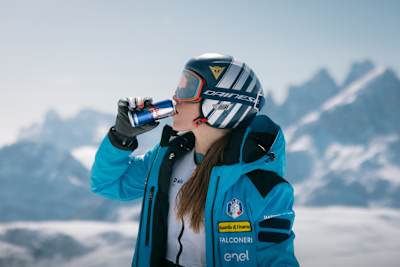
It’s changed a lot over time, and with time – especially now, having been away for so long. How I train, what I eat... it’s all different, because my body is different. With my ‘new’ knee, thanks to science, I can now train more intensely and in a smarter way, but I take experience into my races. I can’t think about challenging a young person’s body like I did 20 years ago. In the World Cup, everyone is a good skier, but not everyone can handle the pressure in important races. Mental performance changes everything.
It changes so much that when we’re feeling good about ourselves, when our emotions are in check and we trust in our abilities, even if our body is [only] at 60 percent, we can still get a podium finish. On the other hand, if your body is at 100 percent, but your head isn’t there, you won’t perform well, I can assure you. Of course, the best possible fitness training is fundamental, especially now with the new equipment. Skiing makes you age more quickly. It’s stressful, but, as Lindsey said, at the top [of the sport] all the athletes have the same potential, and what really makes the difference is learning how to manage your emotions. The more that time passes, the more you have to feel good about yourself; you have to protect your serenity. I’m not just talking about mental preparation, but something deeper. It’s about connecting with the right part of yourself.
Has that part of yourself ever been afraid of a descent?
If you’re a downhill skier and you’re afraid, you’re in the wrong job! Going fast is what we do, it’s what’s expected from us, so fear doesn’t even go through our minds. I was away for a while [following retirement] and I had to get through some major surgeries. But I couldn’t wait to come back, because I’m all about speed. That’s one of the many things that links me to Sofia.
Lindsey is right. Perhaps I’ve experienced fear sometimes, but not in the negative sense of the word. If fear is an emotion that you’re brave enough to listen to, it can be a resource, a guide. We both know that there’s a risk involved in our job, but you can’t focus on that. Instead, you have to focus on your skills, qualities, and the fact that you can do it. We can be distracted by what’s inside us, not by what’s around us. And if we feel fear, it’s not about skiing, but about other aspects of ourselves.
What’s so special about Cortina?
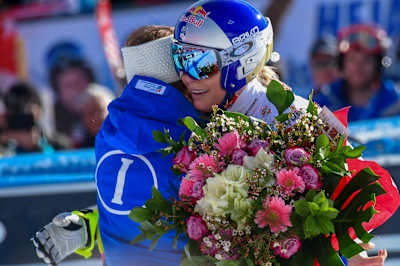
It’s a place where I feel profoundly connected to the mountains. In Lake Louise and Cortina, the mountains understand me, and I understand them. I got my first World Cup podium at the Olimpia delle Tofanein 2004; it’s where I understood the key to my success and where I did my last run before retiring. Sofia was injured, but she drove for five hours to see me and to bring me flowers. I was hoping that it would be a good race at least! [Laughs.]
I knew her knee wasn’t good and that she was struggling to ski. I said to myself, “I have to go to Cortina for what’s probably going to be her last downhill.” I was wrong, luckily. How many times have you won there?
Twelve in total, between downhill and Super-G.
Wow! Coming back to Cortina, it’s true that we both have a special connection to the mountains. The Olimpia delle Tofane is the queen of downhills. There’s something magical about the landscape. When we take the Duca d’Aosta chairlift for the pre-race inspection, surrounded by silence and the dawn that tinges the Dolomites with orange, you feel really grateful to God.
I almost forgot – it was in Cortina on January 19, 2015, that I had my first photo taken with Lindsey.
The season after that was when I started doing well and I got my first World Cup podiums. Also in Cortina, in 2018, I won my third downhill gold, my first at home. There really is something special about doing it in front of your own fans.
Goggia greets Vonn with flowers after her final run before retirement
© Erich Spiess/ASP/Red Bull Content Pool
Who is Lindsey Vonn?
Unlike in other sports, women figure quite prominently in skiing, especially in Italy. What do you think, Sofia?
In the past few seasons, Federica [Brignone], Marta [Bassino] and myself have taken women’s skiing in Italy to an unprecedented level. And we shouldn’t forget the achievements of Deborah Compagnoni. But I always come back to the fact that if you add my and Federica’s podiums together, Lindsey has won as many on her own!
When I’m away from skiing, I can’t wait to get back to the slopes. I’m all about speed, and that’s one of the many things that links me to Sofia

Your admiration knows no bounds…
I feel very small next to her.
Don’t forget you’re a champion. Remember? I think we’re the same person, but just from two different countries. [Laughs.]
You’ve won much more than me. You’re Lindsey Vonn, and it’s an honour for me to race with you. You’ve always inspired me, you know? As you guys will have understood, there’s a great respect between us; a close understanding due to our injuries and being able to come back stronger than before. I’m grateful to have had the chance to share some fantastic moments with Lindsey. The cherry on top would be a podium together, on the highest step, at Cortina, of course.
Lindsey, tell us something we don’t know about Sofia…
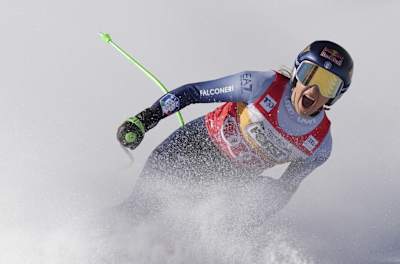
Sofi is tenacious, genuine, natural, honest and passionate. I love her posts on Instagram, because she’s always spontaneous, unfiltered. She’s always herself, and we’re very similar in that way. After my father, she was the first person I told about my comeback.
We trust each other, and I know she would be there if I needed her, and vice versa. Our relationship isn’t that common among athletes.
"Sofi is tenacious, genuine, natural, honest and passionate," says Vonn
© Maria Pizzato/Red Bull Content Pool
Who is Sofia Goggia?
Where do you see yourselves in 20 years, after retirement?
I haven’t skied for six years, so I’m not thinking about anything else! [Laughs.] Ten years ago, if you had asked me the same question, I would never have imagined I would be here. At this point, I really don’t have any idea what life has in store for me.
[In unison, laughing] “Life is like a box of chocolates: you never know what you’re going to get!”
In the toughest moments, my skis were there, pushing me to get back on my feet, to get the best out of myself

If you had to write a letter to your sport, what would you say in it? “Dear skiing...”
You’ve given me everything, and taken everything away from me at the same time.
Dear skiing, you’re a reflection of myself, the way I express myself on good days and bad days. You’ve given me the medals I had been dreaming about since I was a child and allowed me to become an athlete – something I’m very grateful for, because it’s an absolute privilege. I’ve never hated you. In the toughest moments, I hated myself, but you were always there, pushing me to get back on my feet, to get the best out of myself.
Wow, Sofi expressed herself much better than me, even though English isn’t her first language. [This interview was conducted in English.]
What message would you like to leave for future generations competing in your sport?
Everyone falls in the mountains; it’s impossible not to. But picking yourself up and carrying on skiing teaches you what it means to persevere. When you’re at the top of a mountain looking down, you see a world of possibilities; it’s up to you to choose your path. It’s a great metaphor for life.
In her documentary, Lindsey says, “If you’re watching this film, never ever give up, never lose faith in yourself. It’s the most important thing.” I try to remember that every day.
The key milestones
Part of this story