



Bike
MTB
How the pros set up for Lenzerheide’s fast course
We talk to the mechanics fine-tuning the world’s best race bikes.
Part of this story
So how do top riders and their mechanics approach bike set-up for this high-speed course? We spoke to three top mechanics to find out.
John Hall – Aaron Gwin/YT Mob

John Hall – Aaron Gwin/YT Mob
© Bartek Woliński
It’s a tricky track from a set-up standpoint. There are a lot of high-speed sections, hard pedalling out of turns to get enough speed for jumps, not a lot of traction, and everything gets loose and full of big rocks. The bike has to be set up for speed and to take big impacts, but it also needs to be soft enough that it isn’t beating the rider up.
We usually run the Flat Tyre Defender system only in the rear, but the last couple of races we’ve started running it front and rear – this track especially with how rough it is and the bigger rocks that are there one run, not the next.
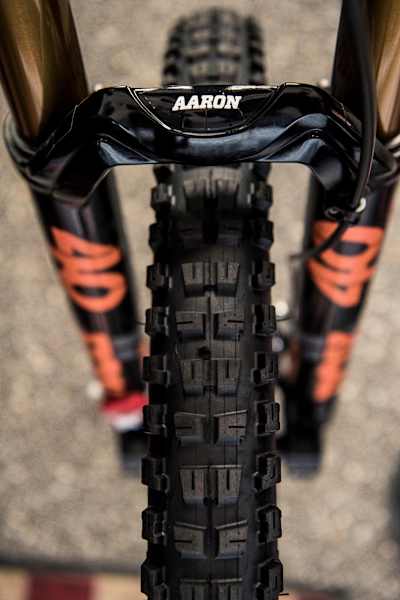
Running the flat tyre defender front and rear
© Bartek Woliński
We run the 2.4in Onza Aquila front and rear – a good all-round tyre for this track. We have a go-to pressure front and rear that we always start from, and we’re just leaving it at that for Lenzerheide. In Andorra we did drop 2psi in the front and 1psi in the rear for a little more traction.

The Onza Aquila tyre is on front and rear
© Bartek Woliński
We’ve played with suspension pressures a little – tried softer, tried stiffer – and we’ve tried different numbers of volume spacers. By the end of Thursday practice we settled on a set-up. We’re actually going a bit softer than usual – opening up low-speed compression and looking for small bump compliance, and letting it sink into the travel a lot more to keep the bike settled.
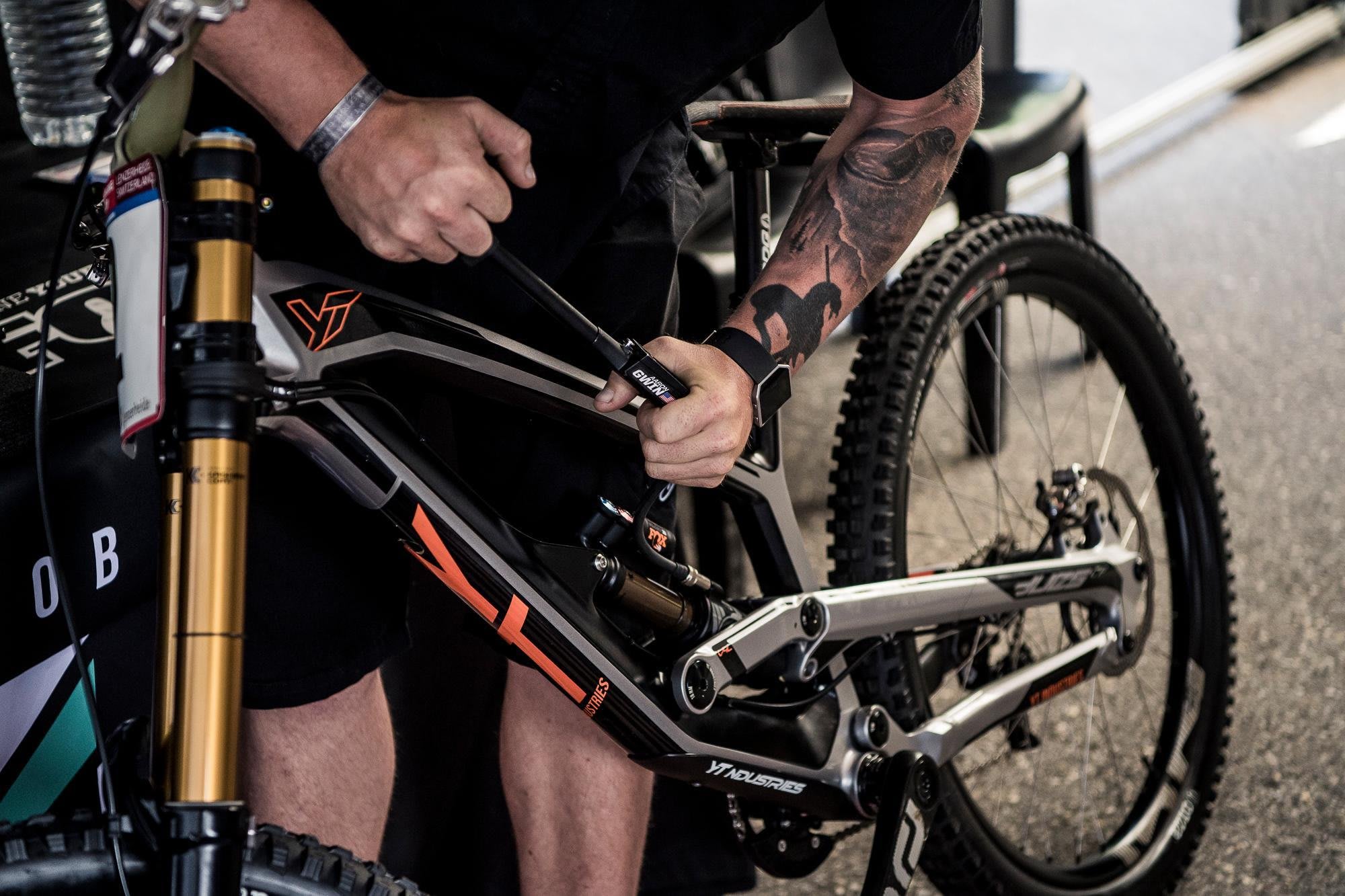
"We’ve played with suspension pressures a little"
© Bartek Woliński
This track’s so loose that if you get bucked or if you get up on top of stuff it can get really sketchy really quickly. Obviously, on any track you want to get the best traction possible, but here it seems especially important.
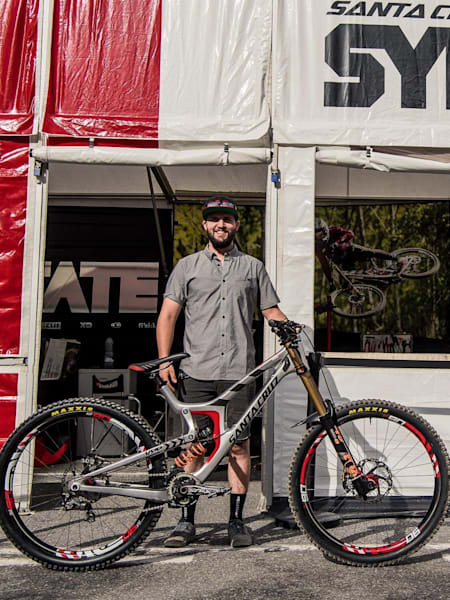
PA Roche – Loris Vergier/Santa Cruz Syndicate

PA Roche – Loris Vergier/Santa Cruz Syndicate
© Bartek Woliński
For a good set-up here, it’s a total mix between strong wheels, good tyres and the suspension not absorbing too much.

2.4inch Maxxis DHR2 in 3C compound
© Bartek Woliński
On Thursday practice we tried the same wheels as we used in Leogang, with a lighter, narrower (27mm width) rim than usual that gives a rounder tyre profile. These are better for a fast track, but there are a lot more rocks here than Leogang and those wheels just weren’t working.

"We went back to bigger, stronger wheels"
© Bartek Woliński
So we went back to bigger, stronger wheels (32mm width), the same ones we used in Andorra with the same tyres, the 2.4in Maxxis DHR2 in 3C compound. Normally we have 27psi rear, 25psi front, but we’ve put a little more here just to roll better – 29psi rear and 26psi front.

Vergier's bike ready for qualifying
© Bartek Woliński
We have the new RAD cartridge in the Fox fork, and they have played with the internal shims since Andorra – but that’s more a progression of the fork and not specifically for this course. Spring rates are the same as usual – 475 spring rear and 80psi in the fork.

Keeping track of changes
© Bartek Woliński
We tried a lot of rebound to go a bit faster with better rhythm, but it was a bit much and we slowed it down. Compression settings pretty much stayed the same as our base setting.

Spring rates are the same as usual 475 rear spring
© Bartek Woliński
Gavin Black – Manon Carpenter/Radon Factory DH
It’s hard to get the right balance of grip and reliability here. You need the tyres hard enough that they cope with high speeds, but you also need traction on the front end for the turns – it’s really fine, loose dirt on top of a very hard base.
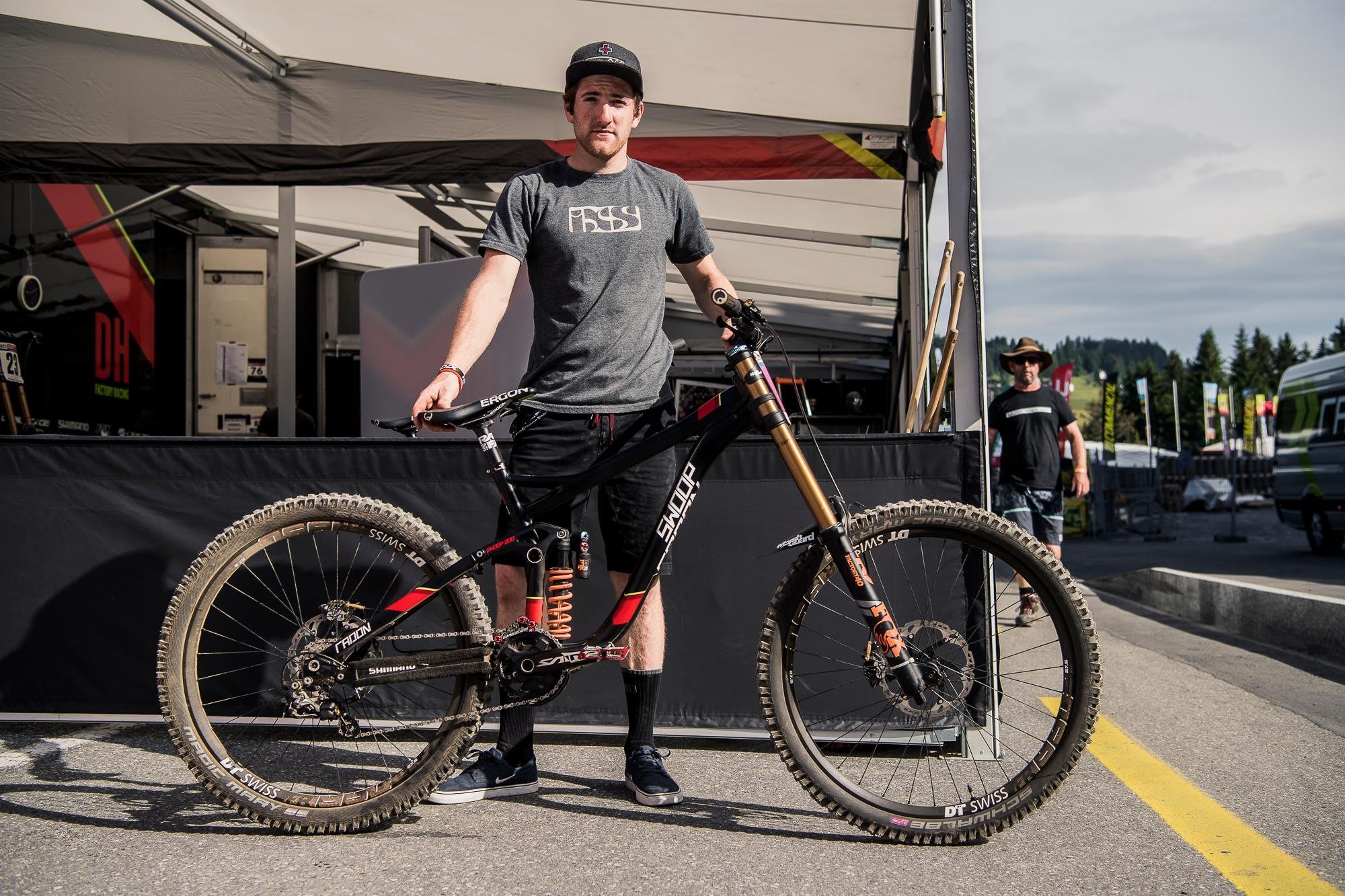
Gavin Black – Manon Carpenter/Radon Factory DH
© Bartek Woliński
We tried a harder compound tyre for faster rolling, but went back to the 2.35inch Schwalbe Magic Mary super-soft compound – we need as much grip as possible. Our wheel set-up is as always – the same rims and spoke tension. In terms of tyre pressure, we went softer than usual – 20psi front and 23psi rear.

All the tools for the trade
© Bartek Woliński
We’ve dropped the handlebars about 5mm – I removed a stem stacker and dropped the crown on the forks a little from Andorra.
Here you can get away with a lower front end for more front grip in the turns. We raised the brake levers up in Andorra to keep weight off the front, but they’ve gone back down here to move Manon forward.

Organised and ready for action
© Bartek Woliński
We made the mistake of going too firm for the rear shock spring rate in Andorra, so for Lenzerheide we have kept that spring rate – essentially the bike is firmer than we’d usually have it for a steeper course. We’ve also gone a little firmer on low-speed compression damping on the fork, and the shock is one or two clicks firmer on low-speed compression and a little slower rebound. This gives us more support in the bike park turns where you want to carry exit speed.
Part of this story


