
Padel
Juan Lebrón Chincoa: 'El Lobo' still hunting for the top spot
Spanish padel star Juan Lebrón fought to be world number one. Years later, with new partners and the same hunger, he still aims to return to the top, where he belongs.
Откъс от статията
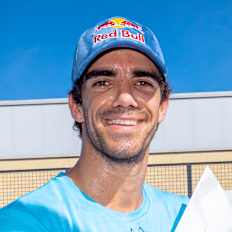

Born in El Puerto de Santa María in 1995, Juan Lebrón Chincoa, known as 'El Lobo' (The Wolf), has already cemented his place as one of padel’s all-time greats. While he spent four consecutive years as the world's number one player, dominating the court with Alejandro Galán, the seasons since have brought new partners, new challenges and a new hunger to reclaim the crown. Don't miss Lebrón in action as the Premier Padel season plays out throughout the year, with every match – from the quarter-finals to finals – broadcast on Red Bull TV. Check here to find out if you can access Red Bull TV's coverage. If you don't see your country listed, then you should check your local listings.
Lebrón is arguably the sport's most well-known player and its biggest star, having first turned pro in 2016. He's enjoyed success as part of Spanish world championship winning teams and paired with some of the biggest names in the world on the padel tournament circuit, including Marcello Jardim, Adrián Allemandi and Paquito Navarro. He's also known for being one of the few players in history able to play at the highest levels of the sport on both sides of the padel court, as a right-side player (his more frequent side), and as a left-side player.
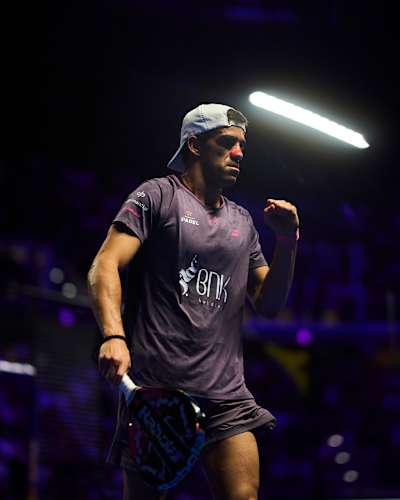
His partnership with Galán was particularly fruitful, with the pair claiming 33 titles in four years. However, their reign came to an end in 2024 and, after short spells with Paquito Navarro and Momo González, Lebrón embarked on a new chapter with Martín Di Nenno. Franco Stupaczuk followed in 2025, and late that year Lebrón joined forces with Leo Augsburger, a hard-hitting Argentine almost 10 years his junior.
Find out more about Lebrón in Padel Life:

10 мин.
Inside Juan ‘The Wolf’ Lebrón’s champion mindset
Get a glimpse into the life of one of padel’s greatest players, Juan Lebrón aka The Wolf.
Despite winning the Finland P2 and consistently reaching the semi-finals in multiple tournaments, Lebrón and Di Nenno were unable to consistently challenge the dominance of the new number one pairing, Agustín Tapia and Arturo Coello. They finished the year ranked fourth as a couple, a testament to their competitive spirit and a platform to build on for the future.
The partnership with Augsburger brought Lebrón back to winning the biggest matches. In April 2026 the pair beat Galán and Federico Chingotto in the Brussels P2 semi-finals, then came from a set down to beat Tapia and Coello 2-6, 6-3, 6-3 in the final. Finals in Málaga and Milan followed later that year.
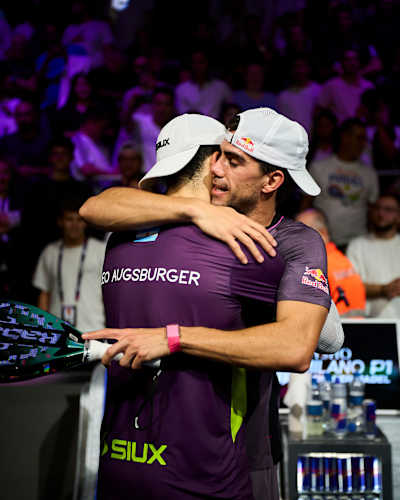
Lebrón embraces team-mate Leo Augsburger after a win in Milano
© Premier Padel/Red Bull Content Pool
It's all by design. Lebrón, has had his sights on the top spot since childhood. Hard work, natural sporting talent and an innate belief in his abilities have seen him reach the top, and even though he faces new challenges, El Lobo is still hungry and still climbing.
The wolf cub
It all began when one of Lebrón's father’s friends gifted him a junior padel racket when he was seven years old. Lebrón’s father played padel at the local club near their home and sometimes Lebrón would tag along, playing with the children of his father's friends.
"I used to go along and when my father finished, when the lights went off, I played against the wall," Lebrón says. "I remember I liked it so much because I was always surrounded by people," he says. "There were always people you could play with. And, as I improved, they started calling me to play with them."
It wasn’t necessarily the sport itself that had Lebrón hooked, but the act of winning. "I love it," he says. "I love winning and competing. I love knowing that I can always give a bit more, that I always have room for improvement in all aspects. Year by year the sport, padel, gives you a perspective that could benefit you in personal terms."

Juan Lebrón executes his signature vibora shot
© Premier Padel/Red Bull Content Pool
I was the first Spaniard to reach world number one in history. Nobody else has achieved this, nor will


Professional aspirations
Lebrón continued playing at his father’s club before transitioning to another club, Las Marías, where other friends trained – friends who had been Spanish champions.
“I was 14 or 15, I started to stand out in my category, and little by little I realised that I was getting results and I started travelling," Lebrón says.
There was the small problem of schoolwork. Lebrón's father insisted his studies were just as important as padel, but Lebrón – who describes himself as a bad student – wasn't convinced. Up until the age of 16, when he moved to Madrid, he spent all his spare time at Las Marías, often rushing there as soon as school finished for the day.
Like all the best athletes, it was a myopic approach to the sport. And one that paid off, but not without hardships along the way.
Sacrifices
Getting to the top requires sacrifice. Lebrón describes his background as "very humble" with his father selling cheese and ham door-to-door from a van. Lebrón remembers his father telling him, 'Always try not to do this, because I don't want to see you like me. I want you to be happy and to achieve your dreams'.
"My father has taught me about sacrifice," Lebrón says. "I told him: “Take me to Madrid [to play padel], I promise you that I'm not going to miss this opportunity."
Living alone in Madrid, Lebrón trained from 9am to 11pm: “I made a sacrifice, I had a goal and I wanted to accomplish it."
Idols
Padel is a huge sport in Spain and Lebrón had no shortage of idols to keep him motivated during his hours on the court.
Juan Martín and Fernando Belasteguín were two stand-outs. So much so that Lebrón snuck in to see them at the Opel Padel Tour at a time when children weren't allowed.
"Young kids under seven weren't allowed in and I remember that I used to sneak in under the seats," Lebrón says, who describes himself as a child as not bad, but naughty. “There was a place where I hid to watch matches, I wouldn't move from there.”
The call of the pitch
Padel wasn't the only love in Lebrón's life. He also describes himself as having been "very good" at football – another sport the Spanish are known to have a knack for.

In another world, Lebrón might have joined Ferran Torres in the Spain team
© Alberto Nevado/Red Bull Content Pool
"I would have won the Golden Ball award, but I stopped playing when I was 14 years old," Lebrón says. "I was in a team called Portuense, but I quit because the pre-season was in the summer and I needed to prepare for the Spanish padel championship."
"When I left the coach called my mum, asking for me to come back. I was embarrassed because I'd let him down. I knew I was good at football, but I wanted to be dedicated to padel. That pre-season of football helped, because I won the Spanish championship."
Career highlights
Whether in football or padel, Lebrón has always known he wanted to be number one. To an obsessive degree: "My life objective was to be number one."
But, being number one doesn't come easy. "After a stage as a young athlete where I won basically everything, I entered the professional ranks and the results were not what I wanted," Lebrón recalls.
He struggled to cope with this for "four or five years", but says he kept studying and kept working until he stood out. In competitions, he says he would face people who were stronger or more experienced than him and told himself if he couldn't reach that level in a given time, he would have to go back to his hometown and give up his dreams.
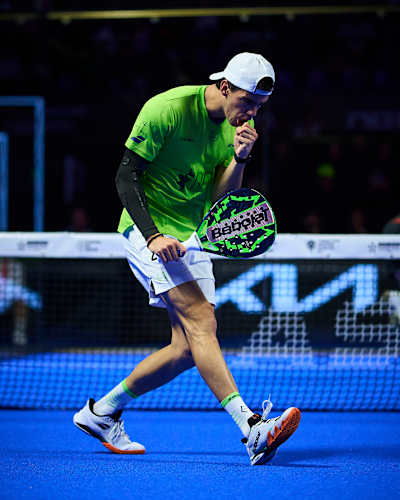
Lebrón sacrificed massively to reach his No.1 ranking
© Premier Padel/Red Bull Content Pool
Finally, his motivation started to pay off. "When things fall in an orderly way, after sacrificing a lot of things of your daily life and when the moment came when I could be number one, I didn’t hesitate for one second. I took it with pride," he says. "I keep remembering this when I have bad results and it gives me the strength to keep going, and to want to keep achieving many things. I was the first Spaniard to reach world number one in history. Nobody else has achieved this, nor will achieve it again."
When he achieved these results in 2019, Lebrón knew he had the chance to go far. He hasn't looked back and says one of the "most beautiful moments" that he can remember of this stage of his life is signing with Red Bull. "For me it was the brand of all athletes and of all sports," he says. "There was only padel missing."
Outside help
Lebrón clearly has a lot of faith in himself, but his religion has also been a guiding force in his life and career.
"I pray a lot, I'm very Christian," he says. "I always ask God for help, but I don't think that God is going to help you if you don't work. You are the first one who has to make the effort so that God helps you.
“Go to work every day as if it was the last day, always try to give 100% during competition,” Lebrón advises. “I am very disciplined, I know my goal to be number one is very difficult but not impossible.”


A team effort
As well as his family and religious beliefs, Lebrón had very real support in the form of Alejandro Galán. But, like any long-term partnership, it was a relationship not without conflict – especially given the high pressure environment of the padel court.
"Of course, there are some times you don't even feel like looking at your partner," Lebrón said early in 2024. "It's like a marriage; many times we act like little boys. We get angry and don't talk to each other. We need to allow this to happen without it taking a toll and continue as professionals. We have to give it all on the court, knowing we can talk later. Of course, this happens in sport, but it can't interfere with our game; we both have big egos, but we should leave this aside."
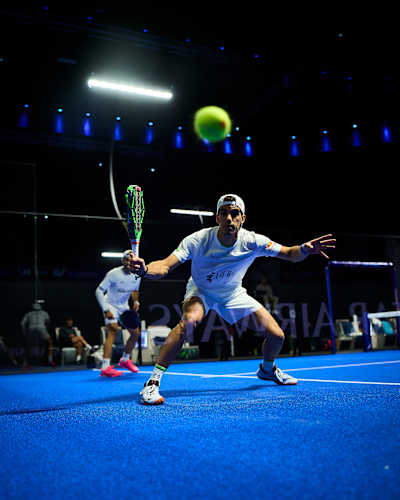
Lebrón is widely regarded as one of the best defenders in the world
© Premier Padel/Red Bull Content Pool
Just a few weeks later, after the third Premier Padel tournament of the season in Acapulco, Mexico, Lebrón and Galán broke up their record-breaking partnership. Lebrón teamed up with Martin Di Nenno to complete the 2024 season, winning the Finland P2 event and finishing third in the Premier Padel Tour Finals.
For the 2025 season, Lebrón teamed up with another Argentinian player, the respected Franco Stupaczuk. They won the Cancún P2 in March and reached four more finals that year, in Riyadh, Miami, Santiago and Valladolid. In the Miami semi-finals they beat Tapia and Coello, the first time in 11 months the world No.1s had missed a final. Injuries to both players broke their rhythm, though, and the pair split in late 2025.
His next choice was Leo Augsburger, a left-side player from Misiones, Argentina, with one of the heaviest smashes on tour. The two had planned to team up for 2026, but they started early. They made their debut together at the Mexico Major in Acapulco at the end of 2025 and reached the semi-finals in their first event.
The partnership has had its tense moments, and cameras have caught more than one heated exchange on their bench. The results have followed anyway. Brussels was Lebrón's first title since Cancún, and it came against the world's two best pairs on consecutive days. Augsburger called it a privilege to have such a role model by his side.
Training is a must
Ultimately, Lebrón's success comes down to one person above all others: himself. He wouldn't have it any other way. "I'm very self-demanding," he says. "I like giving 100 percent. I’m physically fit, but I think I can improve in many things like recovery and keeping up concentration during long matches. This is a new sport and most trainers aren't yet specialised in padel, so we haven't covered all areas yet."

Lebrón is known for his fitness and commitment to his craft
© Alberto Nevado/ Red Bull Content Pool
I'm very self-demanding and I like giving 100 percent, but I think I can improve in many things


At the top of Lebrón's training list is improving his speed, getting more strength in the punch and his reflexes close to the net. But, as a former world No.1, he already has a more complete game than most players on tour. Still, Lebrón doesn’t rest on his laurels.
"I'm mentally strong, otherwise I wouldn't be where I am, but my coach tells me that I have to do exercises to relax in order to be less nervous before matches," he says. "I try to do 10 or 20 minutes of meditation a day to relax my body and not think so much about the tournaments." It's working, but Lebrón admits he's still "a very anxious and nervous guy".
That’s where his coach, Agustín Gómez Silingo, earns his place. The Argentine former pro first sat on Lebrón's bench in 2024, during the Di Nenno partnership, and also coached the Augsburger partnership. Much of his work happens between points, keeping Lebrón calm and connected to the match.
In the Málaga P1 semi-final in July 2026, in front of a home crowd in Andalusia, Lebrón and Augsburger lost the first set 6-2 to Galán and Chingotto and trailed 3-1 in the second. Silingo asked them to find their energy again. They led 5-0 in the deciding tie-break, watched the lead disappear, saved two match points and still won. For a player who calls himself anxious, holding his nerve after losing a 5-0 lead was a big step.
A new horizon
While his dominance has been challenged in recent times, his drive and determination remain undiminished. The seasons since the split from Galán may not have gone exactly as planned, but Lebrón's journey is far from over. He continues to push boundaries, innovate, and inspire, solidifying his status as a true icon of padel.
If his performance so far tells us anything, it’s that he might just be in with a chance. "I had the objective of being number one for two consecutive years, the third one I said, 'I'd like to be number one, but if I'm not, I know the reason for it'. What motivates me a lot is that every year there's always something new. Maybe people out there don't notice this, but I do.
"I would like to win everything, obviously, and I think I can win everything," he adds. "But it has been challenging for us.”
Having been at the pinnacle of the sport, and with the experience of overcoming adversity, Lebrón is ready to write the next chapter of his padel story, competing for the top spots alongside whoever stands beside him.
His first full season with Augsburger proved he can still beat the best pairs in the world. The pair reached Premier Padel finals in Cancún, Brussels, Málaga and Milan, plus the semi-finals of the Rome and Paris Majors. In Milan they came from behind to beat Galán and Chingotto once more and took the first set off Tapia and Coello in the final. The gap to the very top is small, and closing it is what drives him.
The goal is the same one he set as a boy in El Puerto de Santa María. Lebrón wants to be number one again, and every partner change since 2024 has been a step towards that target. If you want to understand what makes his game so hard to read, start with our breakdown of the five skills that define 'El Lobo'.
Where can I watch Juan Lebrón play?
You can watch Juan Lebrón and every Premier Padel match from the quarter-finals onwards live on Red Bull TV.
Find more information on all tournaments, including ticketing, match schedules, current scores, player updates and all the latest news on the Premier Padel website.
About the authors
Откъс от статията