

Stefan Dollinger's Rest Day was shot on snow, but the freerunning's red hot
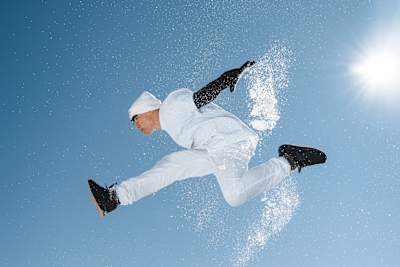
Stefan Dollinger's rest days aren't like yours
© Mathäus Gartner/Red Bull Content Pool
How does a freerunner get the idea to go to Austria in winter to shoot a video?
Of course, winter isn't really the season for outdoor action. Normally freerunners switch to indoor training centres in winter, but the idea appealed to me to try out whether it was possible at all to freerun on snow. You always have to be open-minded and leave enough room for creativity and crazy ideas: that's the only way to create cool projects.
I got inspired by other athletes from all kinds of sports and from clicking through countless videos on the Red Bull website I noticed that there were already loads of exciting freerunning challenges, but to travel to a legendary winter sports resort and perform in winter is totally unique and that was extremely appealing to me.

Stefan Dollinger is one of the hottest young talents in freerunning
© Mathäus Gartner/Red Bull Content Pool
You have to be open-minded and leave enough room for creativity and crazy ideas
Your buddy Philipp Gatterer was again at your side to film this project. How did he react to your Rest Day idea?
We do tricks very similarly and he immediately recognised what I was up to and was right on board, contributing his ideas. Normally snow is a no-go, so we sat down together in the autumn and thought about what kind of tricks and moves might be possible in winter, in sub-zero temperatures and on snow – a completely unfamiliar terrain for me as a freerunner.
How did you prepare for the shoot?
We were out on the snow a lot in November and December, scouting out the coolest spots in St. Anton and testing how it feels to freerun on snow – how slippery is it on the slopes, how does the snow change with different temperatures and what effect does that have on my tricks? Can I do flips? Or do I have too little grip for that?
This was all new territory and we were aware that every little detail could affect the shooting. The warmer it was, the more slippery it became. Icy cold meant more grip for my tricks, but then, of course, the ground is frozen and you can really feel it when you land on your hip after a stunt. Above all, I had no experience of jumps and distances and had to work everything out step-by-step.
That all sounds like a lot of effort with a lot of question marks?
We planned to shoot Rest Day in a total of 10 days and wanted to get as much in the can as possible in that time. We knew that it'd be extremely hard, especially for Stefan, and that the project could push him to his physical limits. That was always a concern before the shoot, but secretly we all knew it was going to be even more extreme. We tried to turn scene-after-scene of our ideas into reality and get Stefan through the shoot in as good a shape as possible.
Our planning was absolutely crazy. It was actually clear to me before the shoot that I wouldn't be able to do everything, because at some point my body would go on strike. It's not just about the risk of injury, but also the altitude and the cold on the Arlberg, which really drains you.
I walked the most important spots several times beforehand and looked at them from different perspectives, so that I could visualise them when the time came. The weather was so brilliant over the entire period though that we just had to take advantage of it and only took a few breaks.
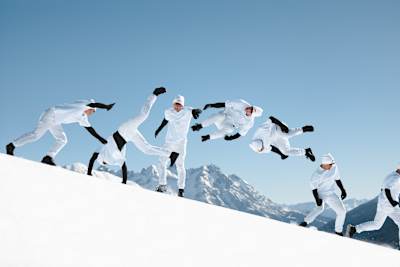
Stefan Dollinger broke new freerunning ground on snow
© Mathäus Gartner/Red Bull Content Pool


What was the biggest challenge compared to 'normal' parkour?
The lack of experience and ever-changing conditions. I know how to accelerate, brake, jump and land when I'm on solid ground. I know how asphalt and concrete react and how it feels when you land and roll off, but I didn't have any experience on snow - and the weather and time of day also changed the conditions each time, so the jump felt different again. So, every move became a challenge, which was equally tough for the body and the mind.
Did you allow yourself a real rest day during filming?
After six days, I was a bit frozen through. I felt every minus degree and my body signalled to me that a break was in order. On this real rest day, I summoned up all my energy – I don't even know what energy reserves I tapped into. The motivation was so strong to finish the project that you just go for it.
When you think back to the shoot, what was a special moment for you?
An absolute highlight was certainly the jump from the Gampen Restaurant, which was seven or eight metres. There, I knew that I had to catch the jump perfectly, because I had a target window of about one metre diameter that I had to hit in order for the stunt to work at all. I had a lot of respect for it and knew before the shoot that this jump was going to affect the momentum of the project. It worked and that released extra energy for all of us.
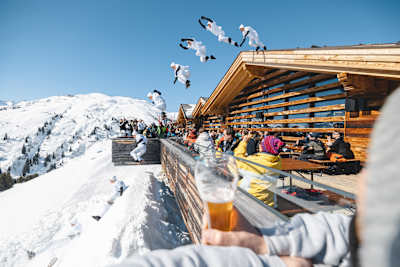
That's one way to liven up the apres ski action
© Mathäus Gartner/Red Bull Content Pool
Now everything's done, you've sifted through the material and the project is going live, how does it feel?
It feels absolutely brilliant. I'm so proud of the sensational teamwork that made this possible. Everyone worked hard to make it happen, so thanks to the entire crew, filmmaker Philipp Gatterer, the TVB of St. Anton am Arlberg and everyone who contributed their part to this project.