Ever watched a football game and wondered which players do what? From goalkeepers making acrobatic saves to strikers grabbing the winning goals, let’s break down what it all means.
In terms of sheer numbers, football is the world’s most popular sport. With more than 250m players across 200 countries, many begin training as young as three. That figure doesn’t even include the billions of fans around the globe.
Some of that popularity comes from how inexpensive it is to pick up, while others say it’s because the sport is easy to learn but hard to master. As long as everyone knows their job – the attackers score the goals, and the defenders keep clean sheets – then you’re on the right path, right?
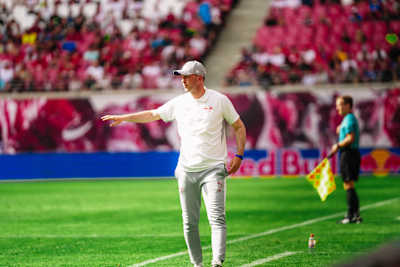
You don't need to be Ole Werner to follow the action on a football pitch
But the trick is knowing what that job is, exactly. Each football team has 11 players on the field, but beyond that it can get a little more complicated. Below we outline the basic playing roles in the simplest of football formations - 4-4-2 - which sees a line of four defenders sit behind a line of four midfielders, then some variation of two out-and-out attackers at the top of the pitch. The many and various subtleties enjoyed by football fanatics - inverted full-backs, trequartistas, false nines, double pivots and so forth - have no place here.
It's also worth noting that unlike Rugby Union, where each player's number denotes their specific role, this is no longer the case with professional football, where each player is assigned a number within their squad as a whole. The traditional numbering system is still useful at amateur levels though, so we've included it, just don't expect it to help you much when trying to decipher next weekend's Premier League action.
01
Goalkeeper
RB Leipzig keeper Péter Gulácsi is a great shot-stopper
The goalkeeper is perhaps the most important player on the pitch, serving as the last line of defence. They must be quick-witted, have sharp reflexes and be able to make rapid decisions. While their main aim is to stop the other team scoring, they are also crucial in launching attacks by distributing the ball after a save.
A goalkeeper almost always remains centrally positioned in goal, though in modern high-pressing systems they may act as a sweeper-keeper, playing further up to support the defence. They’re the only player allowed to use their hands (within the penalty area) while everyone else must stick to their feet or throw-ins.
Key skills
Reflexes: for reliable shot-stopping
Decision making: to know when to stay on their line and when to come out
Communication: to organise the defenders in front of them at set-pieces.
02
Full-backs
Red Bull Bragantino's Juninho Capixaba plays at left-back
These are the wide defenders located on the right and left flanks. 'Full-back' is the general term, but the left-sided player is known as the left-back and the right-sided is the right-back. Often tasked with opposing the rivals’ wingers, full-backs need significant stamina and pace. Quick footwork and physicality are key, since they may often find themselves one-on-one, needing to force a pass or risk leaving their keeper exposed.
In attacking play, full-backs are often expected to provide width to their team's attacks, so some attacking skills are also important, such as crossing, reading the game and timing runs. In some formations, particularly those that involve three centre-backs, full-backs have fewer defensive responsibilities and may be known as wing-backs.
Key skills
Stamina: in order to get up and down the pitch supporting both attack and defence
Pace: to match opposing wingers - often the fastest players on the pitch
Crossing: for creating scoring chances from wide areas.
03
Centre-backs
El Chadaille Bitshiabu is a young centre-back with a bright future
These central defenders are the backbone of the defensive line. Whether used in classic pairs or with a sweeper behind, their job is to protect the heart of the defence: intercepting passes, making tackles, blocking shots and winning aerial and physical battles.
In older formations you might have seen a sweeper, who sits between the goal and the defensive line to “sweep up” any balls that get through. Against modern high-pressing tactics, centre-backs must not only defend, but also be comfortable on the ball and capable of starting attacks from the back with accurate passes.
Key skills
Reading the game: to recover the ball through interceptions and tackles
Physicality: to out-muscle opposing strikers, jump the highest at corners and generally be imposing
Passing: to keep the ball moving and away from opponents.
04
Defensive midfielder
Austria's Sarah Zadrazil plays in defensive midfield for Bayern Munich
Taking position in front of the defence, the defensive midfielder’s role - which you might also hear referred to as a holding midfielder, a deep-lying midfielder or simply as a 'six' - is to disrupt the opposition’s central attacks and shield the back line. They win loose balls, make tackles, dictate tempo and often force opponents to play wide rather than down the middle. Although they might not score many goals, they’re vital in transitioning the ball from defence to attack.
Key skills
Reading the game: positional sense is vital in the key midfield battlegrounds
Tenacity: a good six never lets an opponent get away from them
Strength: to protect the ball in crowded areas.
05
Central midfielder
Dominik Szoboszlai, now of Liverpool FC, is a versatile midfielder
Central midfielders operate between defence and attack with duties in both phases of play. They often set the rhythm of the game, recover possession, drive play forward and link up with attackers. They need stamina, tactical awareness, precise passing and the ability to drop back when defending.
Key skills
Vision: a midfield general needs to be able to see all the passing angles and pick up their team-mates' runs
Passing: because it's no good being able to see the runs if you can't hit the runs
Stamina: because they don't call it the engine room for nothing. What use is a box-to-box midfielder who can't run from box to box?
Positioned on the outer flanks of a traditional four-player midfield, wingers are the wide-area threats. Their primary tasks are creating space, supplying chances to others and scoring themselves. Positioned near the touch-lines, they stretch opposing defences and exploit width. They must be adept at dribbling, possess strong footwork, speedy movement and accurate passing and shooting.
Key skills
Pace: a full-back can't block your cross if they're still trying to chase you down
Dribbling: keeping the ball close to your feet while sprinting is a fine art
Crossing: to put the ball on your striker's head from wide areas.
07
Attacking midfielder
Xavi Simons, one of Dutch football's biggest stars, plays as a 10
Operating behind the striker and ahead of central midfield, the number 10 is usually the team's creative hub. They dribble, thread passes, spot runs, unlock defences and often have one-on-one opportunities. Vision, decision-making and technique are crucial in this role.
Depending on tactics, formation and game state, the number 10 role can take a variety of different forms, but it generally applies to either an advanced, creative midfielder or a slightly more withdrawn support striker.
Key skills
Vision: you are often the player with the creativity and finesse to unlock a stubborn defence
Technique: passing, dribbling, shooting - you need to do it all, ideally
Ball retention: you might not find a killer pass every time, but keep the ball and try something else
08
Striker
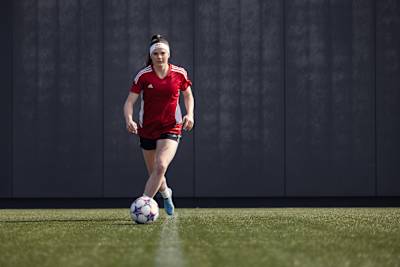
Trinity Rodman is one of the most exciting forwards in the women's game
The No.9 - aka centre-forward or striker - is the team’s chief goal-threat. Positioned in the opponent’s half, usually close to the penalty area, strikers are expected to finish chances and pose a constant danger. They require pace, clinical shooting, good movement and the ability to hold up play to bring others into the attack.
Key skills
Hold-up play: the ability to hold on to the ball and battle opposing centre-backs gives your team-mates time to get up the pitch in support
Shooting: because your main job, after all, is to put the ball in the net
From the keeper to the striker, every position has a specific part to play in a team’s success. Some players rely on one-on-one bravado, others on raw stamina, and others on physicality or technical finesse. It’s the collective coordination of all 11 that makes football so thrilling to watch.