
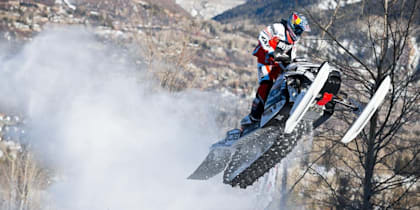
Snowmobile
Take a deep dive into the history of snowmobiling
From early days of Joseph-Armand Bombardier to the electrifying Taiga Motors, discover Québec’s pioneering role in the evolution of the snowmobile.
The innovators of Québec have defined the sport of snowmobiling for much of the past decade. From revolutionary mechanical advancements to adrenaline-fuelled racing concepts, and now, the electrification of the off-road sector, La Belle Province continues to lead the way.
With an annual average snowfall up to 3 metres and a landscape dominated by vast rural terrain, it’s no surprise that the snowmobile has become an essential — for utility, sport, or, pure adventure.
The origins of driving on snow date back to 1922, when Joseph-Armand Bombardier — a teenager from Valcourt, Québec — took his newly-designed, fan-propelled “oversnow” machine out for a rip on the local streets. Little did he know, this barebones invention would lead to improvements in essential services across rural Québec, and later on, become one of Canada’s favourite winter activity.

15 min
Révolution de Braaap a Zap
Explore the uniquely-Canadian evolution of the snowmobile.
To celebrate the contributions of Québec to the outdoors industry, we've taken a deep dive into the history of driving on snow. Watch the exploratory, action-packed documentary in the player above, or continue reading to learn how the snowmobile evolved from this, to this:
01
The early days
The history of snowmobiling dates back to the early 1900s when Joseph-Armand Bombardier, a young mechanic and inventor from the rural town of Valcourt, Québec, struck an innovative idea to save his struggling garage. He sold gas and fixed vehicles during the summer months and business was thriving. But come winter, his clientele was unable to travel due to heavy snowfall. An idea came to mind: what if he could develop a vehicle that could efficiently drive on snow?
By 1935, Bombardier assembled the first official snowmobile that used an innovative sprocket wheel system to propel the tracks through the snow. This revolutionary system led to the creation of the seven-seat B7 snowmobile which quickly became a must-have for doctors, ambulance drivers, and priests working in remote areas.


How does a sprocket wheel system work? Snowmobiles use large gears with evenly spaced teeth as wheels. When the gears rotate, the teeth grab hold of the track, which moves the track forward.
These initial vehicles came equipped with a 10 horsepower two-stroke engine and a flurry of issues — including lack of maneuverability, discomfort when faced with challenging terrain, as well as changing times. In the spring of 1947, provincial and local laws brought snowplowing to rural Québec and demand for large snowmobile busses quickly diminished.
Bombardier spent the next twenty years testing, refining, and improving his designs before bringing them to a consumer market.
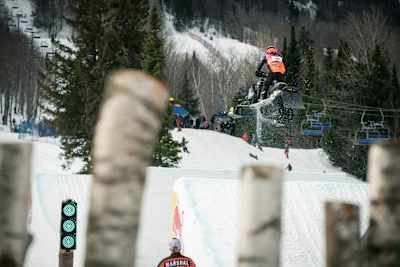
Megan Brodeur competes at Red Bull Sledhammers at Ski La Réserve
© Felix Rioux / Red Bull Content Pool
02
From Ski Dog to Ski-Doo
It’s 1959 and Bombardier is ready to introduce his latest single person snow-sports machine to world — similar to ones we are familiar with today. In preparation for the official launch, they decides to rebrand as Ski Dog. But while creating their first sales brochures, a typo emerged, and the infamous Ski-Doo legacy was born.
These newly-released lightweight Ski-Doos outfitted a smaller, more efficient engines and were targeted towards recreational rider. Each year the company manufactured twice as many snowmobiles as the last and it wasn’t long before organized racing ensued.
03
If you build it, we'll race it
Snowmobile racing was first documented at Manitoba’s Beausejour Winter Festival in 1962, as thousands of fans gathered from across the province to watch six racers rip around a rough semi-circle at speeds up to 25 km/h. Less than a decade later, the once-intimate Beausejour Winter Festival would rally in crowds over 25,000 at the Canadian Power Toboggan Championships, where Gilles Villeneuve of Québec established himself as one of the top snowmobile racers of his era.
Snowmobile race disciplines explained:
Today, the world of snowmobile racing is still dominated by Quebeckers — with the likes of Francis Pelletier, Naeli Lebel, and Megan Brodeur leading the way. However, the machines, disciplines, and race tracks themselves have progressed significantly since the age of Villeneuve.
Snocross prodigy Megan Brodeur is no stranger to the evolution of the sport. Born and raised in Coaticook, Québec, Brodeur became the youngest women’s Snocross racer in history to win the North American championship, at 18, and has since won three more championships in a row. She is also a frontrunner in the highly-revered Red Bull Sledhammers hillcross event at Ski La Réserve — innovative competition where riders navigate more than 10 daring features as they climb more than 100 vertical metres to the finish line.
“[Red Bull Sledhammers] is a little like snocross, where you’re one-on-one,” explained Brodeur. “But instead of 180 and 90 degree turns, it’s a straight line up to the top of the mountain.”
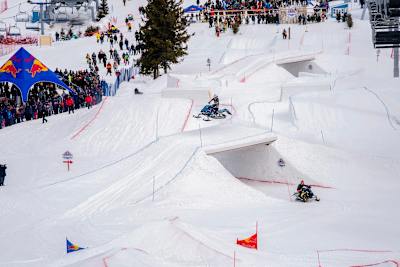
Racers tackle the first crossover feature at Red Bull Sledhammers.
© Dan Mathieu
“At first, I didn’t know if I was going to like it,” she added. “But you can’t miss your jump once you overcome your fears… The feeling of speed, the action, the noise, and obstacles, is really what makes you feel a passion for the sport.”
After a three year hiatus, Red Bull Sledhammers is set to return on April 2, 2022, with a revamped course and 32 invited pro riders -- with Brodeur being the only woman competing at this year's event.
Learn more about this year's Red Bull Sledhammers event!


I feel privileged to be able to represent Quebec and to live near Valcourt, where everything began.
04
The electric revolution
From the revolutionary sprocket wheel systems and flexible suspensions, to the trailblazing Red Bull Sledhammers hillcross course, the innovators of Québec have guided the direction of snowmobiling history for the past century. Now, they look to the future with the advancements of Taiga Motors — a snowmobile manufacturer committed to electrifying the trails.
What began as a wild plan by a hobby group at Montreal’s McGill University, Taiga Motors has recently taken the off-road sector by storm as they provide the ability to sustainably explore without compromising performance and power. These battery-powered snowmobiles pack up to 180 horsepower, eliminate virtually all engine sound, and can travel up to 100 km on a single charge.
For legendary ice climber Will Gadd, Taiga snowmobiles have become an essential tool for both reducing his carbon footprint and accessing frozen waterfalls off the beaten path.
Take a behind the scenes look at Will Gadd’s recent trip to Québec in the gallery below:

Will Gadd uses a Taiga Snowmobile to access a remote ice climb
© Maxime Messier

Will Gadd prepares for an ice climb in Québec
© Maxime Messier

Will Gadd climbs a frozen waterfall in rural Québec
© Maxime Messier