



Red Bull Motorsports
F1
Defying the elements: Red Bull Racing's greatest wet-weather drives
Red Bull Racing drivers have produced some of the most breathtaking wet-weather drives in Formula One history – here are seven of the very best.
Formula One's rainmeisters are a legendary group of drivers. Men whose exceptional skill comes to the fore when the weather is at its worst. When it rains in F1, visibility drops, grip vanishes, and standing water poses a serious hazard. And yet some thrive in the very worst conditions, setting the pace as they scythe their way to the front.
Jim Clark, Ayrton Senna and Michael Schumacher are some of the greats, while this century drivers in Red Bull colours have blazed a trail. So grab your umbrella as we take a look at seven of the definitive wet-weather runs from Red Bull Racing….
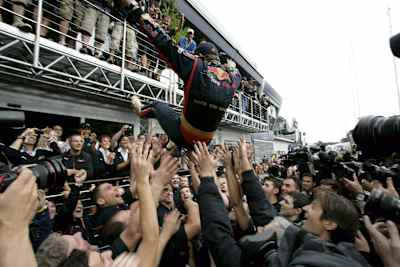
Splashdown: Sebastian Vettel celebrates at the 2008 Italian Grand Prix
© GEPA pictures/Red Bull Content Pool
01
Italian Grand Prix 2008
It’s fitting that the first win in Red Bull Racing colours came during one of the wettest Italian Grands Prix on record. The conditions were perfect for Sebastian Vettel to tear up the script and write a new chapter in F1 history.
The Faenza team were F1’s finishing school. The final rung on the long and slippery ladder to F1 and a seat with a World Championship-contending team. Their chassis was built to be competitive but not a frontrunner. A superb all-rounder of a car that graduates from the Red Bull Junior Team used to fine-tune their racecraft in the crucible of F1.
But with the wet weather levelling the playing field, the 21-year-old Baby Schumi stepped up and delivered victory for Toro Rosso on home soil. “This is the best day of my life. I will never forget these feelings. It is so unbelievable. It is better than I had ever expected,” he said. “A big thank you to everyone in the team for their great work.”
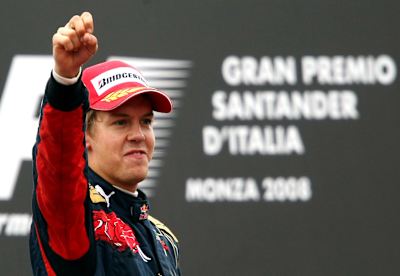
Sebastian Vettel became the first Red Bull driver to win in F1
© Getty Image/Red Bull Content Pool
Despite the fact it rained all weekend, flooding the beautiful Parco di Monza, Vettel put his STR3 on pole. In the race, with rain lashing the historic circuit, Vettel controlled the entire Grand Prix from the front with ice-cool composure. While far more experienced drivers slid off or fell back, Vettel never put a wheel wrong, crossing the line to become the youngest driver in F1 history to win a Grand Prix – a record that was only broken by Max Verstappen at the 2016 Spanish Grand Prix.
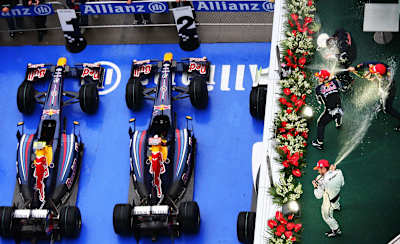
Breakthrough: A 1-2 for Red Bull Racing at the Chinese Grand Prix in 2009
© Getty Image/Red Bull Content Pool
02
Chinese Grand Prix 2009
Three races into his career as a Red Bull Racing driver, Vettel delivered the team’s maiden victory – again in the wet and this time in Shanghai, with the German leading home a one-two finish with Mark Webber. This was more than a win in extraordinary circumstances: this was a composed team performance. On Saturday, the team had to carry out major repairs to Vettel’s car during qualifying, giving the German just a single run in Q3.
One was all he needed as he put the car on pole. In Sunday’s wet-dry race, Vettel was unstoppable in his drive to the finish, controlling his emotions and exhaustion as he pushed for the line. “I was trying to have everything under control, but it was difficult,” he said at the finish. “At some points I was trying to bring the car home, but that meant I lost focus, so then I just tried to take it corner by corner.”
This was a breakthrough win for a team that announced them as World Championship contenders in a new era for F1. Although the 2009 world championships would go to Brawn GP – who soon morphed into Mercedes – Vettel and Red Bull Racing would go on to dominate F1 for years, cleaning up four consecutive Drivers and Constructors world titles.
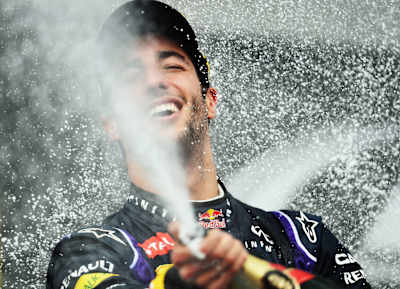
Daniel Ricciardo revels in victory at the 2014 Hungarian Grand Prix
© Getty Image/Red Bull Content Pool
03
Hungarian Grand Prix 2014
The 2014 season was a challenge for Red Bull Racing as new rules negated their game-changing aerodynamics in favour of more powerful engines. So when a heavy shower arrived shortly before the start of the Hungarian Grand Prix, it created conditions for an upset.
This time it wasn’t Vettel who capitalised but Daniel Ricciardo on his debut season for Red Bull Racing. Starting P4 behind his team-mate, the wet/dry conditions caused collisions, spins and retirements but the Red Bull Racing pit wall quickly switched the Australian on to a three-stop strategy, which saw him leading as early as Lap 10.
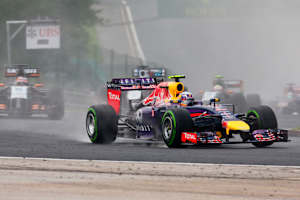
Daniel Ricciardo wins in the wet at Hungary
© Getty Image/Red Bull Content Pool
He wouldn’t stay there due to Safety Car intervals and pit stops but the Honey Badger was in the hunt, charging through the pack, braking late and finding gaps all over the circuit. As the track dried and World Champions Fernando Alonso (Ferrari) and Lewis Hamilton (Mercedes) jostled for the lead, Ricciardo joined the fight.
With four laps to go, he pounced on a lock-up by Hamilton and passed Alonso with three laps to go to take the victory. “To have to pass guys again to win the race… makes it a lot more satisfying,” said an elated Ricciardo at the finish.
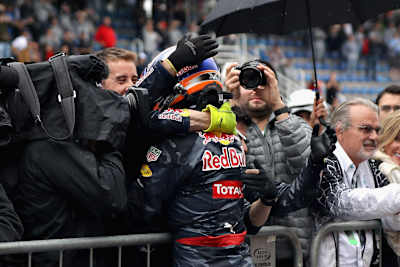
Max Verstappen's brilliant third place at São Paulo in 2016
© Getty Image/Red Bull Content Pool
04
Brazilian Grand Prix 2016
Verstappen arrived in F1 as the youngest-ever driver with an awesome reputation from his successes in karting. He became F1’s youngest race winner on his debut for Red Bull Racing in Spain but it was his performance at Interlagos later in the 2016 season that made him a world star.
At the Brazilian Grand Prix, heavy rain handed the Dutch driver an opportunity as he showed four World Champions – Hamilton, Kimi Räikkönen, Vettel and Fernando Alonso – as well as the champion elect, Nico Rosberg, that he was a next generation’s supreme talent.
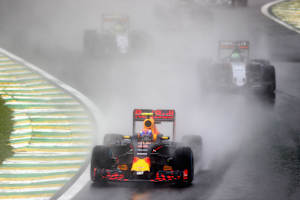
Max Verstappen on the charge around Interlagos in 2016
© Getty Image/Red Bull Content Pool
First he went wide around the outside of Turn 3 to pass Räikkönen and then he did the same to Rosberg, emerging from the spray in second place. Drivers spun, Räikkönen crashed out on the start-finish straight and Vettel did a terrifying 360 and ended up facing oncoming cars.
Verstappen spun too, but somehow saved the car to continue his charge. But a late pit stop for full wets dropped him to 16th – so he just did it all over again, reeling off one brilliant overtake after another to come home in third place.
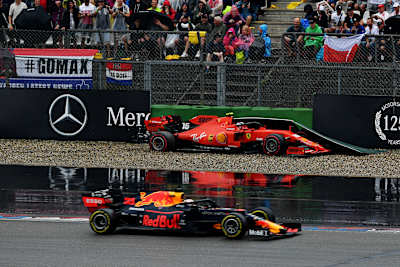
Max Verstappen passes the stricken Ferrari on Charles Leclerc
© Getty Image/Red Bull Content Pool
05
German Grand Prix 2019
The rain was so heavy that the first three laps at the Hockenheimring were behind the safety car using 20 hot cars with huge tyres to clear the standing water. At the start of the race, visibility was low and grip poor, leading to Verstappen spinning 360º but somehow keeping going. After 20 or so laps and with the track drying in places, teams risked moving on to slicks. Cue more spins and mayhem as Lando Norris (McLaren) and Charles Leclerc (Ferrari) slipped away.
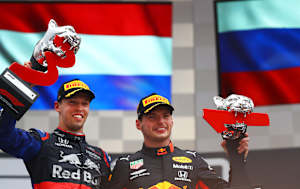
Max Verstappen and Daniil Kvyat celebrate in Hockenheim
© Getty Image/Red Bull Content Pool
Race leader Hamilton (Mercedes) pitted for slicks, crashed, crossed the circuit to pit for a new front wing and inters, picking up a time penalty in the process. That handed the lead to Verstappen, who stayed on top through two more rounds of pitstops as the field pitted for inters and then risked slicks again.
In clear conditions, Verstappen controlled the race to the finish while Vettel (Ferrari), who started P20, made his way all the way up to second and Daniil Kvyat put Toro Rosso on the podium for only the second time in their history.
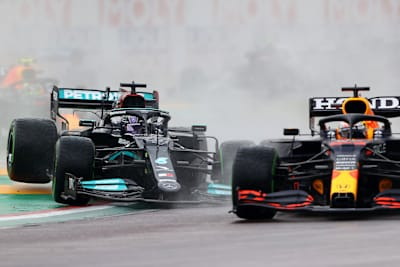
Max Verstappen keeps Lewis Hamilton at bay at Imola in 2021
© Getty Image/Red Bull Content Pool
06
Emilia Romagna Grand Prix 2021
While Verstappen often had a race-winning car, by 2021 he had a strong enough car to push for the world championship title. Defending champ Hamilton (Mercedes) won the opening race and was on pole. But if Verstappen could get in front at the narrow Imola circuit, he could try to keep Hamilton behind him.
At the start, Verstappen bolted off the line and launched past both team-mate Sergio Pérez and polesitter Hamilton into Tamburello. Verstappen led the rest of the way while Hamilton tried to find a way past. The Dutchman almost span at Rivazza but somehow maintained control, kept the lead, and pulled away to score the first win on the way to his maiden World Championship.
“The conditions were challenging out there, and it was very hard to stay on track but we stayed out of trouble,” said Verstappen. “We won because we made the right calls with tyres at the right time and the Team managed everything well in these conditions.”
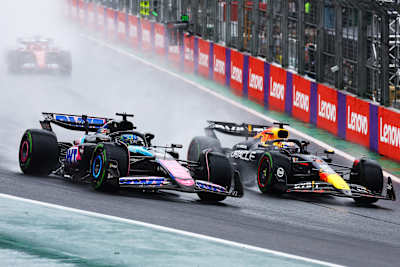
Max Verstappen takes the lead from Esteban Ocon at Interlagos in 2024
© Getty Image/Red Bull Content Pool
07
São Paulo Grand Prix 2024
Arguably the greatest wet-weather drive in F1 history with Verstappen’s superlative skill on show in the worst conditions. His 2023 campaign was the most dominant F1 World Championship of all time but in 2024, McLaren had closed the gap on Oracle Red Bull Racing and the heat was on.
Verstappen arrived at Interlagos without a win since the Spanish Grand Prix in June. The Grand Prix weekend couldn’t have had a worse start: first Lando Norris claimed victory in the Sprint race and pole position to tighten the screw.
Verstappen's qualifying was one to forget: he was eliminated in Q2 when the session was red-flagged on his flying lap. He then needed a new engine fitted which demoted him to P17 on the grid. So when the lights went out, he was ready to start fighting back and race through the unrelenting rain. False starts, crashes, restarts, more crashes, and even a black flag for Nico Hülkenberg (Haas).
But Verstappen weaved his way through the cars, ticking off the places. With rain intensifying, the leaders pitted – but Esteban Ocon (Alpine) and Verstappen stayed out, inheriting the lead and second. Their gamble was instantly rewarded when a crash saw the race red-flagged.
With fresh tyres, Verstappen quickly took the lead at the restart and by the time the flag fell, he was 19 seconds out front. “It was definitely an emotional win; I was really motivated and put everything into this race and I surprised myself today as I wasn't expecting to finish in P1,” he said. Not only was he ahead of Norris but he’d effectively derailed the Brit’s title charge.
