




Bike
Trial Biking
Riding backwards on one wheel down a ski jump? Mission accomplished
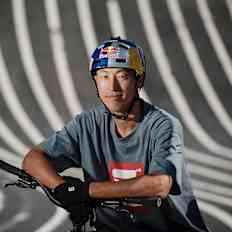
Tomomi Nishikubo redefined the limits of trials riding by completing a world-first feat: a backwards, front-wheel-only descent of a ski jump that earned him two world records.
Riding a bike down a steep hill is challenging. Doing it backwards while balancing on just the front wheel seems almost impossible. But that's exactly what Japanese mountain bike trials rider Tomomi Nishikubo achieved after two years of meticulous planning.
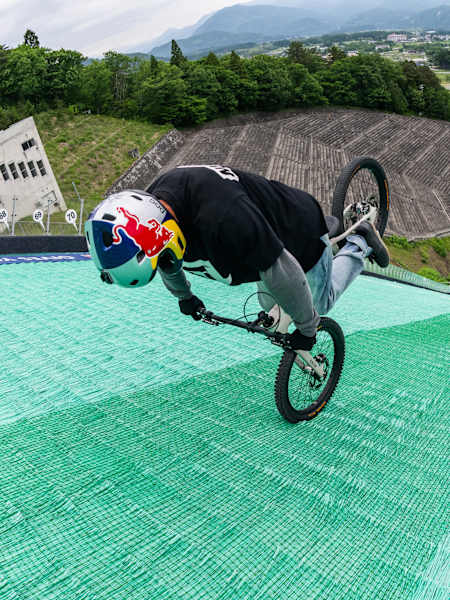
On May 27, 2026, Nishikubo descended a daunting 37.5-degree Olympic ski jumping hill in Hakuba, Japan, while balancing only on his bike's front wheel, a trick known as a fakie nose manual. In mountain biking, fakie means riding backwards, while a nose manual is balancing on the front wheel without the rear wheel touching the ground. Watch it happen in the video below:
01
Setting two Guinness World Records
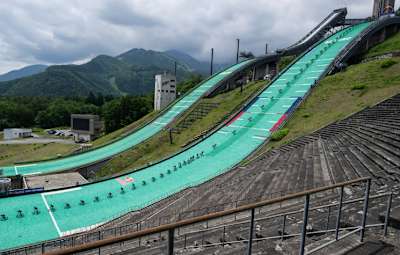
Tomomi Nishikubo's incredible successful run in sequence
© Jason Halayko/Red Bull Content Pool
With his successful run, Nishikubo not only pushed trials riding into new territory, but he also set two new Guinness World Records in the process. He set the mark to beat for the steepest bicycle fakie nose manual at 37.5 degrees, and the longest distance travelled by bicycle fakie nose manual on a ski jumping hill, covering 136.6m.
What makes the records even more impressive is the fact that he reached a speed of over 60kph and had to maintain the front-wheel balance for 35 seconds as he descended the ski jump.
02
The inspiration behind the world record attempt
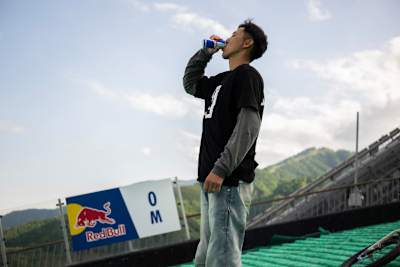
Tomomi Nishikubo takes a moment between attempts
© Jason Halayko/Red Bull Content Pool
Nishikubo had always dreamed of performing his signature trick, the fakie nose manual, somewhere truly special.
Always on the lookout for the right destination, he had a moment of inspiration when watching Japanese ski jumper Ryōyū Kobayashi set a new world record of 291m in Iceland, eventually settling on Hakuba as the perfect location for his own record.
03
A project two years in the making
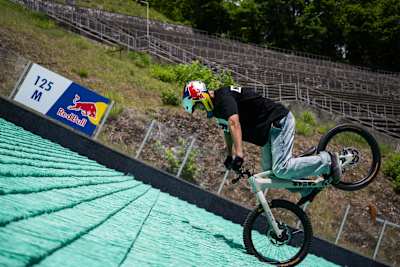
Tomomi Nishikubo holds the fakie nose manual past the 125m mark
© Jason Halayko/Red Bull Content Pool
With an idea in place, Nishikubo first travelled to Hakuba in August 2024 to scout the location and see whether his dream could become a reality.
The following year, he was ready for his first attempt. Unfortunately, after 35 runs, he was unsuccessful. Despite the disappointment, Nishikubo remained positive as he identified several problems that would need to be resolved.
He realised that if he could create enough grip between the tyres and the ski jump surface, as well as maintain speed using controlled braking, then it might actually be possible.
04
Testing and training for his next attempt
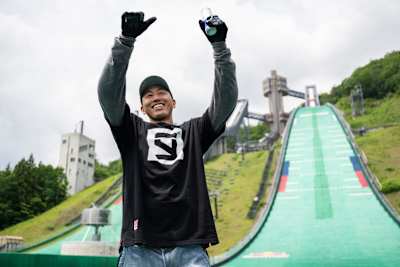
Tomomi Nishikubo celebrates his two new world records
© Jason Halayko/Red Bull Content Pool
Determined to give himself the best chance of success, Nishikubo built a 10m practice hill matching the jump's gradient and tested four different 24in tyre options before modifying them with custom metal studs for improved grip.
The 34-year-old then travelled back to Hakuba to test his findings before deciding everything was now in place, and he was ready to try again.
On the first day, the improved traction generated so much braking force that the brakes began to overheat. By the end of day two, all 10 spare brake rotors had been destroyed.
On day three, Nishikubo switched from resin to metal brake pads and immediately saw a difference. With overheating no longer an issue, he approached his next attempt with confidence and completed the record-breaking run more than two years after first conceiving the idea.
