
Cycling
A beginner’s guide to the Tour de France
Get your head round one of the largest sporting events on earth with this beginner’s guide to teams, tactics and lingo.
Switch on a bike race and you might think it is pretty straightforward - i.e. first to cross the line wins the race - but scratch beneath the surface and you’ll find the Tour de France is a fascinating mix of tactics, etiquette, big personalities and sometimes arcane rules.
A little bit of history
This is the 106th edition of the Tour de France and the 100th year the yellow jersey has been presented to the overall race winner. What started as a publicity stunt for newspaper in 1903 is now one of the greatest sporting events in the world, with 12 million spectators watching it live by the roadside plus a further 3.5 billion people watching on television in 190 different countries.
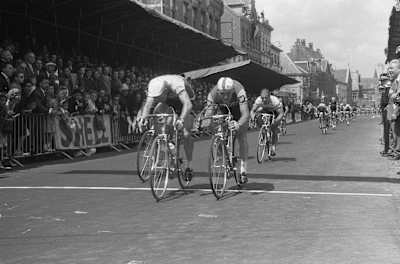
A snapshot of Tour de France history
© Nationaal Archief
2019 Tour de France race route
Starting in Brussels on July 6, it winds its way 3,480km around the country in 21 stages, which breaks down into 7 flat stages, 5 hilly stages, 7 mountain stages, 1 team time trial and 1 individual time trial, finishing in Paris on the July 28. While the start can be held anywhere, the final stage is always on the Champs-Elysées, a grand spectacle where riders career around the cobbles and the sprinters fight for the honour of winning the final stage, and the winning team, safely out the way, near the back of the race, sips champagne.

What the coloured jerseys mean
Sometimes described as a ‘game of chess on bikes’ the tactics of a three-week long race requires fast thinking and good mathematics. Weather, crashes, mechanicals and plain bad luck all play their part. Every stage has its own winner, prize money and points but the overall winner, on general classification, is the rider who completed the distance in the least accumulated time. It's technically possible for the overall race to be won by a rider who hasn’t won a single stage outright.
The famous yellow jersey is presented every day to the rider who has clocked up the least time on their bike, the leader of the general classification. This is the big battle and the riders most people know (Geraint Thomas, Chris Froome, Bradley Wiggins). GC contenders have to be all-round athletes because whilst they often use the climbs to put time into their rivals, they can’t afford to lose time, so need to be able to hold their own near the front of the race, day-after-day. A white jersey is presented to the highest placed young rider on GC and there is also a separate competition for team classification.
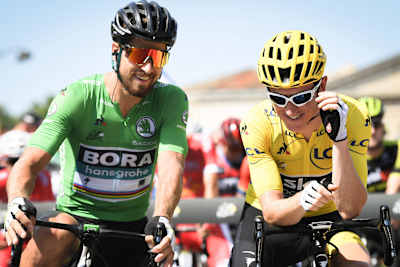
Geraint Thomas during Tour de France 2018
© Pauline Ballett
Pure climbers compete for the Polka Dot jersey, this is based on points awarded at the summit of each categorised climb and mountain-top finishes. These are the super skinny, small riders who excel at the lung straining, leg burning challenge of racing up mountains – but you won’t see them near the front on a flat stage.
Flat stages are competed for by the sprinters, these power-house riders battle it out shoulder to shoulder and knee to knee at speeds of 60kph or faster to be the first to cross the finish line each day. At every stage, points are awarded to the first 10-25 riders that cross the finish line.
The amount of sprint points awarded depends on the day’s course (a flat course produces more points than mountainous terrain) and in what place the rider finishes that day. To spice things up some stages have intermediate-sprints within the stage that are also worth points. The leader on points wears a green jersey, it is sometimes called the sprinter's jersey.
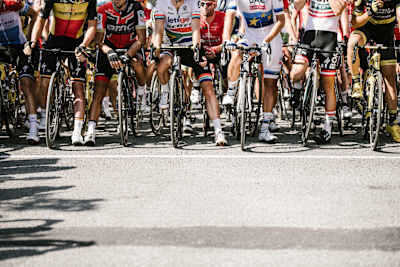
One of the most intense start lines in sports
© Pauline Ballett

Tour de France teams
There are a total of 176 riders in 22 teams, each with their own support team of mechanics, soigneurs (assistants), medics, chefs and physios led by a Director Sportif – the head of the business. The Director Sportif is in the following team car, he sees everything, dictating tactics and relaying information to every member of the team and support staff. The team cars can offer water, food and even spare bikes in the event of a mechanical.
Riders have to wear an ear piece so they can hear their DS and communicate with other riders on the team. Sometimes tactics can be planned in advance and executed with precision; other times there are split second decisions to be made in response to the tactics of other teams.
Tour de France etiquette
There are the rules written in the rule book and there are the unwritten rules of the riders, many of which are based on what could be termed ‘sporting’ behaviour, or simply, tradition. Never take advantage of a rival’s mechanical problem or crash; if one rider needs to pee you all pee; share your food and water if a rival needs it. If a rider is passing through his home town, or it’s his birthday, and the mood of peloton is right they may let him ‘escape’ off the front to look like he is leading the race. There is normally one rider in the race who is looked to with respect to lead these decisions, often but not always, a yellow jersey contender.
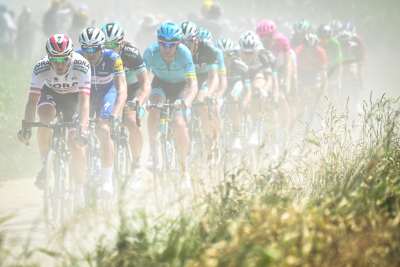
Riders must know TDF etiquette
© Alex Broadway
Following the race
One of the joys of watching the Tour de France is you can appreciate the race on many levels; switch the race on for the final kilometres to root for the lonely, solo rider looking to win a single stage, or marvel at the skill and pace of the final sprint. Or you can become immersed in the intricacies of the team tactics, following the key figures every day.
The really dedicated will be watching the entire stage, day after day, even the long boring sections before the racing starts to heat up and the riders just chat and swap sandwiches out of their musettes (feed bags). Even these sections have their own appeal; the stunning French countryside, the random ‘art’ made out of hay-bales and the beautifully decorated small villages. Be ready to write off July as you get sucked into watching the Tour de France and fall in love with this travelling circus, this beautiful race.
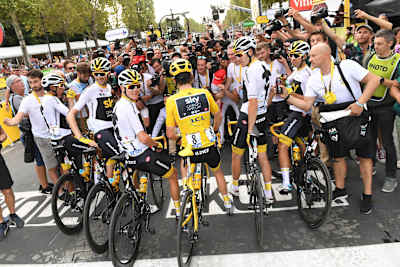
Team Sky during Tour de France 2018
© Pauline Ballett
Names to watch out for
Yellow Jersey
In the absence of Chris Froome, who only recently had a major crash, all eyes will be on Geraint Thomas, last year’s winner, to be the team leader for Ineos (formerly Team Sky). Another GB name, or rather names to watch are the Yates brothers, Simon and Adam. Simon Yates very very nearly won last year’s Giro (the Italian grand tour) so is clearly capable, but his brother Adam Yates is also waiting in the wings ready to show his potential as an overall race winner.
Outside of the UK look to Nairo Quintana, the diminutive Colombian riding for Movistar who is a master of climbing. This year might also be a chance for the French to get one of their own in Yellow in Paris with Thibaut Pinot (Groupama-FDJ), definitely a rider to watch on the mountainous stage finishes.
Green Jersey
Whilst its disappointing that GB’s Mark Cavendish ( Dimension Data) is not riding the tour this year for the first time since 2006, there are plenty of other sprinters vying for the space. Despite being near the end of his career, Cav hopes to ride the tour again, so maybe we haven’t seen the last of him in green yet.
Peter Sagan is always a favourite in any sprint finish, and his all-round prowess means he has won the points jersey six out of the seven times he has ridden the Tour de France. This year he failed to win his National Championship, so for the first time in a long time he will be riding in the same plain Bora-Hansgrohe kit as his team mates. This shouldn’t however slow him down.
For a fresh face to follow keep an eye on Wout van Aert (Jumbo-Visma), the young Dutch rider has been setting races alight with a promising 6th place at Milan-San Remo, a one day classic race normally won by a sprinter (Cavendish won in 2009). Just 24, this is his first Grand Tour, so he will try to make his mark.

A Tour de France dictionary
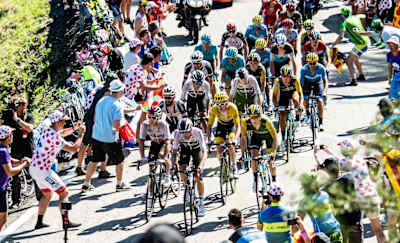
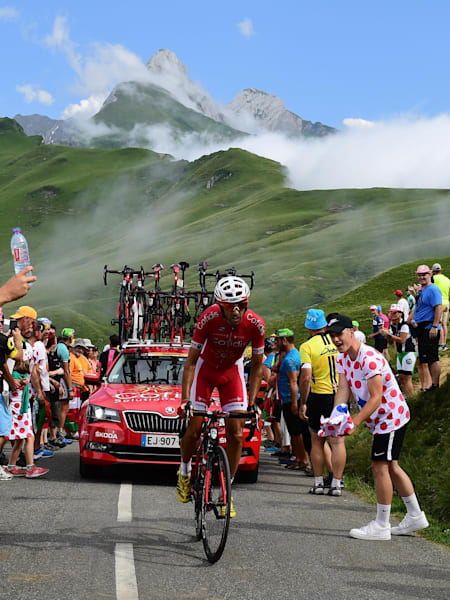
The crowds cheering on the peloton
© Alex Broadway
La Grande Boucle: The big loop. An affectionate name for the Tour de France.
Maillot jaune: Yellow jersey. Also used to refer to the rider wearing the yellow jersey, as in ‘the yellow jersey is 30 seconds behind the front group.’
Lanterne rouge: The last rider. The translation means ‘red face’ presumably because of the embarrassment of being last, but actually being dead last is a lucrative as it has a celebrity of its own that can be traded against at post-tour races and events.
Tête de la Course: Head of the race. Simply meaning the rider or riders who are leading on that stage. If the yellow jersey holder is not in the front group, you can bet they will be keeping a careful eye on who is and how far ahead they are getting.
Chute! Chute!: Crash! No one ever wants to see riders hurt but there is undeniably an undertone of excitement when the shout goes up, followed by a flurry of action as commentators try to work out what has happened, who has gone down, and how that has affected the race.
Domestique: Servant. A rider whose role is to support other riders on their team, their jobs range from fetching and carrying extra food and water, blocking the wind at the front to protect another rider, chasing down other riders who are a threat to their leader’s position, and even giving up their own bike in the event of a mechanical.
Taking place between July 6-28, the 2019 edition of the Tour de France marks the 100th anniversary of the famous yellow jersey. For results and more info, and to enter the official Fantasy League, visit www.letour.fr/.


