

Cliff Diving
Meet the 20-year-old who’s built to dive off 27m-high platforms
Aidan Heslop is one of the stars of the Red Bull Cliff Diving World Series – discover how he fell in love with cliff diving and is helping push the sport further.
Part of this story


It’s the summer of 2012 and Aidan Heslop is watching a video of Gary Hunt about to take his third Red Bull Cliff Diving World Series title. It’s the first time 10-year-old Heslop has seen cliff diving and he’s spellbound. For the past three years, he’s been diving in his local pool in Plymouth, in the southwest of England, but suddenly he realises that this is the sport for him. That's all it takes – a mate sharing a video – and the fire is lit.
Today, Heslop is one of the world’s most prestigious high divers, the creator of what is officially the world’s hardest high dive and one of a group of young athletes taking the sport into a new era. And among his competitors is Owen Weymouth, the childhood friend who first showed him that video, and who’s taking part in his sixth year in the World Series.
Hear Aidan Heslop's full story on the Beyond the Ordinary podcast:
Heslop remembers it like this.
“When I saw the video of Gary doing a new dive in one of his competitions, I was hooked,” he says. "I was always quite a hyperactive kid, running around the garden or jumping on beds or from sofa to sofa, and I never really clicked with any sports. But I did with diving. I had a natural talent from the very start.”

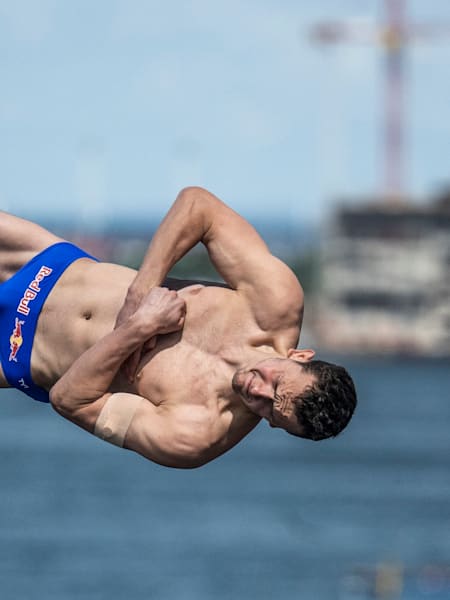
Aidan Heslop prepares to leap into the Seine
© Romina Amato/Red Bull Content Pool
Everything I've done in normal diving up until now has been to benefit my high diving

From the very beginning, Heslop’s goal has been to compete in the Red Bull Cliff Diving World Series. “I progressed in my 10m and 3m diving but everything I've done in normal diving up until now has been to benefit my high diving,” he says.
The result is a finely tuned 80kg cliff diver’s body with a resting heart rate of 41 that's perfectly conditioned for diving off a platform 27m. “Since he’s very young,” says cliff diving legend and World Series Sport Director Orlando Duque, “we knew he was ready for big things in terms of strength, speed, the difficulty of his dives.
“He’s shown in this first full season what he is capable of and I think there is more to come. I’m curious to see where he's going to go, what he's going to try and if he's going to focus on polishing these dives he’s doing now.”
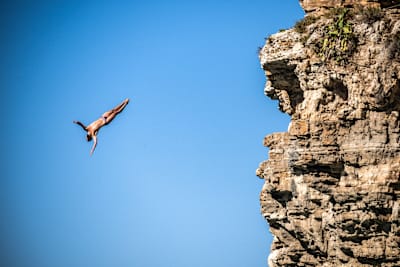
Heslop competing in Polignano a Mare
© Mauro Puccini/Red Bull Content Pool
Heslop’s rise has coincided with a steep change in the evolution of the sport, as the dives have significantly changed. There was a time when most divers were simply doing whatever they could do off the 10m board with the addition of the barani – the move that lets athletes land on their feet.
Typically, that was the triple half, three somersaults with a half twist. The hardest dive was a triple quad – three somersaults and four twists. It was the first dive invented specifically for cliff diving by Hunt, and it was the dive that got Heslop his first podium in 2019.
Fast forward to June 2022 and Heslop is taking part at the Boston tour stop on the World Series. For this dive, he needs a run-up and launches himself into the air from the platform. In the three seconds that it takes to hit the water, he manages to execute a dive consisting of four forward somersaults with three-and-a-half twists pike before an almost perfect landing on his feet. It’s enough to secure him his first World Series victory – fair enough when you consider it’s been described as the world’s most difficult high dive.
I’m curious to see where he's going to go, what he's going to try
More Beyond the Ordinary episodes


The degree of difficulty (or DD as it’s known in the sport) is calculated by the type of take-off, number of somersaults and twists, and the position during the somersaults and the entry. This particular dive had previously earned him the gold at the FINA High Diving event in Abu Dhabi, UAE, in December 2021.
“Nowadays the sport is getting pushed so much,” says Heslop. “It’s just not the case anymore that it’s the 10m dive with a little bit extra. I do the hardest high dive in the world at the minute and if anyone wanted to do that, minus the barani on 10m, you'd have to be superhuman. It’s just physically impossible.”
Hunt is considered a cliff diving legend, having taken nine world titles, and he agrees that the sport is only going to continue evolving.
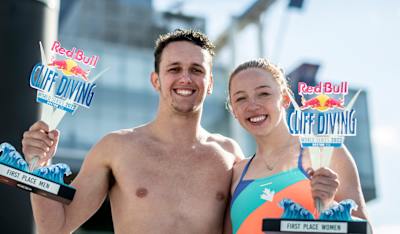
Aidan Heslop and Molly Carlson celebrate in Boston
© Dean Treml/Red Bull Content Pool
More than a decade of a regular competition schedule and consistent diving conditions on the World Series circuit have helped change the game, and men and women continue to come in to push the sport further. Can Heslop, who in many ways has emulated Hunt's diving style, be one of those taking it forward? Throughout his career, he’s been prepared to push and try new dives.
“A lot of it came naturally just because of my willingness to try dives,” says Heslop. “I had a Mexican coach for a while. And he was just as crazy as me and he would let me do the hardest dives I could possibly do off the highest boards. I think that’s partly why I was progressing really fast – I was just learning all these new dives because I would just go for it.”
But Heslop is keen to point out he’s not completely fearless – and the sport doesn’t just reward the brave. “There’s definitely some kind of fear and you feel it on every single dive. When I go up onto the 27m platform, I know that if something goes wrong, the consequences are going to be huge. The impact from 27m is like hitting concrete sometimes. When you hit the water, the force is so strong that it can rip your legs apart.”
During his first ever Red Bull Cliff Diving World Series event in Polignano a Mare in 2018 when he was 16, Heslop landed badly during one of his training dives. “I couldn't sit down on my coccyx for more than five minutes for the next two to three months.”
When I go up onto the 27m platform, I know that if something goes wrong, the consequences are going to be huge
You need to go onto the platform with 100 percent confidence that you’ve got the dive dialled, he says. “In my mind it's not going to go wrong.”
But there will always be an element of fear. The trick is not to let it overrule your ability to do the dive and to relax as much as possible beforehand. He’ll listen to some rap or drum n bass, depending on his mood – but always the same song throughout the whole comp.
“I try and be as Zen as possible and just focus on the dive itself and block out all the external factors like the wind and the crowd,” he says.
There are also some superstitions he needs to take care of, too, like wiping his hands on his trunks just to get his hands a little wet.
He explains: “There is then a moment before I dive, where it's just me and the platform and the dive which is a super important thing for me. But my heartbeat is going crazy!”
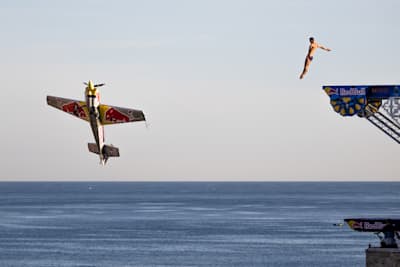
Dario Costa flies by as Aidan Heslop makes his dive in the Volare Duet
© Dean Treml / Red Bull Content Pool
In Paris, the stop following Boston, Heslop also performed his world’s hardest dive. Before he took his run-up his heart rate was recorded at 180bpm – equivalent to almost his maximum training zone. “I thought I was calm but it seems to be my mind overruling everything, including how fast my heart is going,” he says.
Beyond the Ordinary’s Dakar Rally series


He won one more time at the Sisikon stop in Switzerland in September, and with one last round to go, he has a real shot at landing a first world title.
I was always known as the scruffy kid. I could do the big dives but I just didn’t look quite as tight as everyone else
It’s been 10 years since he watched the video of Hunt that inspired him to get into cliff diving. It has been a long journey and not all of it has been easy. “To the level that I'm at now, I’ve definitely put in a lot of work in different aspects,” says Heslop. One of the things he’s really had to focus on was perfecting his form. “I was always known as the scruffy kid. I could do the big dives but I just didn’t look quite as tight as everyone else and I’ve had to work on that for many years.”
But this year all the hard efforts seemed to pay off for Heslop. In Boston, and again in Switzerland, he didn’t just perform the world’s hardest dive, he also won the competition, finishing ahead of the man who for so long was his inspiration. “It was weird, but a cool feeling,” he says. “You look down and you’re like, that's my hero for the last 10 years below me on the podium. He’s the first high diver I ever saw – our techniques are very similar – but just because he is my hero doesn't mean I don't want to beat him.”
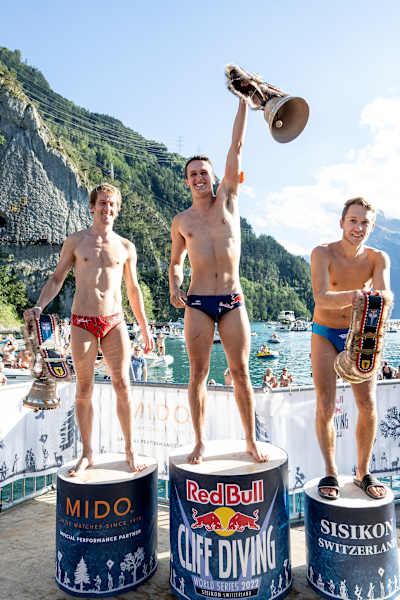
Aidan Heslop celebrates his victory on the men's podium
© Dean Treml/Red Bull Content Pool
Heslop’s ambitions don’t end with beating his hero. “I think it is to show some dominance in the sport, not just to win a world championship – to be fairly untouchable, to be the person that everyone wants to beat.”
Whatever his fortunes in the months and years ahead, one thing’s guaranteed – with his spectacular diving style, Heslop is a joy to watch, and he's a diver who can help inspire the next generation.
Part of this story