


Bike
MTB
Maintenance checks to get your mountain bike running smoothly
Follow this complete guide to get your bike gleaming and running smooth for summer riding.
After a long season of riding your mountain bike through the grime and mud of winter, it’s a good idea to give it some TLC in the form of a thorough check-over and clean. That way, it’ll be running better than ever this spring, and you’ll also reduce the amount of maintenance in the long run.
There are a number of areas of the bike that you should pay close attention, not least the suspension, brakes and bearings. We spoke to experienced mechanic and author Pete Ballin to hear some of his experience of keeping bikes running smoothly.
Drivetrain
Get your drivetrain squeaky clean for spring
© Bartek Woliński
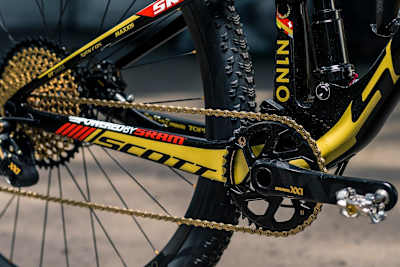
The area that probably takes the most abuse from muddy conditions is the drivetrain – the chain, cassette and derailleur are constantly turning, and any grit and water in the system will wear things out quickly. And let’s face it, last time you rode your bike in the mud you threw it in the shed and forgot about it… now it’s time to clean up.
It's a good idea to give the cassette, chain and chainring a good scrub with an old toothbrush and some degreaser to thoroughly remove all the grime. You can remove the parts to do this, or carefully clean them on the bike. Once rinsed and dry, apply a good quality chain lube, making sure each link of the chain is coated.
Make sure derailleur is lined up with chain line
© Bartek Woliński
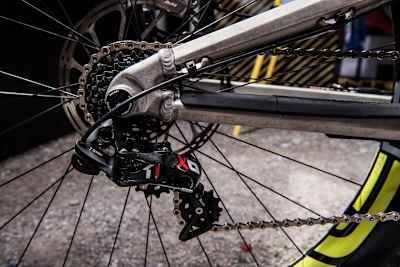
Now, check the gears are running and changing smoothly. First, check everything is straight – that the derailleur lines up perfectly with the chain line. (If something’s bent or severely out of line, your first port of call will be your local bike shop.) In the top- and bottom-most gears, the jockey wheel of the derailleur should line up with the cog on the cassette – if not, this should be fixable using the limit adjuster screws. Next, put the bike in a stand (professional or makeshift) so the rear wheel can spin freely, then change through the gears, up and down the block, to see if everything is smooth and precise. A bit of lag might be fixed by adding or removing tension from the cable.
If you’ve neglected your bike during the darker months, you might need to invest a small amount in a new gear cable:
“Another sure-fire way to make to improve shifting performance is replace the inner and outer gear cable – bent, twisted or rusty cables cause a lot of shifting problems.” – Pete Ballin
Brakes
Make sure brake disc isn't scratched up
© Miles Holden
Water, grit and mud means reduced lifespan of your brake pads, and this can lead to more wear all-round. Drop out your wheels and take a look at the amount of material left on each brake pad. Unequal wear means brakes that aren’t correctly aligned. If there’s little or no material, you’ll be wanting to check the discs for damage too.
“If you notice the disk has any excessive scoring, it should be replaced.” – Pete Ballin

Give your brake levers a pull to check pads
© Nathan Hughes
With the wheels back in the bike, check the feel when pulling the brake lever. Spongy? It shouldn’t be – there should always be a definite, firm bite point. Bleeding your brakes (changing the hydraulic fluid) gets rid of any air bubbles and dirty, old brake fluid, so you might want to drop into your local bike shop for a bleed.
Bearings
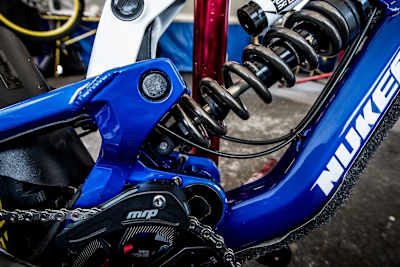
Tape and foam for protecting pivots and bearings
© Nathan Hughes
There are many bearings on a mountain bike, each of them playing its own important role as part of a greater machine. All bearings should run free and smoothly, but after regular wet rides they can begin to wear and sometimes seize altogether. This often goes unnoticed, but you’ll know the difference when everything’s running smoothly again.
Suspension pivot bearings can be checked by removing the rear shock and cycling the frame through its travel – this should be almost effortless. Headset bearings take a lot of abuse and can really affect the feel of a bike, so check those by lifting the front wheel off the ground and turning the handlebars side to side – again, this should be effortless and smooth throughout its range. Wheel bearings should turn with little stiction, and there shouldn’t be any lateral movement (play) in the wheel. If there is, it’s time to replace those bearings.
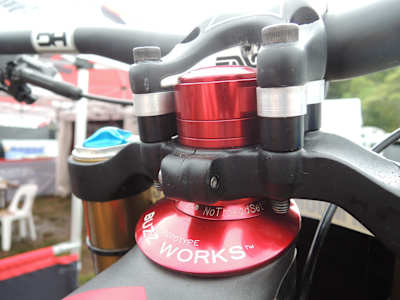
Test headset bearings by turning handlebars side-to-side
© Ric McLaughlin
It's a good idea to check shock bushings and bearings for any rattles – bearings should only move in a circular motion, never up and down or sideways!
“If you notice any play in the back end of your bike, it can often be worn frame bearings or bushings. Before checking them over, ensure all the pivot and shock bolts are tight. Then, put a hand on one bearing or bushing at a time and pull the frame firmly up and down with the other, so the wheel makes contact with the ground. If you notice any play in even just one bearing, it's a good idea to replace the others at the same time. It can be easy to cause damage without the correct tools and knowhow, so it’s best to get a pro involved.” – Pete Ballin
Suspension
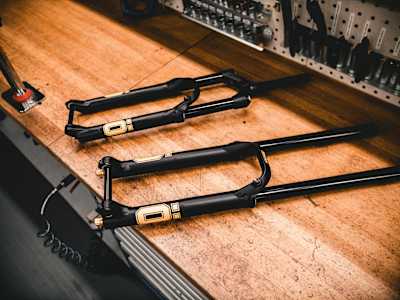
Time for a full suspension clean
© Oskar Sahlin
Cleaning the external, visible areas of your suspension fork and rear shock isn’t going to be enough to get them working perfectly after a winter that has most probably damaged the seals and affected the internals. Now is a good time to send suspension units off to a professional service centre like TF Tuned. The ride feeling of a newly serviced and tuned fork and shock is always noticeable. You’ll be set for spring and likely summer too.
“Dropper seatposts take the same kind of abuse as your suspension during winter. If the seat doesn’t want to go up or down, the system probably needs a bleed if it’s hydraulic, or otherwise a replaced cable. If the seatpost itself sticks or is notchy in its motion, it’s a good idea to get a full service.” – Pete Ballin
General checks
There are some general checks that you should do regularly.
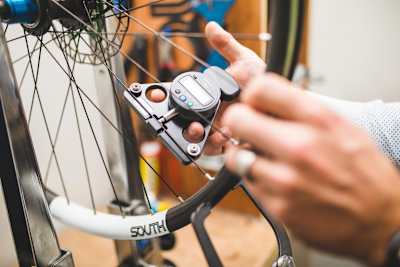
The tension on the spoke is tested
© Ewald Sadie
- Wheel spoke tension should be regular – any loose spokes means you should get your wheel tensioned and trued (straightened). Any significant side-to-side or up-down movement when you spin the wheel is a sure sign it needs truing.
- Check rims and tyres for any damage that might have been hidden by that winter-long coating of mud. Likewise, give a glance to your frame, handlebars and stem to check for any damage.
- Replace tubeless tyre sealant – it’s a good idea to do this every few months.
- Go over the whole bike checking every bolt is tight and, if you want to do things to the text book, check manufacturer torque setting recommendations on each bolt too.
