

Bike
MTB
How to choose the best MTB handlebars
In the market for some new bars? Here’s how to make sure that you invest in the best.
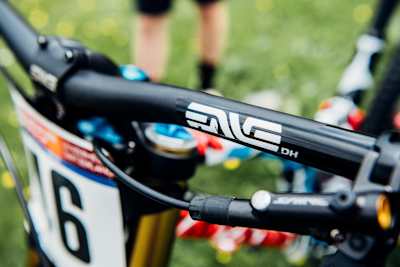
ENVE Composites handlebar and stem
© Bartek Woliński
Handlebars. There’s a bit more to them than just a bent tube. They're not only an essential for physically holding on to your bike, but also a key aspect of how it feels on the trail and, more importantly, how well it fits you.
The other bit of good news with bars is that you don’t need to spend big money to upgrade or improve things. Equally, if money is no object, you can also buy something pretty flash.
Here’s what to look for:
Width
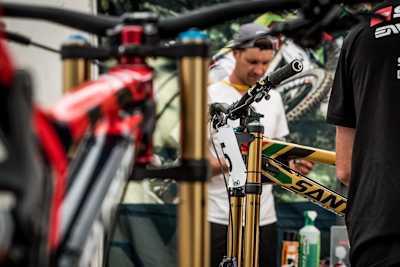
Greg Minnar’s patriotic Santa Cruz
© Nathan Hughes
How wide a handlebar is has been one of the biggest trends in mountain biking for a good few years now. There was a time when anything over 700mm (27.5in) was viewed skeptically, but now some of the UCI World Cup DH racers have broken the 800mm (31.5in) mark.
So why so wide? Well, the theory is that it helps to spread your weight over the front wheel and means that steering inputs require less force. It really helps in terms of trail position too; imagine pushing a car with your hands close together compared to spread further apart.
Bar width is of course dependent on size and despite the fact that Greg Minnaar runs 800mm+, that doesn’t necessarily mean that you should. That said, if you’re not sure what width you’re after, then buying an 800mm bar and cutting it down to size is a good option. An old lock-on grip collar makes for a useful saw guide.
Height
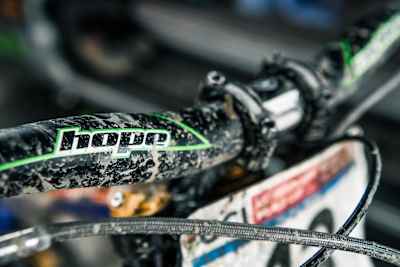
Prototype Hope handlebars, cut down to 740mm wide
© Bartek Woliński
The amount of rise (measured from the bar’s centre to the top of the upward bend) can also dramatically affect things and often depends on the type of trails you like to ride and your bike’s stack height (the distance between the ground and the top of the headtube).
Taller bars work well on bikes with low front ends or when tackling steep trails, as they help to move your weight backwards, while lower rise bars work best on faster, flatter trails or on bikes with high stack heights. Typically bars are available in rises between completely flat (although these are getting rarer) and 40mm.
Bend/diameter
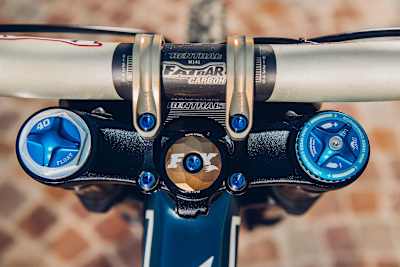
View of the Renthal 35mm Fatbar and stem
© Bartek Woliński
A handlebar has two bends; one up, one back. Their purpose is designed to provide a more natural position for your hands to grip with. Around seven degrees of backwards sweep and five degrees of upwards sweep are around the norm, but flatter and more swept options are available. It’s worth bearing in mind that rolling your bars forwards or backwards in your stem can alter the feel too.
The latest trend in handlebars is the move to the thicker 35mm diameter clamping surface.Manufacturers are moving towards it and, as a result, so are after-market companies. This is up from the previous ‘norm’ of 31.8mm. Remember, thicker bars will require a bigger stem to match.
Material
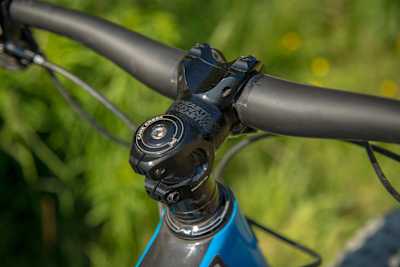
Santa Cruz carbon fibre handlebar
© Dave Mackison
When it comes to handlebar material you have two options; metal or carbon fibre. Cromoly steel bars are popular with BMXers but seldom seen these days in mountain biking, where lighter alloy is more prevalent. Carbon-fibre versions will offer the same angles, but at a lot lower weight.
They were initially treated with skepticism by more gravity-orientated riders, but the use of unidirectional carbon fibres by the big brands has increased reliability and strength phenomenally. They’re also more forgiving than of old too; manufacturers can now tune in more ride dampening to mimic the feel and shock absorption of alloy bars.


