



Bike

MTB
What is XC MTB and why should you give it a go?
Fresh from a world championship win in Val di Sole, Britains Evie Richards shares her guide to cross-country mountain bike racing.
Cross-country mountain biking is one of the most popular types of cycling, and it’s easy to see why. The form of cycling gets its name literally because it takes place in the countryside, allowing riders to explore bridleways, trails, and fire roads free from traffic and the worries that come with it.
It’s not limited to a leisurely spin on a Saturday afternoon, either. A professional sport since 1990, the UCI Mountain Biking World Cup is the pinnacle of XC MTB racing and sees the best riders in the world compete on some of the planet’s most technically demanding courses.
To get the full low down, we spoke to Red Bull athlete and newly crowned cross-country world champion Evie Richards to find out what XC MTB is and why we should all be getting a piece of the action…
What even is XC MTB?

Cross-country riding takes in fireroads, singletrack and woodland paths
© Bartek Wolinski / Red Bull Content Pool
Cross country mountain biking (or XC MTB for short) is a varied discipline of off-road riding. A ride can take in anything from fire roads to twisting singletrack, and there is a competitive side to it too for those who want to put their skills and speed to the test.
“The most common type of XC MTB race is the Olympic discipline, which is what I race in at an elite level,” explains Evie. “Essentially, there is a marked out course that you race for a set number of laps or time. There are also short course and marathon races, which are, as you can probably guess, shorter or longer in distance. Most courses will include some hills and descents and technical sections like jumps, berms [curved, raised banks that allows riders to carry speed into corners] and rock gardens [a section of rocky, uneven terrain made up of razor-sharp stone and slabs that are slippery when wet].”
How does XC MTB differ from Trail MTB?
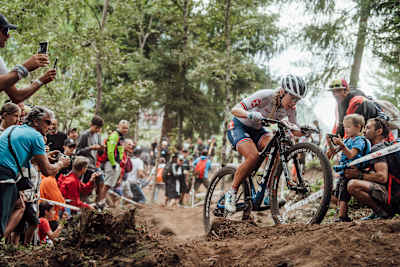
Evie powering to victory at 2021's Val di Sole MTB World Championships
© Bartek Wolinski/@wolisphoto
While there is quite a lot of overlap in terms of areas and features ridden, the focus of the ride will be different and XC MTB can probably be considered slightly tamer than all-out trail riding.
When I’m doing a XC training session, I'll generally try to ride a loop or section of trail as quickly as I can
“When I’m doing a XC training session, it will include all-out efforts up off-road climbs, practising my technique on small jumps and uneven terrain, and just generally trying to ride a loop or section of trail as quickly as I can,” explains Evie.
Trail sessions meanwhile are generally undertaken at a much more relaxed pace – on the uphills at least. Instead, it’s the downhill sections that get the adrenaline pumping, as riders test themselves on bigger jumps, higher drops, and features such as berms at speed.
How do you get into XC MTB?
When I first started racing, I used a hardtail that I’d bought to ride to and from my weekend job on
Most entry-level mountain bikes are based on the standard cross-country bike design, so if you’ve already got one of those, that’s the main hurdle overcome.
“When I first started racing, I used a hardtail [front suspension-only mountain bike] that I’d bought to ride to and from my weekend job on,” says Evie. “Although it’s a million miles from the bike I ride now, it was a great way of getting into mountain biking without having to spend loads on new kit.”
Bike sorted, it’s time to find a race near to you. British Cycling’s website is a good place to start and lists all upcoming events within an adjustable radius of your home.
“Every area has its own local series, and you’ll be surprised to see what there is on your doorstep,” adds Evie.
Can anyone do it? If so, where?

The ability to ride the likes of berms is key before signing up to a race
© Bartek Wolinski / Red Bull Content Pool
The great thing about XC MTB is that it’s a really accessible form of mountain biking. Unlike other competitive disciplines – such as downhill, 4x and enduro – XC requires a much lower level of technical skill. But that’s not to say it’s as easy as riding a bike.
“Before you enter your first race, you should be able to ride confidently off-road and be comfortable tackling sometimes uneven terrain and the occasional section of singletrack,” says Evie. “If you’re not quite there yet, spend some time practising and get yourself used to the riding off-road – either at a dedicated trail centre or the paths and bridleways near your home.”
Once you feel like you can hold your own, you don’t have to throw yourself in at the deep end either. Although most courses include daunting technical features like jumps, ruts, and rock gardens, there will also be an alternative, beginner-friendly path to take.
What do you need to take part in a XC MTB race?

Evie rides clipped in, even over technical terrain
© Bartek Wolinski / Red Bull Content Pool
Other than a bike, there is only one other must-have when lining up on the start line of a XC MTB race – a helmet. But there are a number of things that will make your race more enjoyable (and could even boost your performance, too).
“When racing, I wear a cycling jersey and pair of bib shorts, and I can’t recommend riding in proper clip-in shoes enough – they take a bit of getting used to at the start, but are so much more efficient than just flat pedals and trainers,” explains Evie.
While Evie has mechanics on hand during her races if there are any issues, she recommends carrying all the tools required to fix a puncture (spare inner tube, tyre levers, mini pump and multitool) and everything you’ll need to keep you properly fuelled during your race.
“I tend to stick to carrying a water bottle filled with 50/50 Red Bull and water,” adds Evie. “But if your race is longer, you might want to consider carrying something quick release like a gel, too.”
Is XC MTB racing safe?

Even if you do fall off, it's rare that you'll hurt yourself too much
© Bartek Wolinski / Red Bull Content Pool
“Although professional racing might look quite fast and furious, it’s a safe environment where all the riders are looking out for each other,” says Evie. “A local event series will have a friendly, welcoming atmosphere where you’re able to take the race at whatever pace you feel comfortable.”
Plus, if you do fall off, you're probably a lot less likely to hurt yourself than if riding on the road. Not only does the technical nature of the terrain and obstacles mean speeds are generally a lot slower off-road, but the mud and grass courses are a lot more forgiving than crashing on tarmac.
And if you’re new to XC MTB – how to get started...
- Get yourself a bike – check out our recommendations for the best entry-level MTB bikes that will be great for cross-country
- Ride some local trails – practise your riding on these beginner-friendly trails
- Find an event – head to British Cycling's website to find a race near you
