





Fitness
Chess
How fitness helps Tania Sachdev stay sharp at the chessboard
Grandmaster Tania Sachdev explains how exercise, yoga and mental training help her stay focused, manage pressure and perform during long chess tournaments.
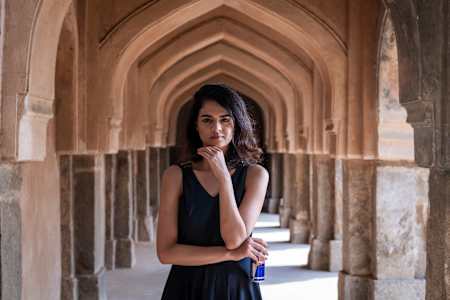
Tania Sachdev is a chess champion who has spent more than two decades proving that success on the board requires more than just a sharp mind. A Woman Grandmaster, former Asian women’s champion and one of India’s most recognisable chess figures, she has competed at the highest levels of the game while helping inspire the country’s new generation of players through her commentary and presenting. Here, she reveals how training her body and mindset has helped her stay at the top of her game.
01
Why physical fitness matters in chess
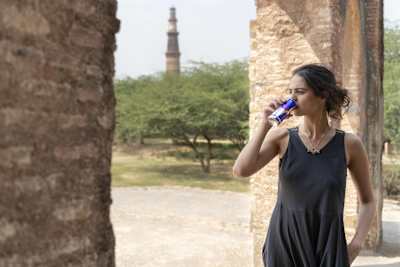
Sachdev was first introduced to chess when she was six years old
© Ali Bharmal/Red Bull Content Pool
Chess is the ultimate mind sport. It develops and enhances so many cognitive skills. Every game demands concentration, reasoning, logical thinking, memory, pattern recognition, intuition, spatial intelligence and decision making. You also need strong control over nerves as well as good fitness levels to have the stamina required for the mind to work well.
It’s important to keep one’s brain working and challenged to develop these skills further. I like to get my brain out of its comfort zone. Solving positions and training games help keep the mind working.
I enjoy things that challenge our thought process in general. I like things that make me ask questions for me to understand them. For example, puzzles and quizzes are definitely fun - especially on long flights - but they also make me think. I believe even interesting conversations keep our minds engaged. However, to keep the mind sharp for chess, one needs to train at chess! It’s that simple.
Most may not realise it, but physical fitness does a great deal in improving your chess game. In fact, I would say that whether you’re an athlete or not, physical fitness and a healthy body are important for a good, happy life.
02
The training routine that works for me
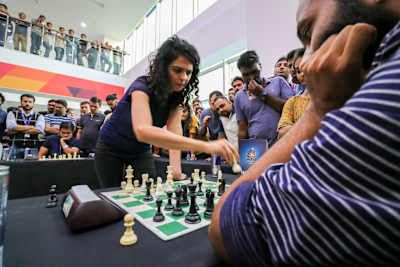
Taking on all comers at Red Bull Battle for the Queen
© Focus Sports/Red Bull Content Pool
Chess games can last up to seven hours, and tournaments can have between nine and 13 games. That’s a lot of time! For the mind to work at its best, having physical stamina is key. When I workout in the lead up to a tournament, I focus on building stamina. During a tournament, I prefer doing a light exercise routine after a game just to refresh my body and take my mind off the game I just played. The exercise could be a walk, a swim, or a quick gym session. It’s just something to let the stress melt away.
I actually prefer playing sports over going to the gym. I find that playing badminton or table tennis is way more fun than gym workouts!
Apart from sports, yoga and meditation also help a lot. Yoga is great for core training and overall toning. Meditation and breathing techniques are great before, during and after a game. They help calm you down so you can re-adjust and re-focus your mind. Working on and improving one’s breathing is a great way to make sure your brain works well, even in high-pressure moments.
More inspiration for your fitness journey
03
Building mental strength alongside physical fitness
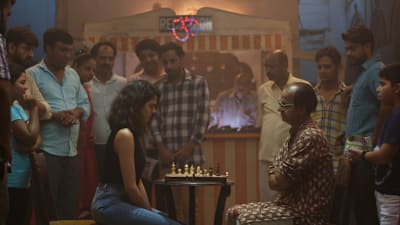
Working out her next move
© Achal Gupt
Every chess player faces challenges. Most of the time those challenges are opponents, but quite often they can be in the form of self-doubt. I think every player doubts themselves and finds a way to make excuses at some point or the other. But a professional chess player can’t spend too much time stressing on things like that.
In my case, I talk to myself and coach myself out of it. I find that it really works for me. I think talking to oneself is a very important tool that all of us can use. Take a moment, close your eyes and just encourage yourself. Tell yourself that you’ve got it together and believe that you actually do. Then no excuses can come in your way. You’ve just got to pick yourself up because no one can do it for you.
