











Red Bull Motorsports
F1
How much horsepower do F1 cars have?
The world’s best drivers are getting to grips with a new generation of F1 engines and cars. How much horsepower does a Formula One driver have at his disposal and what makes it so vital?
Part of this story
Formula One is the pinnacle of motorsport, not only because it pits the best racing drivers in the world in competition, but also because the cars are not the same. Each team is locked in a technological battle to produce the quickest car. The reason for that is that F1 is not only a sport but also a testing ground designed to engineer better cars for road users.
Every few years, F1 changes its regulations to shake up competition and to stimulate innovation. For 2026, the sports organising bodies, the FIA and F1, have introduced the biggest rule change in the sport’s history to develop cleaner, faster and more durable engines.
As engines take centre stage, let’s take a quick look at these all-important power units, learn how we got here and look to see where this journey is leading.
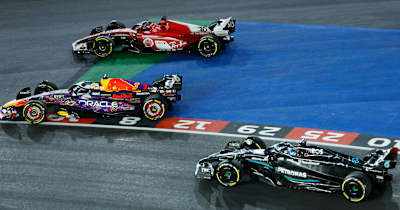
Verstappen takes the lead of the Las Vegas Grand Prix
© Getty Images/Red Bull Content Pool
01
What is horsepower?
Horsepower (hp) is a unit of measurement for power, defining the rate at which an engine performs work. It was coined by Scottish engineer James Watt (1736-1819) to compare steam engine power to horses, with one horse capable of lifting 550lbs (250kg) one foot (30cm) in a minute. With F1 racing, horsepower affects the car’s top speed and acceleration. Simply put, the more horses, the faster the car.
Less simply, the latest F1 engines are hybrids, generating half of their horsepower from an internal combustion engine (ICE) and half from kinetic energy, which is why power unit (PU) is a more accurate term for engine and hp is often substituted by kilowatts as the measure of energy. Let’s pause to enjoy the fact that Watt’s successors named their unit of power after him and not his horse.
02
Impact of horsepower on F1 car performance
To win a Formula One Grand Prix, drivers need a competitive amount of horsepower under their right foot. When performance is separated by hundredths of a second, a car that’s down on power is going to be left struggling at the back.
While horsepower is essential, it’s not the only element at play. Aerodynamics are crucial for efficient performance. Super Formula cars in Japan have half the power of an F1 car but use so much downforce that they can hit top speeds of 320kph.
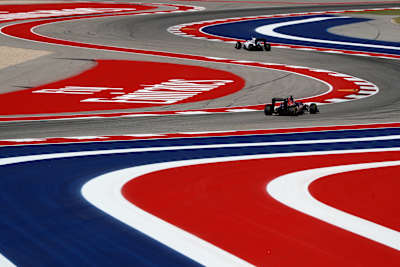
F1 cars have superlative grip
© Getty Images / Red Bull Content Pool
And then there’s the driver. A top driver like Max Verstappen can maximise performance by pouncing on opportunities when they arise. His win at the 2025 Japanese Grand Prix ranks as one of his best because while he didn’t have the quickest car, he was able to put it in the right place on the track to stay in front and win the race.
03
The evolution of F1 car horsepower
Engine regulations have continually evolved across more than 75 years of F1 racing, balancing power, efficiency and sustainability. The first two seasons of F1 in 1950 and ’51 were dominated by Alfa Romeo, whose 158/159 Alfetta was powered by a supercharged 1.5-litre, eight-cylinder engine producing 350hp.
Fast forward 15 years and the Ford Cosworth DFV (Double Four Valve), a 3-litre V8, was a huge step forward, winning its very first Formula One race at the 1967 Dutch Grand Prix at Zandvoort. This mighty engine was responsible for winning 155 races and 12 championships and remained in use in F1 for another 15 years.
The Ford-Cosworth DFV offered a reliable plug-and-play power unit to enable teams like Lotus, McLaren, Matra/Tyrrell and Williams to go racing and win world championships. While it could only reach 400 horsepower, its design helped lay the groundwork for turbocharged engines to soar the horsepower to over 1,000.
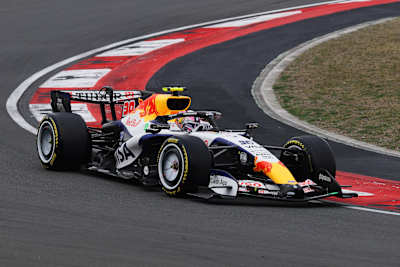
Racing Bulls are also using Red Bull Ford Powertrain engines
© Getty Images/Red Bull Content Pool
04
F1 races into the age of turbo power
Renault pioneered turbocharging their engines in the late 1970s but it took nearly two full seasons to master the technology. But when they broke through, it was spectacular as Jean-Pierre Jabouille won at the French Grand Prix (French driver, car, engine and tyres!) with his team-mate René Arnoux third after a legendary showdown with Ferrari’s Gilles Villeneuve.
Turbos boosted output to 1,000hp but it was laggy, making the cars unpredictable, and the turbo era of the 1980s was short-lived due to safety concerns. But, in time, naturally aspirated engines closed the gap to turbos and by 2005, they were putting out over 900hp.
The current F1 power units have 1.6-litre 90-degree V6 turbocharged engines with an 80mm bore and 53mm stroke and two electric motors: MGU-K and MGU-H. The MGU-K adds 160 horsepower, while the MGU-H manages the turbocharger. The piston engine alone adds approximately 840 horsepower, significantly boosting efficiency and performance.
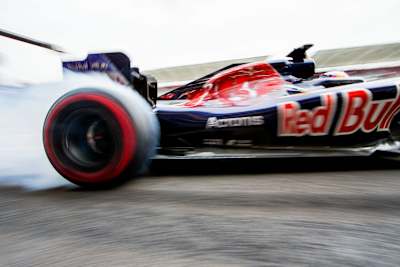
Wheelspin: putting horsepower through the rear tyres
© Getty Images/Red Bull Content Pool
05
Smaller is beautiful
F1 is driven by developing engines for the real world. The environmental impact of fossil fuels and vanishing resources, plus a global financial crisis, combined to usher in a new set of regulations that would push toward developing smaller and more fuel-efficient power units that could still put out more than 1000hp.
Since 2014, F1 has used the most fuel-efficient engines in the world, reintroducing turbochargers and sophisticated hybrid technology to boost horsepower to more than 1000hp. Half the size of that mighty Ford-Cosworth DFV, the power units used from 2014-25 featured two energy recovery systems – one working on kinetic energy, the other recovering energy from heat. The hybrid units generate a 161hp (120kW) boost of electric power to enable overtaking or defending.
The 2026 F1 rules use hybrid technology to improve on those figures, with the hybrid unit producing 50% of the power and the ICE burning significantly less fuel.

The Oracle Red Bull Racing team in the factory at Milton Keynes, England
© Getty Images/Red Bull Content Pool
06
What’s new about the 2026 power units?
The number of manufacturers producing F1 engines has almost doubled with the new Red Bull-Ford Powertrains, Audi joining Ferrari, Mercedes and Honda, with Cadillac due to start producing their own power units in 2029.
Gone is the heat-powered hybrid, replaced by a sophisticated electric motor which generates power from kinetic energy – the MGU-K (Motor Generator Unit – Kinetic). This generator is connected to the crankshaft and converts kinetic energy into electrical energy, harvesting energy when the car slows down and providing additional power to the drivetrain when accelerating.
A new feature is “super clipping”, where the MGU-K generates power even while the driver is still on the throttle. Super clipping can’t fully charge the battery but it will soon enable drivers to race without having to adjust their racing style to slow to recharge, while also improving fuel economy.

Verstappen in the 2025 RB21
© Getty Images/Red Bull Content Pool

Verstappen in the 2026 RB22
© Getty Images/Red Bull Content Pool
07
Why did F1 change the rules and regulations?
Chiefly, it was because all the teams had cracked the formula and there was little to separate the performance of the cars. Downforce was so high that drivers could take F1’s most challenging corners like Eau Rouge at Spa flat out. In 2025, the field was separated by about 1.4 seconds.
At the Italian Grand Prix, the top four cars crossed the line within 0.4s of each other. In 2026, the performance is much wider: in qualifying in China, Kimi Antonelli’s pole time was 1:32.064 while Sergio Pérez’s best lap for Cadillac was 1:36.906. That’s a difference of 4.842 seconds over one flying lap.
F1 is about technological innovation and one way of looking at the current set of regulations is that they are all about developing the most effective MGU-K, which will ultimately be adapted and used on roads. For example, Ford offers two hybrid options for its Kuga/Escape model: a plug-in unit that you charge up and boosts performance and a version that recovers power from kinetic energy to improve fuel economy. Sound familiar?
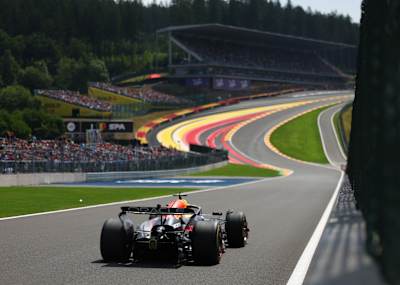
Max Verstappen enters Eau Rouge at Circuit de Spa-Francorchamps
© Getty Images / Red Bull Content Pool
Having been building winning race engines for decades, initially powering McLaren to two drivers' world titles in 1998 and ’99, Mercedes are the early frontrunners in a power unit-friendly championship. As the outfit supplies three other teams, it means Mercedes has twice as many engines on track and therefore double the data and feedback to use in developing the technology.
But the other teams will be working to unlock more horsepower. Ferrari’s race starts are already the best in the field, while the Red Bull-Ford and the new Audi power units both look capable. The performance gaps will close – it’s all a question of time.
08
How does horsepower in F1 compare with other championships?
Horsepower is only part of the story: each car is designed to perform in a specific arena. Rally cars need high acceleration rather than high top speeds, while rally-raid cars need low-down torque to power over rocks and sand dunes. In NASCAR and IndyCar, drivers keep the pedal flat to reach high speeds around ovals. F1 cars need high acceleration and a high top speed to master purpose-built tracks and street circuits.

Mattias Ekström in the Ford Raptor T1+
© Kin Marcin / Red Bull Content Pool
Horsepower side by side
Competition
Vehicle
Arena of use Engine
Engine
Turbocharger
Hybrid
Output
Top speed
Family runabout
Ford Kuga/Escape
Public roads
2.5litre four-cylinder
No
Full Hybrid (FHEV) or Plug-in (PHEV)
190hp/142kW (FHEV)
125mph (201km/h)
WRC
Ford Puma Hybrid Rally1
Asphalt, gravel and dirt
1.6litre Hybrid
Yes
Yes
500hp+/273kW+
193km/h (120 mph)
WR2C
Ford Raptor T1+
Dirt, sand and rocks
5.0-litre V8
No
No
400hp/300kW
180km/h (112mph)
Super Formula
Dallara SF23
Race circuits
2.0L turbo I4
Yes
No
550hp/410kW
320km/h (200mph)
NASCAR
Ford Mustang
Ovals
5.0-litre V8
No
No
700hp/552kW
320km/h (200mph)
IndyCar
Dallara DW12
Ovals and street circuits
2.2-litre V6 hybrid
Yes
Yes – energy recovery unit (ERU)
750hp/559kW
386km/h (240mph)
Formula One
Oracle-Red Bull Racing RB22
Racetracks and street circuits
Red Bull-Ford DM01 1.6-litre, V6
Yes
Yes – MGU-K
10000+hp/745kW
370km/h (230mph)
Part of this story


