
Rugby
Jack Nowell's tips on improving your speed and agility as a winger
The Exeter Chiefs and England Rugby man explains how to work on the essential skills needed to play on the wing.
Here he shares why speed and agility are so important as a winger – and how these essential skills can be improved.

Why you need good agility as a winger
“No winger wants to get tackled,” says Nowell, “which is where your agility comes in: you have to beat defenders and avoid being brought down. Agility involves your footwork and your acceleration skills, because a lot of the time we’re in a tight space out wide and it’s about beating that first defender – once the first defender is out the way, you’re going to find yourself in a lot more space.”
How to improve your agility
Building leg power is essential to improving agility
© Greg Coleman / Red Bull Content Pool
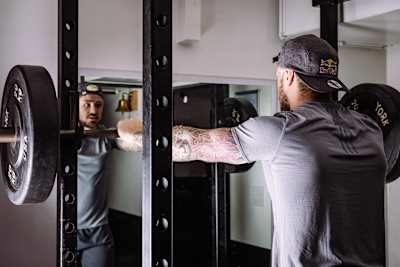
When it comes to working on your agility, and your ability to step out of trouble, Nowell says there’s one thing you can’t afford to ignore: leg day. But that doesn’t mean spending hours at the squat rack, and rather than training heavy, you need to train smart.

“A big thing is your leg power,” he says. “You can do as many running and speed drills as you want, but if you haven’t got any leg power, you’re not going to be able to bust through tackles or have the power you need off the floor. Building your leg power is probably the most important thing you can do as a winger.”
Building your leg power is probably the most important thing you can do as a winger
While strength is your ability to lift things, power is your ability to lift them fast. It stands to reason, then, that to work on your power you need to train at speed – in and out of the weights room.

“At Exeter, we do a lot of single-leg power bounds,” says Nowell. This involves jumping forward on one leg, aiming to spend as little time on the ground as possible.
“We also do a lot of single-leg squats," he explains, "and then when we’re out on the field we’ll use a ladder to build our reaction speed off the floor.” The classic ladder drill is the one you’ve seen in American football films: the fast-feet test whereby you run the length of the ladder, stepping both feet into each box as you go. There are others, though, that test different aspects of your agility. The single-leg shuffle, for example, is another effective way to work on your power. This involves running adjacent to the ladder, stepping your near foot in and out of each box while your other leg keeps pace.
How to improve your speed as a winger

To improve his speed on the pitch, Jack does a lot of running drills
© Exeter Rugby / www.jmpuk.com
Like agility, speed is something some are blessed with, but many more are not. However, while Nowell says “it definitely helps if you have some natural pace", there are ways you can quicken up.
“It’s definitely something you can train and work on,” Nowell explains, “and again a lot of speed work is done in the gym, building your leg power. Then you have to do your running drills, so a lot of ‘A’ and ‘B’ skips, knee drives and moves like that.”
These sorts of drills help boost speed by strengthening the link between your legs and mind, so you can recruit the correct muscles more quickly. They all help to improve muscular endurance, as well as range of motion. 'A' skips are performed by skipping forward, lifting your lead knee while keeping your standing leg straight, alternating legs as you go. 'B' skips are similar to 'A' skips, but include extending your leading leg out in front of you after you've brought it to waist height and before it strikes the ground.
