
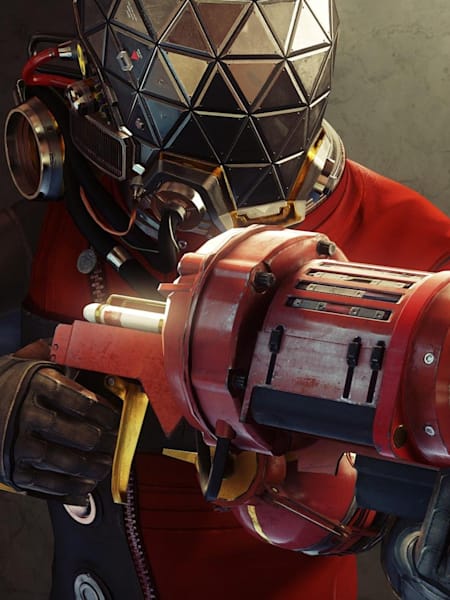
Games
Prey: All your favourite sci-fi movies in one game
We speak to Arkane Studios’ lead designer on how they brought a sci-fi nightmare to life.
To a host of gamers around the world, Bethesda Softworks and Arkane Studios’ Prey is the only game with that name that’s going to matter. Despite sharing the name with a 2006 release by Human Head Studios, the only thing the two share apart from the name is that they deal with aliens – this year’s title looks much scarier.
You won’t be able to detach your spirit from your body, nor will you be armed with a spirit bow, but you do have to survive being hunted down by terrifying aliens, as almost all of your favourite scary sci-fi movies are brought to life right here. Will you be the hunter, or the hunted?
Ahead of Prey’s launch, we spoke with Arkane Studios' lead designer, Ricardo Bare, about what the Prey name means for this game, alternate history, and why it’s essentially about a dungeon in space.

Planted in the space boots of a character named Morgan Yu (you can choose whether to be male or female), you wake up aboard a massive space station named Talos-1, and as Bare tells us, “[it’s] in the middle of an experiment to change humanity forever. Things quickly go terribly wrong, however, and you quickly realise that a species of alien has overrun the entire station.


“They’re called the Typhon, and in addition, they happen to be hunting you. You have no memory of how you got to the space station, why you’re a part of this experiment. And so, your immediate task is to figure out ‘what the heck am I doing here, how do I survive’. You’ve got to use your wit, your weapons and a host of really cool mind-bending powers.”
As the latest single-player first-person RPG adventure from Arkane, you might find a few similarities with previous titles the studio has created, such as Dishonored, Arx Fatalis, and it takes plenty of inspiration from System Shock, but distilled into one location, where you’ll be watching your back throughout. And that ties into the name, which despite having some connections to Human Head Studio’s game of the same name, Bare assures us nothing from that title has made its way into this year’s game. Nada.
“After we finished Dishonored, we wanted to work on another game, in addition to Dishonored 2, and one of the things we were most excited about was doing a sci-fi,” Bare tells us. “And we’re all big fans of games like System Shock and Deus Ex, so we started prototyping, and thinking about a concept that was set on a space station, for a sort of a lone survivor, hostile environment, open-ended game. It’s quite similar to a game we had worked on before, called Arx Fatalis, only that was a fantasy game. But it was the same kind of structure, where players were let loose in a dungeon and they’re free to roam all over the place.
“So Prey is similar. And at some point, Bethesda approached us, and was like ‘Hey, we have this name, does it fit your concept? It’s a really good name’, and we were like ‘sure’. It’s actually incredibly hard to name video games, because one word, clear, good names; the vast majority of them have already been trademarked and copyrighted.”
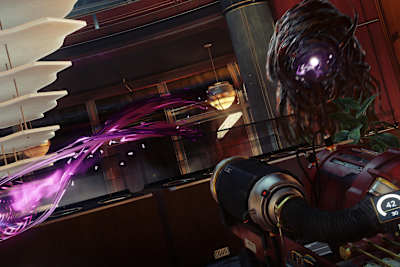
The Typhon look like formidable foes
© Arkane Studios/Bethesda Softworks
Again, System Shock comes up in our conversation, and for any sort of first-person RPG-esque title, it’s one title that has inspired plenty, with Deus Ex and Bioshock taking cues from it, and Prey is another that looks to draw from that same well – it’s essentially a spiritual sequel, right from the sci-fi setting down to giving the player several means of getting through the game.
“One way that Prey is different from Dishonored – and similar to System Shock – is that it does have a lot more of what you would call classical RPG elements. It has a grid inventory system, like you might find in Resident Evil, Deus Ex or System Shock.
“It has a pretty big skill tree that enables players to specialise when you begin the game, and you learn about all the ways you can upgrade your character, players can start to conceptualise their character, like, 'Ok, what kind of character am I going to play? Am I going to play someone who's more like a soldier? Or a hacker? Or someone who is sneaky? Like, what approach am I going to take in order to overcome these, really really difficult aliens,."
Along with a host of assorted weapons at your disposal, you’re able to tap into a set of supernatural powers, derived from neuroscience experiments that are divided into alien and human skills. From upgrading your jump or hacking skills, to taking on the powers of the Typhon, such as telekinesis, or, handily, turning into a chair. It’s not the same as BioShock, but you can combine your powers and create ridiculous set pieces that sound like they’d be ideal for watching on repeat on YouTube.
“Prey is open too," says Bare. "It's not a mission-based game. It's not like you have a mission, you go do that mission, you leave and you never come back. It's one huge space station, and the player has the ability to be like, 'You know what, the main story is telling me to go to this place, but I want to go back to this place, because I want to grab something, or there was something cool there that I left unexplored.’
“And the player can even go outside the space station, which is pretty cool and new. Players can circumnavigate the entire station; it's one big open world in zero g – it's super fun.”
We treat the world like another character
From the way Bare describes it, Prey’s space station setting evokes feelings of it being more of a space dungeon of sorts: different in look and feel to your typical fantasy dungeon, but similar in how you have one huge place to explore, with plenty of nooks and crannies to sink your teeth into and creatures to fight that differ as you get deeper and deeper into it.
“We have a poster on our wall – we have these little posters we made, inspiration posters of sorts we made to crystallise the values of the game – and one of them is called ‘space dungeon’. Because that's the idea. You know, Dishonored is this huge game that spans locations across an entire city, and Dishonored 2 even more so. So what we were doing with Prey, is actually, pick one location, and go super deep on it. One self-contained location, and that's sort of what the space station represents. Even though the space station is huge, and it feels like a big world, it really is like, let's focus in on, and go really rich on the details, and the lore, and the possibilities, if we really constrain this one game to this location.”
Despite being pinned down to this one locale, you can expect the Talos-1 to still be filled with all of the world-building flourishes that Arkane are known for, even if the world feels a little tighter.
“If you're the kind of player who loves playing games where you feel like you've really been transported to this alternate universe, there are layers and layers of cool environments and backstory and really interesting things to discover about the world. We treat the world like another character. It's a really cool place to explore
“That's one of our core values: make AI that has really interesting behaviours and patterns, and give the player a bunch of really cool, very flexible powers and weapons, and then we don't tell the player that the way to solve this problem is to do X, Y, Z,” he says, “It's totally up to you. It's the kind of game, your story is going to be different than my story, when we talk about how did we beat that really hard alien, or how we got past that one section… What's cool about that is that it makes the players feel like they own the experience; it lets you be creative as a player.”
And that’s the concept that helps to set it apart from plenty of other FPS titles which place more emphasis on huge multiplayer games, leaving the single-player campaign – if there is one – more as just an appetiser of sorts.
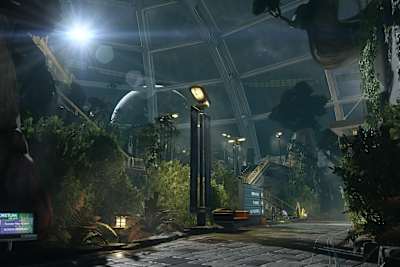
The space station Talos-1 is huge
© Arkane Studios/Bethesda Softworks
“Not many people are doing it,” Bare tells us, about making richer single-player first-person stories. “It helps us stand out, and one of our strengths is doing that kind of thing. But in order to make it worth the player's while, the thing that's cool about the kind of games we make, is that they offer a lot of replay value. You know, versus a very canned, scripted single-player campaign, if I was to play it again, I'd experience the exact same thing; if you played Prey again, you can play a totally different character, try out different things, as in one playthrough you can't unlock all the upgrades.
“You can't possibly make all the story choices. So you can start a new game, make a totally different character and make different story choices, go to different parts of the space station. I think that's one reason why our single-player campaigns offer a great deal of value.”
That said, Prey does have two main ways to end the game, but it’s not about how you finish up your space adventure – it’s how you got there. “What we've said is that the game can sort of be divided into two main ways to end the game, but there are also tons of little details along the way that alter things.
With the Typhon, we wanted to avoid typical sci-fi tropes
“It's hard to talk about without giving away too many spoilers; but you are one of the few survivors on the space station and occasionally you'll meet pockets of other survivors. And the way you treat them, the way you interact with them and how you decide to deal with them all have rippling consequences. They change things, sometimes in big ways, sometimes in small ways.”
The game’s alien enemies, the Typhon, look and sound quite creepy and Arkane wanted to set up their aliens as paranormal beasts that prey on you on a more mental level.
“Our design approach [with the Typhon] was that we wanted to avoid typical sci-fi tropes; humanoids with laser guns, or anything that was a bug-like creature, so we deliberately set up this theme of that they need to be paranormal, almost very mysterious and enigmatic, and even many of their powers, their game mechanics, all feed into that theme,” Bare explains.
”Mimics are able to camouflage themselves, Phantoms murmur with creepy human-like voices and shift around very quickly and hide from the player. Poltergeists are completely invisible and manipulate things with telekinesis and try to smash you with them.
“So a lot of them have a kind of 'I can't trust what I can see' vibe, but then the other thing is their behaviours are really interesting and connect with the game mechanics in cool systemic ways, which is what we like to do at Arkane. But, the behaviour I described with the Mimics, it's not scripted at all. The level designers do not script and tell them what to turn into; it's totally part of their AI.”
The world of Prey is very much like our own, but it’s set in the future, and the game world’s history took a different path. One difference is that JFK survived his assassination attempt, and spurred on his world’s advancement of space travel – but that’s not the only change you’ll find in Prey.
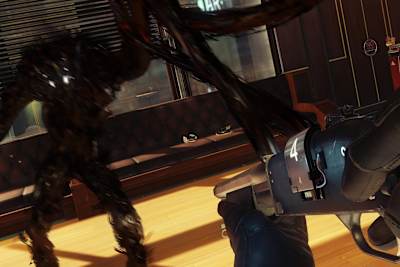
Phantoms are scary
© Arkane Studios/Bethesda Softworks
“That’s probably the biggest main change [in the world of Prey]; it's not quite the one event that everything ripples from, but it is one of the touchstones,” says Bare. “That’s one really great example of how the world in this alternative history has gone down a different road, or a slightly different road, to what we know. The other, of course, would be that the first few Russian satellites that the Russians launched encountered alien life. So that resulted in this collaboration between the US and the Soviets to try and understand it and contain it, which eventually led to the space station that you play through in the 2030s.”
“There are a lot of other details too; we love to sprinkle emails and books throughout the space station – if you've played Dishonored you know about that – all to flesh the world out. One of our designers thought it was interesting that they added a book that's written from the perspective of a fiction author who writes alternate history. Their version of fictional, alternate history is about the Vietnam War; so that implies that in the world of Prey, that war never happened.
“So there's all kind of little things like that, and if you're the kind of character that loves to read all of the notes and the books and the backstory, and pay attention to all the details in the world, you'll find all sorts of surprises in there,” Bare explains.


With the game having been in development for around three years, Bare is looking forward to seeing Prey rolled out to the masses and the reception it gets. One thing’s for sure, it’s going to be a weird and wonderful adventure, and one we have hardly seen before.
“We have been working on this game for a really long time, and I guess one of the greatest pleasures and privileges that I look forward to is just hearing about all the different ways that players use our game in ways we didn't anticipate or even expect,” he says. “I'm looking forward to being surprised by what YouTubers come up with and all the glorious ways they completely shatter our game.”
Prey launches on May 5 on Xbox One, PlayStation 4 and PC.
For more gaming coverage, follow @RedBullGames on Twitter and Instagram and like us on Facebook.

Assassin's Creed Black Flag Resynced
For the leap of faith.
How well do you know the Credo? Take the quiz, test your knowledge, and a unique in-game reward awaits those who complete the challenge.
