
Games
Follow the ping
There is an invisible force all around us. It benefits most of us, but for an elite subculture of gamers it can bestow superpowers, wealth and freedom. There’s one place where it exists in its purest
Frisco, Texas, is the last seven exits of the Dallas North Tollway. Around 50km from downtown Dallas, Frisco is where the line of suburban development – the office parks, bank towers, Whataburgers, and apartment complexes – begins to end, at least now. In between the new developments and construction sites are still bits and pieces of the old North Texas plains that have defined the region ever since the inland sea that once cut through North America receded into the gulf about 260 million years ago.
Around 1,200 years ago, the Caddo indigenous people moved west from the Mississippi River Valley and set up the first permanent settlements in this area, farming corn, squash and beans. Around 200 years ago, local cowboys built the first settlement of Frisco while driving cattle from ranches south of here up the Shawnee Trail and on to the markets in Kansas and Missouri, where they could make $30 to $50 per head. And since about 2020, young men from around the world have been quietly flocking to Frisco where, hidden away in mundane apartment complexes, they play Call of Duty: Warzone for up to 24 hours a day and earn incomes of up to $50,000 a month.
Call of Duty is a series of first-person shooter video games that began in 2003. In early 2020, the series released Warzone, a free-to-download battle royale game in which up to 150 players compete against one another on a single enormous map, in teams of four, three, two, or individually, depending on the game type. Because the game was simple to play, free (its revenue model is based on microtransactions for special character and gun skins, and other unlockables) and entered the market just before a pandemic would trap millions of people in their living rooms for months, it quickly exploded in popularity and became the predominant first-person shooter game played around the world.

Tommey during the $6,000 wager match against Jukeyz and HisokaT42 in Dallas
© Joseph Swide

Tommey, Almond, Jukeyz and HisokaT42 play in a two-on-two, wager match
© Joseph Swide

Almond during the $6,000 wager match against Jukeyz and HisokaT42
© Joseph Swide
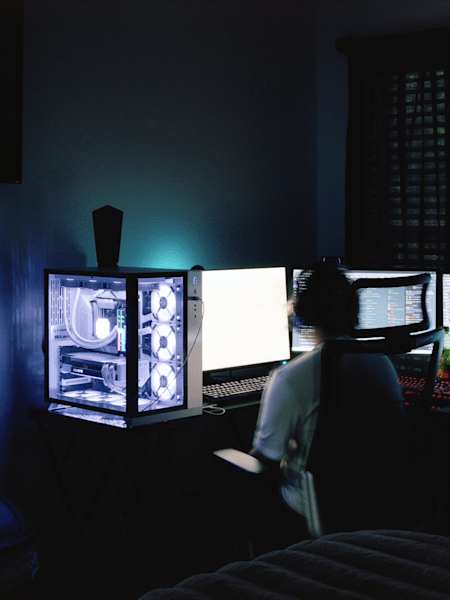
Flxnked and aHTracTXII live in a new apartment in a gated complex near the centre of Frisco. The apartment is clean and simply furnished: white walls, grey carpets, a stock image of a cityscape framed on the living-room wall, and a glass bowl of M&Ms on the kitchen countertop. From the back of a high-speed modem on the living-room floor, twin cables run into each bedroom where, next to neatly made beds, sit glowing computer set-ups optimised with dual monitors for simultaneous gaming, streaming, and communicating with fans.
Stretched out on the couch, aHTracTXII scrolls through local DoorDash [America’s Deliveroo] options – Chick-Fil-A, Shake Shack, Raising Canes – before narrowing in on an order of Five Guys. Although it’s 5pm, he’s only been up for a couple of hours, making it somewhat unclear what meal this constitutes, but with a $1,500 online tournament starting in less than an hour, this might be his only chance to eat for the next five or six hours.
A soft-spoken and boyish 25-year-old from Chicago, aHTracTXII has been a professional gamer since he began making thousands of dollars a month in Call of Duty tournaments as a 13-year-old. However, until his move to Frisco a couple of months ago, he’d never lived away from home. “I’ve never had a real job. I just graduated high school and continued gaming,” he says. “I love it. It’s freedom – streaming whenever I want, eating whatever I want, doing my own thing and being on my own. Well, with him, I guess.”
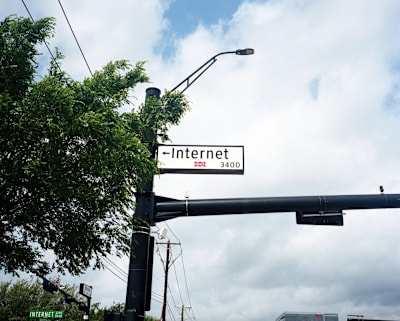
Servers industry: a street sign for Internet Boulevard in Frisco
© Joseph Swide
Flxnked moved from Minnesota to Frisco in early 2022. He grew up playing hockey until a knee injury as a teenager shifted his focus towards Call of Duty. In 2019, he received an esports scholarship to join the Call of Duty team at Davenport University in Grand Rapids, Michigan. However, when COVID struck, he dropped out of school and turned pro, hustling in the online community to gain access into the invitation-only tournaments that build the careers of elite players. “You’ll have months where you make zero dollars,” he says. “And then you’ll have months where you’ll make, like, $10-12,000 in one month.”
In a typical professional-level competition, two teams of two players each enter the game as one team of four. This way, they’re unable to kill each other, making the competition one in which each duo tries to rack up the most kills against the other players in the lobby. Therefore, unlike some esports in which players compete on a Local Area Network or LAN – where computers are linked in close proximity – or at the very least in private sessions, Warzone pros are competing on the internet in public lobbies against regular people who often have no idea at all that there are pros alongside them playing for thousands of dollars. This aspect of Warzone competition is what makes it accessible and relatable to the masses of viewers who watch these matches on streams, but it’s also a system that leaves the potentially lucrative income of elite professionals at the mercy of internet speeds. It’s this emphasis on internet speed that sets Frisco apart for players like Flxnked. “Anywhere else, the best ping you’ll usually get is like 15 [milliseconds],” he explains. “And here you get seven. You can even get lower sometimes. It’s absurd.”
For all of its invisible digital and wireless magic, the internet is essentially a vast physical network of servers, cables and modems that allow signals carrying information to travel between computers throughout the world. The speed by which information travels that network, either between devices or between servers and devices is referred to as ‘ping’ and is typically measured in milliseconds. There are essentially two major ways to shorten ping time. One is to improve the physical condition of the network itself so that information can move through it faster. For example, wireless internet is generally slower than connecting through physical cables, with fibre-optic cable networks being the absolute gold standard. But once speed is maximised through improving the hardware, the only other way of lowering ping time any further is by shortening the distance the information has to travel – setting up the computer as close as possible to the server.

‘0% packet loss’ requires an extremely strong internet connection
© Joseph Swide
Anywhere else, the best ping you’ll get is 15 milliseconds. Here, it’s seven. It’s absurd
Call of Duty’s servers are run by the game’s parent company, Activision Blizzard, and there are 29 dedicated Call of Duty servers around the world, with 12 in the US alone. While they’re located in various major metropolitan areas throughout the country – New York, Los Angeles, Chicago, San Francisco, Seattle, Atlanta etc – it’s known in the Call of Duty community that the Dallas servers, for whatever reason, provide the best ping times.
For the average internet user, latency or ping is often not very consequential – a slight delay in a video call or in live-streamed media. But for a gamer, every millisecond of delay in movement or reaction can have a tangible impact on the game. In Call of Duty, those milliseconds can be the deciding factor in landing a shot on an opponent before an opponent can fire a shot of their own. For the professional gamer who spends the majority of their waking hours playing wager games or online tournaments for thousands of dollars, this subtle advantage can mean the difference between never making it out of the stereotypical mother’s basement and living in a well-appointed Frisco apartment with a closet full of designer garments. If Usain Bolt could guarantee a 30-millisecond advantage in every race simply by living in an apartment in Frisco, Texas, it’s fair to say that he very well might be renting the unit next door, with his own bowl of M&Ms on the counter.If Usain Bolt could guarantee a 30-millisecond advantage in every race simply by living in an apartment in Frisco, Texas, it’s fair to say that he very well might be renting the unit next door, with his own bowl of M&Ms on the counter.
You’ll have months where you make zero dollars, then others it’ll be like $10-12,000
Exit 14 of the Dallas North Tollway looks not so different from the 13 exits before it or the 25 after it. But past the Mattress Firm and Dick’s Sporting Goods, behind the Post Office, and before the Planet Fitness – in the middle of yet another perfectly manicured office park – a towering black monolith contains what could be the source of Frisco’s mystical essence. The name on the building reads ‘Inwood National Bank’, but public records list the address – 13760 Noel Road – as the Dallas-area home of Activision Publishing, Inc.
“If I were a betting man, I’d put money on that being where the servers are,” says Alex Gill, a gaming specialist for Red Bull who has spent the last four years in the Frisco esports scene. “If they’re not there, they’re in a private building nearby. We know they’re in the Dallas area, but everyone says Frisco. I don’t have a source for that; it could be that [Activision Blizzard] just told some people and it started a rumour. But it’s tribal knowledge.”
When he was growing up, Gill says, Dallas always had a seemingly magnetic pull for gamers. “Playing in the late ’90s, the companies that developed these earlier games didn’t have dedicated servers. The way it worked was a player would set up a game, running it off of their computer as a server, or the developers would spin up [a session – enable an on-demand gaming server]. I remember Dallas was a place that a lot of them did spin up, because it’s centrally located in the US. Then, in the early 2000s, when online gaming started to ramp up, that’s when it happened.”
Whether it was gamers migrating to Frisco that brought the servers here, or the servers that drew the gamers, Gill says is a mystery. “It’s a chicken- or-egg question. There were a few teams already located here – Complexity Gaming [founded in 2003] brag about being the oldest esports organisation that’s still in operation. They’re owned by the Dallas Cowboys. Team Envy, historically one of the biggest names in Call of Duty, was here. OpTic Gaming won top three esports brand globally for a couple of years in various rankings. I don’t know if the servers were already in Texas at the time, but they moved here from Chicago and it made this triumvirate of three of the larger older esports organisations. I haven’t talked to anyone at Activision Blizzard, but to me that would be the reason they’d want to build servers not only in Dallas but in Frisco. I don’t think it’s a coincidence.”
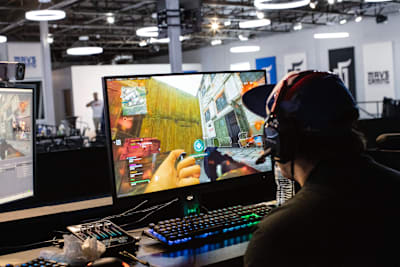
Jukeyz’s screen during the wager match
© Joseph Swide
Then, in 2020, a global pandemic changed everything. “Servers became much more relevant,” says Gill. “Previously, [Activision Blizzard] did all their events in Columbus, Ohio. All the teams played on a private local server at the venue, where everything is even. But COVID threw a wrench in the system, because suddenly they had to do the pro leagues remotely. That brought ping back into the equation.” The 2020 Call of Duty League World Championship, the first time the championship was held online, was won by the Dallas Empire.
“There was a bit of drama early on, where these teams in Texas were winning and everyone was saying, ‘Oh, that’s just because the servers are in Dallas. You’re not really better than us.’ Then a weird thing happened: a bunch of the pro teams’ rosters all moved to Frisco. Their organisation operations stayed in LA, New York, wherever, but the rosters moved to apartments and houses in Frisco to be closer to the ping. I don’t think results changed that much, but that was a moment where the teams maybe recognised how important the ping was. When we really became a kind of a Call of Duty mecca for pro players.”
Today, however, the Inwood National Bank building isn’t giving up its secret. It’s the weekend and the office is closed. The sun is blazing, and the only person around is a guy across the street, quietly cleaning out his car.
On a hot Saturday afternoon in the Deep Ellum section of Dallas, the city’s young, beautiful, and well-dressed pack the sidewalks outside the neighbourhood’s bars, restaurants and music venues as cars and motorcycles cruise the streets, creating a soundtrack that ranges from country to drill to Mexican corridos. A block from the main strip, in the air-conditioned calm of a converted industrial space that now houses the Dallas Mavericks Gaming Hub – a sleek esports venue funded by the city’s NBA franchise – Gill and a few staffers work quietly in the otherwise empty space to set up computers, monitors and an enormous projection screen for a Warzone match later that day. It will be between four of the top players in the world, who will be competing online in lobbies among the general public, for a wager of $6,000. As the staffers finish the set-up and run their first online test of the game, the computer reports a theoretically impossible ping of zero milliseconds.
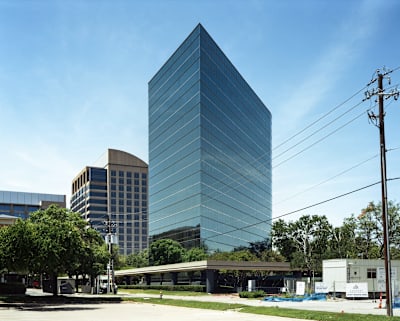
Stone Tower in is the presumed home of Dallas' Call of Duty servers
© Joseph Swine
The headliner for the day’s match is Jukeyz, a professional from Liverpool with more than $200,000 in career earnings from Warzone, which makes him one of only two Europe-based players on the game’s top 10 earnings list. Due to the effect of transatlantic distance on ping speeds, Europe-based players are at a significant disadvantage when playing a US-based game against US-based players on US-based servers. Jukeyz’ position on the earnings list despite this handicap speaks to both his talent as well as the reason for his visit to North America, and Dallas in particular. While officially he was on a 12-day, three-city US tour to build his audience and grow his brand, a welcome bi-product of his time in the States was being able to play every day with better ping and win more money. And the centrepiece of his stop in Dallas was a match against two of the best players in the world – together, the best duo in the world – Frisco residents Almond and Tommey.
Another Minnesotan transplant to Frisco, Almond is a 23-year-old phenom who, according to esportsearnings.com, earned more than $250,000 from Warzone in 2021 alone. Tommey, a 29-year-old from England who recently moved to Frisco as well, is currently the top earner of all time in Warzone, with listed winnings totalling more than $400,000.
Jukeyz’s playing partner is HisokaT42, a teenager from South San Francisco, California, who had been a junior college football player until he figured out he could make $50,000 a year playing Warzone. His dad – whose equally imposing physique and youthful energy makes him seem almost like a big brother – has come to support his son’s rising star with the same intensity as if this were the sideline of any major professional sport.
As they enter the Mavs Gaming Hub for the match, Tommey is wearing Balenciaga, while Almond carries a Gucci bag. HisokaT42 is draped in Burberry, and Jukeyz removes the Rolex from his wrist as he sits down in the gaming chair, takes a hit from his asthma inhaler, and the four men start the match.
In the best-of-five series, Almond and Tommey quickly take the first two games and thus gain control of the match, before Jukeyz and HisokaT42 manage to pick up a win in the third game and stay alive in the series. In the fourth game, HisokaT42 reaches what athletes in traditional sports would refer to as a flow state. In person, it looks like a man sitting frozen in a chair, staring unblinking into a screen, completely detached from the world around him. But on the screen, the seizure-inducing speed and agility with which his virtual avatar moves through the map, and the lightning quickness of his reflexes and reactions to every potential target or threat, are almost impossible to track.
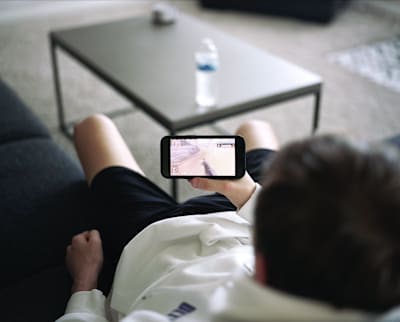
Flxnked watches the stream of an online tournament
© Joseph Swine
“There are questions over how much ping really impacts the outcome of these matches,” comments Gill. “To a point, of course, it does matter, like if it’s really slow. But there’s a threshold where it doesn’t necessarily impact performance. If somebody has a 30 ping and another has a 10 ping, that’s 20 milliseconds advantage, but there’s another area being studied inside gaming and that’s human physical response time. There are players that have absolutely the fastest reaction time, but there are also players at the top that I might even have a faster reaction time than. However, they’re better because they’re actually able to predict the future – they’re inside the heads of their opponents.”
In a fast-paced, instinctual game like Warzone, the best players employ a technique called ‘pre-firing’. “You literally start shooting before you even see an opponent, predicting where they’re going to be,” explains Gill. “The players entering that flow state are going to end up winning, no matter what. That being said, you still have that 20-50 millisecond advantage. I might not be able to feel it, but they can.”
HisokaT42 racks up 35 kills and evens the series as his dad’s celebration booms across the venue. Although he and Jukeyz lose the fifth game, and with it the $6,000 wager, the performance dominates the post-match conversation, exemplifying the mystical lure of Dallas for Warzone players. Eliminating every millisecond creates the potential for moments in which the distance between the gamer and the game disappears, and every mental impulse is translated directly into virtual action.
For devotees of Call of Duty, there are other places in the world with Activision servers or high-speed internet. But there’s nowhere else like Frisco. Whether housed in an immaculate climate-controlled suite or a humble closet maintained by a lone IT guy, the ping is here. And while it might be nice to get a peek at these holy servers, the magic can’t be understood simply by looking at a couple of objects inside the Inwood National Bank building. It’s far more evident in the 25-year-olds from Chicago leaving home to spend all their waking hours in dimly lit suburban apartments, the 23-year-olds from Minnesota with closets full of Gucci and Balenciaga, and the Liverpudlian crossing the Atlantic to team up with a 19-year-old South San Franciscan just to experience this unadulterated gaming fix.
As the rest of their travelling party head-off for dinner and drinks, Jukeyz and HisokaT42 stay glued to their screens late into the night, savouring their last tastes of Dallas internet to win back their money in online wager games. Eventually, they’ll meet back up with the group at a nightclub in time for the VIP booth and bottle service.

