
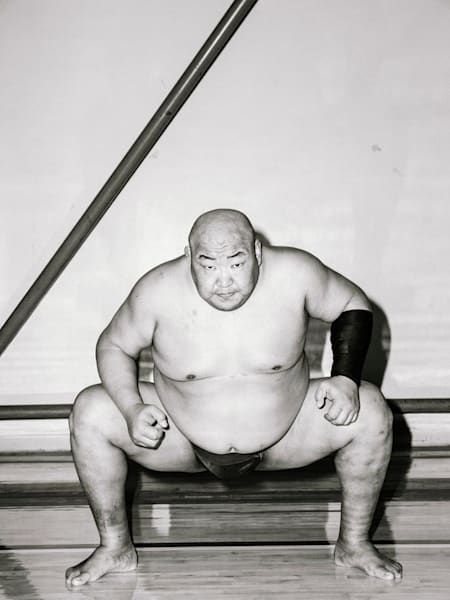
Meet the sumo wrestlers competing in this year's US Sumo Open
US Sumo Open competitors share their views on the changing face of sumo, as it grows in global appeal.
Practised for more than 2,000 years, sumo is still Japan’s national sport, but no longer its exclusive field of mastery. International competitors have muscled in, forcing the country’s wrestlers to push harder for a place at the top. Nowhere is this more evident than at the largest contest outside Japan: the US Sumo Open.
Viewed from the bleachers, the three sumo squatting on the basketball court below look like oversized tan beach balls. It’s an unusual juxtaposition. After all, this is California – the arena of California State University Long Beach, to be precise.
Built in the shape of a pyramid that mirrors the clement sky, this 4,000-seater is home to the Long Beach State 49ers basketball and athletics teams. The interior of the Walter Pyramid is festooned with gold and black banners reading ‘Go Beach’, there’s a stall selling kettle corn, and, whichever way you turn, vendors are ready to furnish spectators with hot dogs and oversized sodas. In short, the place is as American as apple pie.
All of which makes the two Japanese and one Mongolian sumo all the more conspicuous as they warm up against the polished wood and black markings of the basketball court. The three athletes are Byambajav Ulambayar, a 1.84m-tall Mongolian and former sumo pro; the 1.92m-tall Hiroki Sumi from Japan; and, standing at 1.7m, the relatively diminutive Takeshi Amitani, the former five-time Japanese National University Champion. What brings them to town on this mid-March afternoon is the 19th annual US Sumo Open – the largest and longest-running sumo event outside Japan.

Takeshi Amitani
© Jeremy Liebman

Byambajav Ulambayar
© Jeremy Liebman

Hiroki Sumi
© Jeremy Liebman
Collectively, its participants have amassed 18 World Sumo Champion titles and travelled from as far afield as Japan, Mongolia, India, Egypt, Tajikistan, Georgia, Ukraine, Norway and Germany. If the eclectic make-up surprises you, it shouldn’t. More than any other sport, sumo is a tradition in transition. In Japan, the best national wrestlers are regularly bettered by a new influx of Russians, Mongolians and Ukrainians – nations that have proudly adopted its national sport and set out to dominate it.
So great is the impact of non-Japanese in sumo that in 2017 Japan celebrated its first yokozuna (the highest rank) in almost 20 years: Kisenosato Yutaka. But when Yutaka retired this January, at the age of 32, a brace of Mongolian wrestlers were competing for the top spot. This development is indicative of the changes happening across sumo. In short, sumo is a heritage in the midst of being reimagined and remoulded to fit the tastes of a wider, global audience. And nowhere is this more evident than at the US Sumo Open.
Worth the weight
Two days before the 19th US Sumo Open is due to begin, The Red Bulletin arrives in Long Beach. Inside the Walter Pyramid, sheltered from the bright sunlight, we find some of the event’s most famous competitors weighing in. Ulambayar, the 35-year-old former pro, tips the scales at 161kg. "I’m so skinny,” he jokes.
As Ulambayar dons a purple floral gown and paces around with regal grace, 29-year-old Sumi clutches his plentiful stomach in his hands and climbs onto the scale. At 220kg, he will be one of the heaviest sumo to compete in the competition. At 100kg, 26-year-old Amitani easily makes middleweight class. As Ulambayar attempts to score a basketball with a balled-up towel, Amitani and Sumi form a little-and-large double act, with the former translating our questions for his towering counterpart.
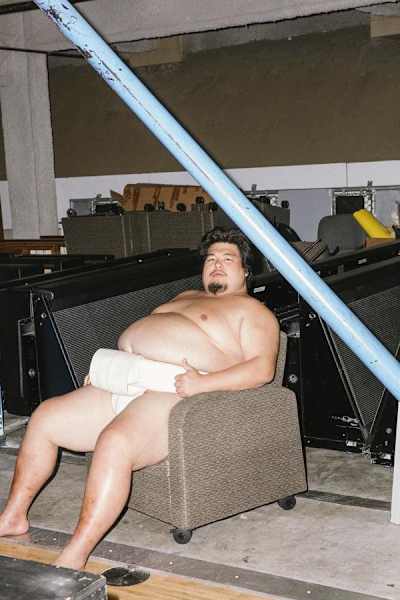
At 220kg, Sumi is one of the heaviest competitors
© Jeremy Liebman
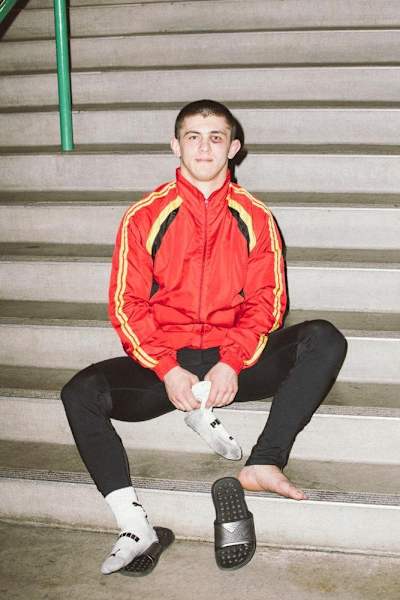
Perpetually beaming, Sumi – who, in 2018, fought in a one-off WWE Greatest Royal Rumble – resembles a Japanese version of Dustin from the Netflix series Stranger Things. Amitani, meanwhile, is handsome and muscular with swept-back hair and a cauliflower left ear, one eye partially closed from injury. "I train very hard,” Sumi says through Amitani. "I bench-press 90kg, shoulder-press 60kg, and leg-press 140kg.” He acts out the movements as he speaks, fleshy limbs bunching up. He points to his right knee, where an angry, jagged red line of scar tissue is visible. This, Sumi says, has put paid to his deadlifting and squatting days.
Amitani’s routine is similar. Back in his college days, he wanted to bulk up, so he mainlined sushi, ramen and the sumo staple chanko-nabe – a relatively healthy stew loaded with proteins such as chicken, tofu, meatballs or fish, plus starchy rice or noodles, and veggies including bok choy, mushrooms, daikon (white radish) and carrots – to build himself into heavyweight shape. Now, as a middleweight, he includes running in his regime.
Sumo is the hardest sport in the world. It's just brutal
Last night, the three sumo enjoyed a barbecue at their hotel. "We had 5-6kg of meat,” smiles Ulambayar. It was clearly a welcome change from chanko-nabe – to build the body shape needed for top-flight sumo, the likes of Ulambayar will shovel down industrial quantities of the stew on a daily basis. Dinner, meanwhile, comprises lighter fare such as fried mackerel, noodles and salad. And because sumo is a 365-day sport without competitive seasons, the diet of a professional wrestler remains the same all year round. All of this feeds into the typical Western image of the sumo as an obese but muscular athlete.
Many sumo – especially the Ukrainian competitors – come from a more traditional wrestling background, but packing on as much mass as possible is essential for the heavyweight stars of the show, not just to add to the spectacle but to make themselves an immovable weight. The heavier you are, the harder it is for your opponent to shift you from the ring.
Training with opponents who weigh in excess of 160kg makes match preparation easier, too: try to stop one of them and your legs will quickly develop the strength necessary to withstand their onslaught in the ring. Sumo can grow so large that a 1994 study by sports scientists from four Tokyo universities – conducted to determine the upper limit of fat-free body mass in humans – found that the average competitor’s body is 26.1 per cent fat, as opposed to a bodybuilder’s 10.9 per cent.
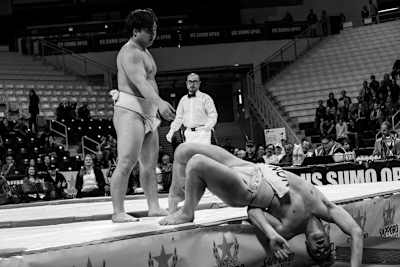
Amitani dispatches an opponent in the men's middleweight rounds
© Jeremy Liebman
But to be classified as a professional sumo involves more than just a big appetite; it requires dedicating oneself to a sumo stable in Japan and training day-in day-out to compete at the highest level. Anything outside of that is considered ‘amateur’. While Amitani was only ever a collegiate sumo wrestler in Japan, both Sumi and Ulambayar competed as professionals. Now, all three live in California and, as such, are arguably the face of the sport outside Japan.
With sumo now recognised as an Olympic sport (though still not on the programme for Tokyo 2020), their services are more in demand than ever. When he isn’t competing, Amitani teaches in a nearby dohyō (ring) and regularly performs for television, expositions and conferences, as does Sumi. Ulambayar, meanwhile, came to the US in 2007 to appear in the film Ocean’s 13, and he hasn’t looked back.

But the US Sumo Open is not just another expo for these wrestlers – as well as being the most prestigious competition outside professional sumo, it’s also a way to keep their hand in alongside foreign competitors. Ulambayar has taken the top spot in the heavyweight class 10 times since 2007, while Sumi won 234 matches during his professional career in Japan. "Sumo is very simple,” Amitani translates for Sumi. "There are many people who respect what sumo is, so I don’t mind if non-Japanese people compete. Sumo is still a minor sport, and I want it to be more popular. I was a professional for many years in Japan, but I wanted to show my techniques to more people. That is why I came to America."
Our resident Mongolian, Ulambayar, is a man of few words but deep insights. "I love my sport,” he says. "In America, it’s a growing sport. The competitors are getting stronger and learning a lot. I think they respect the culture. It’s difficult to fight the guys who haven’t been professional. With a professional, you know their moves. Others come from different sports, like judo, so we don’t know how they will move.” He shrugs. "But I’ll handle it.”
Brawn in the USA
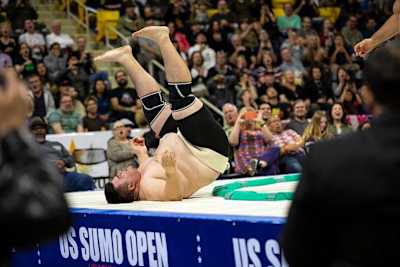
US hopeful Jose Galindo takes a tumble in the men's heavyweight final
© Jeremy Liebman
While the former pros are feeling strong, there are a whole host of American-born sumo eager to make their names known. Lightweight Andrew McKnight is a wiry, kinetic Californian native. "I’ve always wrestled, and sumo was just something to do,” he says. "I think a lot of guys hope to be a professional boxer or MMA fighter, but once you accept that isn’t going to happen, this is a good step down."
Feeling inspired a year ago, McKnight built a ring in his backyard and has been practising with his roommates ever since. This will be his first competition. "I love the traditional side,” he adds. "In my mind, sumo is like American professional wrestling, in that it’s a theatre show. It’s nice to see something where the old ways are respected, even if they no longer make much sense.”
Heavyweight Jose Galindo, meanwhile, got into sumo after watching Ulambayar body-slam an opponent on YouTube. Born and raised in Utah and Los Angeles, Galindo used to play semi-professional football. He’s now a chiropractor by trade and appears for his weigh-in covered in red cupping bruises. Like McKnight, this will be his first tournament. "I started participating a month and a half ago,” he says. Now, having filled in the entry form and paid the $30 fee, here he is. "It’s been a baptism of fire,” Galindo admits.
Not every American competitor will be making their debut, however. Heavyweight Kelly Gneiting is a legend in the sport and has claimed the US national championship five times. Gneiting, who weighs in at 197kg, originally got into the sport after becoming too heavy to compete in Greco-Roman wrestling. Now 48 and sporting a grey beard, he’s also the only competitor here to have competed in the very first US Sumo Open in 2001.
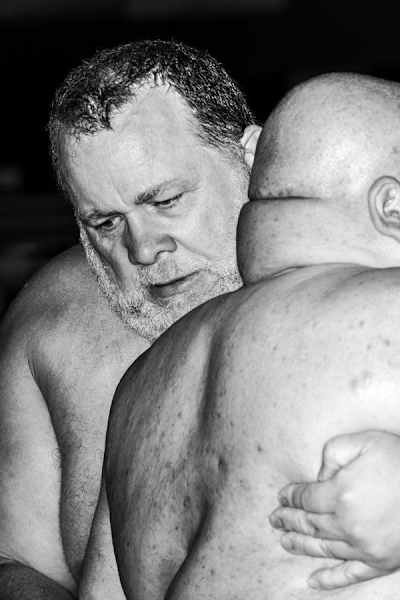
America's Kelly Gneiting (left) grapples with a fellow contender
© Jeremy Liebman
"The highest truths are hidden from people,” he says, philosophically. "One is that sumo is the hardest sport in the world. It’s just brutal.” He recounts a story of how, during his time in Tokyo in 2004, he was beating a champion when the president of the sumo team gave his opponent a signal, which led to Gneiting taking a palm to the eye. "You don’t do that in sumo,” he says. "It felt like the kitchen sink had fallen on my head. Things they wouldn’t stand for in the US or the UK, over in Japan it’s normal.” He claims that the Japanese team didn’t like a foreigner muscling in on their sport – an attitude that Gneiting says was once widespread in professional sumo. Over the years, though, he believes the Japanese have learned to "release their baby”.
Slapping, leg-sweeping and pulling the belt are allowed; punching, kicking and hair-pulling are not
Andrew Freund is the founder and organiser of the US Sumo Open and has the frantic energy of the sleep-deprived. Having spent time in Japan in the early ’90s, Freund began putting on sumo events in California as a hobby, before organising the first US Open in 2001. The mix of competitors, he says, has traditionally been 50 per cent American, 50 per cent foreign. And 90 per cent of the time it’s the foreign competitors who end up on the podium. "The US is a little behind the curve in terms of international amateur sumo,” he shrugs.
Freund explains that the dichotomy between Japanese and non-Japanese sumo is not really the focus of division in the sport; the largest contrast is between professional and amateur sumo. "Professional sumo in Japan is its own entity entirely,” he says. "When you join pro sumo, you don’t have a vocation, you don’t have a holiday, you don’t have your own place. You wanna go somewhere for a day? You have to check with your coaches. Most of these guys are training 365 days of the year. It’s not like [American] football where you have a season of three [or four] months, then a down season with free time."

Ulambayar, he explains, was a professional sumo for five years. During this time, he got to see his family only once. "Once you’re pro, you can’t do anything else. And once you retire, you can’t go back.” But not everyone who practices sumo in Japan does so within the rigid confines of its heritage – far from it. "Tens of thousands of people practise sumo in Japan,” Freund says, "but there are only 600 to 700 ‘pros’.” The others practise sumo like you might play football. There are elementary-school teams, company teams, regional teams, salary men competing after-hours. You might see the Nissan team squaring up against the Toyota team, for example. "It’s not about sumo inside and outside Japan,” Freund says. "It’s about pro and amateur standards in Japan and worldwide.”
In terms of the Japanese response to non-Japanese competing, Freund admits reactions are mixed: "On the one hand, there are some purists who say we’re diluting and corrupting the sport, that these guys don’t know the concepts of honour and Japanese tradition.” Despite this, there is an official moratorium on foreigners joining professional sumo stables, with just one allowed per team. "There are 700 pro sumo on 35 teams, which means no more than five per cent of them can be foreigners,” Freund says. "That’s pretty damn strict. If you lifted that ban, you’d have 7,000 Mongolians pouring into pro sumo tomorrow.”
Others, meanwhile, think the influx of fresh blood into the sport encourages Japanese sumo to train even harder. And Freund believes that the Japanese unreservedly support foreign participation outside the country. "It’s the Japanese national sport, foreigners are learning it, and [the Japanese] take pride in that. Foreigners are learning Japanese culture and techniques. It’s an inevitable thing once a sport becomes popularised – people will want to do it.”
Lords of the ring
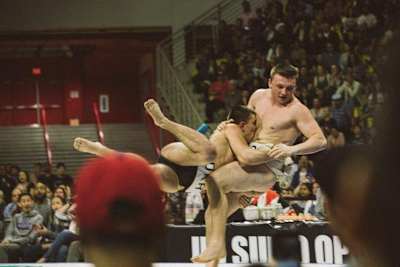
Karachenko and Semykras battle in the men's lightweight final
© Jeremy Liebman
It’s competition day. The 4,000-strong audience is hunkered down with bento boxes and cans of Sapporo as ritual taiko drummers perform. These Japanese accoutrements aside, this could be the crowd for any traditional American sport: eclectic and not shy of verbalising their enthusiasm.
By the dohyō, a Japanese referee in a white shirt, bow tie and gloves calmly officiates. Matches frequently last as little as 10 seconds before being won by the first wrestler to either knock down their opponent or force them out of the circle. There are 82 recognised techniques for doing this, most of which involve pushing or throwing. Slapping, leg-sweeping, and pulling of the belt (mawashi) are allowed; punching, kicking, and pulling of the hair are not.
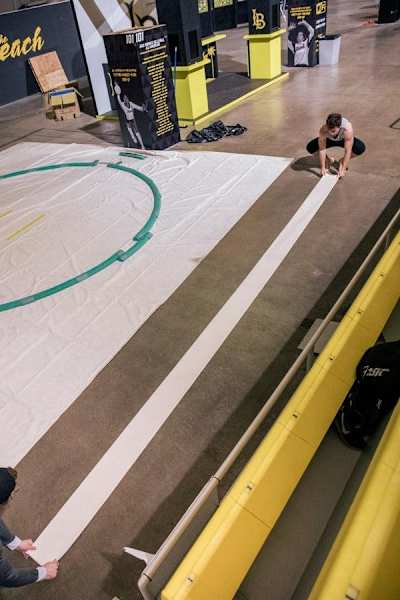
Andrew McKnight prepares his sumo belt – mawashi – for his first tournament
© Jeremy Liebman
Beneath the bleachers, the sumo await their matches. Some sit wrapped in towels, others chat among themselves. The Ukrainians – an unusually muscular group – are sequestered in a corner, warming up. Some competitors alternate between practising moves and napping. McKnight has taken himself off to perform some Jedi-esque stretches. Ulambayar waits calmly in his purple gown, eating. The Norwegian team – all blond hair and matching tracksuits – have set up their national flag in a corner, like some makeshift Arctic base camp.
The men’s lightweight matches are over in a flash, with McKnight and the 12 other US competitors quickly ejected from the dohyō and the tournament. At the climax, Ukrainian Sviatoslav Semykras launches himself at his opponent’s chest and, with a half somersault, sends him flying into the crowd before landing neatly on his feet to claim gold. Not for nothing are the Ukrainians revered in this sport.
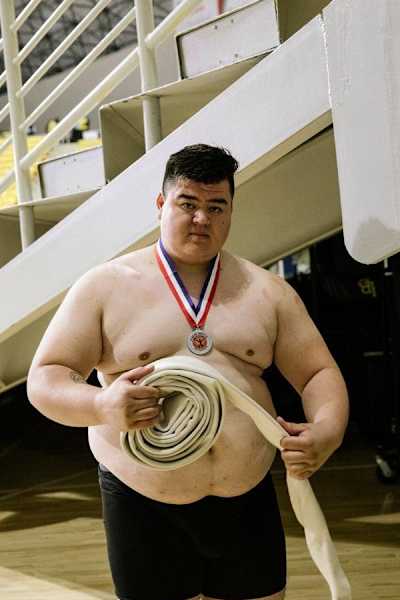
Sviatoslav Semykras takes the men's lightweight title
© Jeremy Liebman
The men’s middleweight competition offers few surprises. Amitani is the clear master of his class. While others grapple and shove, the Japanese wrestler deftly sidesteps, tussles and pushes, using his opponent’s weight against him to claim the top spot, his second win in three years.
It’s the men’s heavyweight competition that most spectators have been waiting for. Next up is Ulambayar, squaring up against the Egyptian Ramy Elgazar, US Sumo Open champion in 2015. A sumo match begins when the two opponents rest both fists on the floor of the dohyō, and Ulambayar and Elgazar revel in the element of theatre by placing just one hand down, then standing up, stretching or walking around the ring when the other’s knuckles hit the floor. When they finally clash, the Egyptian knocks the Mongolian down and out. It’s only Ulambayar’s seventh loss in more than a decade of US sumo matches.
Newcomer Galindo’s tournament looks set to come to an abrupt halt as he squares up against Gneiting, but then, all of a sudden, the veteran is out of the ring and Galindo stands victorious. It’s an incredible result for someone who admits to having trained for only a few months.
Galindo’s next opponent is Sumi. They grapple for a while, then Sumi goes down. The referee, believing the American’s foot left the ring first, awards the match to the Japanese wrestler. The crowd boo. A replay is checked, the panel of officials consulted. The result is reversed and Galindo wins, beating his second world champion in two matches. As Sumi sits serenely, the victor gees up the crowd with his arms. "I’ve been to Super Bowls, NBA finals, and this is more fun than all of them!” says an audience member.
Sumo is very simple... People in Japan don’t mind when Japanese sumo don’t win
Eventually, with every favourite eliminated, Galindo faces off against Oleksandr Veresiuk in the final, but succumbs to the onslaught of the Ukrainian. Resigned to second place, a beaming Galindo shakes his opponent’s hand. “I feel good,” he enthuses afterwards. "Going up against Hiroki was amazing. I didn’t think I’d beat him – I was just hoping to tire him out.” His confidence newly bolstered, Galindo wants to continue to compete in sumo. If today’s performance is anything to go by, he could well be America’s best sumo athlete since Gneiting.
Jose Galindo of USA takes second place in the heavyweight tournament
© Jeremy Liebman
As the day’s competitions come to an end, the Ukrainians have emerged victorious in every category – both men’s and women’s – except men’s middleweight, which Amitani claimed for his home country, the originators of the sport. Results such as these are becoming commonplace, but Amitani appears to bear no ill will towards the foreign usurpers, believing instead that the increase in popularity is good for sumo. “I think it’s great,” he says. “Sumo is very simple, and many people can enjoy doing it. People in Japan don’t mind when Japanese sumo don’t win.”
Perhaps, then, the influx of foreign talent into the sport does not represent a dilution of sumo’s traditions, but rather a widening of its parameters – and people’s perceptions – making for a more inclusive sport. "In America, they see sumo as two fat guys belly-bucking, and they think it’s funny,” Gneiting says in parting. “But sumo is a legitimate martial art, and nothing could be further from the truth.”
For more information, click here
