
Running
How a girl from a remote Nepali village became a world-class trail runner
At just 14, Mira Rai ran away from home to fight in a war. Now she’s running to champion the women of her country.
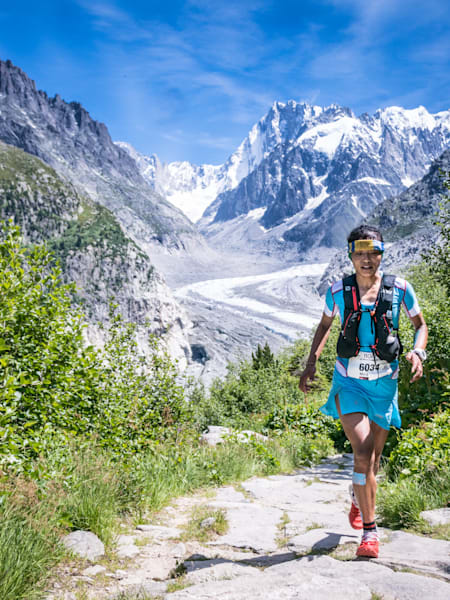
In June 2015, Nepalese trail runner Mira Rai was the women’s winner of the 80km du Mont-Blanc – a gruelling ultramarathon through the French Alps. The athlete, then aged 26, was running her first high-profile European race, and she triumphed by 22 minutes, smashing the 2014 winning time by six minutes.
Sixteen months earlier, Rai didn’t even know what an ultramarathon was; 10 years before that, at the age of 14, she’d left her home village in the Bhojpur district of eastern Nepal to become a child soldier in the Nepalese Civil War. Just eight weeks before the Mont-Blanc race, her country was devastated by the Gorkha earthquake, which killed almost 9,000 people. As she crossed the finish line, Rai pulled out her country’s flag and held it above her head – an image of hope for Nepal that was beamed around the world.
Rai’s story is one full of optimism. She joined the Maoist revolution as a teenager not to take sides but for a better life than other women in her village were afforded. When the war ended, Rai wanted to stay in the army, but she was denied because, at 17, she was still a minor. Her new career presented itself in 2014, after a chance encounter with two runners. They invited her to compete in the Himalayan Outdoor Festival 50km race, and although she had no idea what it was and had never run that distance, Rai took part – and won. It was to be the first of many victories.
Now, Rai wants to help other Nepalese women take up the sport and, with it, control of their own lives. “Running makes me happy,” she says from her current home in Nepal’s capital, Kathmandu. “When you’re happy doing whatever you do, pain becomes secondary.”

16 min
Mira Rai: the girl who runs on happiness
Mira Rai chose her own path, a path that led her to becoming a symbol of hope when her country needs it most.
The Red Bulletin: Your story seems larger than life…
Mira Rai: It doesn’t feel larger than life. I’m just an ordinary woman from Bhojpur, fighting to do the right things for the upcoming generation of aspiring trail runners in Nepal. I’ve got a long way to go. I get my motivation from people around the world, and my family.
When you were growing up, how did you view your future?
My village is very remote. Running was not an option, though I used to run up and downhill every day for my household chores. I always had a dream that had I been from a different place and had an urban life, I could have studied, gone to a good school, pursued a career. After being disqualified from the army, I enrolled to study; two years later, I [graduated from] secondary school.
You joined the army at 14...
It wasn’t a choice. I forced myself into the PLA [People’s Liberation Army] in the hope that my family would get a better future, but my time there was happy. In camp there were a lot of activities; I was introduced to running as a sport.
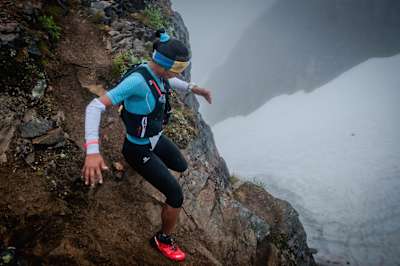
Mira Rai racing the Hamperokken Skyrace in 2015
© Angel Enguita
The Himalayan Outdoor Festival was your first ultramarathon…
I had already participated in a 21km road half-marathon, but I collapsed 400m before the finish, due to the heat. For the Himalayan Outdoor Festival, I wasn’t aware of the route or the distance – I was just invited by some Nepalese Army runners. I had no expectations. I just kept running and running and came first.
You weren’t even wearing proper running shoes…
No, just casual shoes I’d bought at a good price. I got blisters all over my feet, and the shoes were torn apart.
Watching you run, even in competition, you seem so calm…
I move easily in the mountains – the steep hills remind me of my childhood. When you’ve run in the Nepalese mountains, it’s easier to run anywhere else. But if I go to a flat place, I’m less comfortable.
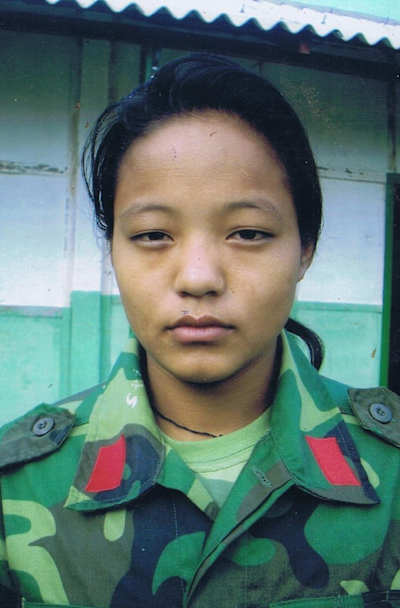
Mira in her Maoist uniform
© Mira Rai
How did it feel to compete in Mont Blanc soon after the earthquake that devastated your country?
I was not mentally stressed, but mentally strong. I always thought I could do my best. I was delighted afterwards – not because I’d won the race, but because my win was for all the Nepalese around the globe. I was happy I could get a medal for our country in that dire situation.
I want to give them a platform: English classes, a college education, physical fitness training and therapy.
Today, you’re far more than a runner – you’re an activist…
I’ve started the Mira Rai Initiative, an organisation that helps Nepal’s aspiring female runners. It was born from my own experiences of growing up in a remote village, being a Maoist fighter and struggling in the city. I want to give them a platform: English classes, a college education, physical fitness training and therapy. Each year, we take in five female runners. We’ve already completed two groups.
What are the challenges in bringing women into sport?
Convincing the parents is the toughest part. Also, making them aware of the positive outcome if they take it seriously. We’ve sent a couple of runners – Sunmaya Budha and Humi Budha Magar – to take part in international races in Hong Kong, Japan and Oman, and they’ve won. That’s an achievement.
Watch Rai’s story in Red Bull’s The Way of the Wildcard series at redbull.com; miraraiinitiative.org


