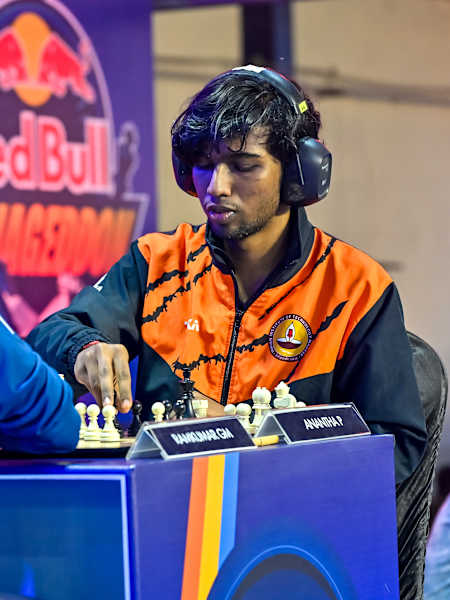
Climbing the ranked ladder in chess is much like climbing the ranks in your favourite competitive game. Here's how Elo works, what your rating says about you and how to use it to track your progress.
If you've ever climbed from Silver to Gold in Valorant or ranked up in Tekken 8, you know the feeling. Each victory will move you up the ladder, while each defeat will take you back down, and the rank will indicate your approximate position on the ladder.
Chess works in much the same way. Ratings help players understand their competitive level, find opponents of similar ability and track their progress. But how does the Elo system actually work?
Elo is a number that estimates how strong a chess player is compared with other players. The higher the Elo, the stronger the player usually is. It does the same job a ranked score does in games: compare levels, find fair matches and track progress. Rather than reflecting a single result, your rating evolves as you play.
Elo is not limited to chess. Its rating method has also been adapted for sports such as football, including FIFA rankings, and competitive games such as Counter-Strike through FACEIT and Age of Empires. Some games use modified Elo systems, while others use different rating methods.
Many gamers casually call any matchmaking rating 'Elo', even when the system is not actually Elo. The same applies to chess, where not every online platform uses the original rating system.
02
What does your chess rating actually mean?
Your rating gives you an idea of your playing strength. It doesn't show how well you played in one game. Instead, it estimates how you might perform against other players over a period of time. So, what do numbers like 800, 1200 and 1600 actually mean?
Rating
What it means
800
Beginner player. You are learning basic tactics, openings and common checkmate patterns.
1200
Developing player. You understand basic strategies and can spot common tactical opportunities.
1400
Improving tournament player. You have a reasonable understanding of chess fundamentals and make fewer basic mistakes.
1600
Strong club-level player. You understand common plans, tactics and positional ideas.
1800
Advanced club player. You can calculate more accurately and understand more complex positions.
2000
Strong competitive player. You have good tactical and positional understanding.
These are rough guides, not official FIDE titles or fixed skill categories. Your playing strength can also look different depending on the rating system and time control.
A 1600-rated player on an online platform is not necessarily equal to a 1600-rated FIDE player.
Anything can happen over the chessboard, regardless of Elo rating
Just as a high rank doesn’t automatically guarantee victory in every video game, a high Elo doesn't mean you can't lose to a lower-rated opponent. You still have to play it out.
03
How do expected and actual scores change your rating?
Before a game, Elo looks at both players' ratings and calculates their expected scores. Expected score is the average number of points a player is expected to score over many games against an opponent of that rating. A win gives you 1 point, a draw gives you 0.5 points, and a loss gives you 0 points.
For example:
If two players have the same rating, each has an expected score of about 50%.
If you are about 100 points higher, your expected score is about 64%.
If you are about 200 points higher, your expected score is about 76%.
These percentages are expected scores, not direct predictions of your chance of winning. They include the possibility of draws.
Elo uses both players' ratings to calculate their expected scores
After the game, the system compares your actual result with your expected score.
If you beat a stronger player, you usually gain more points.
If you beat a weaker player, you usually gain fewer points.
If you lose to a stronger player, you usually lose fewer points.
If you lose to a weaker player, you usually lose more points.
If you draw against a stronger player, you gain rating points.
If you draw against a weaker player, you lose rating points.
Let's take a simple example using the FIDE rating system. You are rated 1600, and your opponent is rated 1400. You both have a K-factor of 20, which determines the size of your rating changes. Your expected score is approximately 0.76 because you are the higher-rated player.
If you win: You gain approximately 5 rating points.
If you lose: You lose approximately 15 rating points.
If you draw: You lose approximately 5 rating points.
04
Provisional ratings and K-factors
New to chess? Your rating might fluctuate quite a bit at first
When you're new, the system has no information about you, so your first rating is a rough guess. During this period, your rating moves quickly, and a single result can cause a big swing.
As you play more games, the system gets a clearer picture and the changes become smaller and steadier. Think of it as your placement matches.
In FIDE's rating system, the size of each change is controlled by the K-factor. A higher K-factor generally means bigger rating changes:
K-factor
Applicable players
40
New players until they play at least 30 games
40
Players under the age of 18 while their rating remains below 2300
20
Players whose rating remains below 2400
10
Players who have reached a published rating of 2400. They keep K = 10 even if their rating later drops below 2400.
FIDE is also strict about getting on the ladder. To receive a first official rating, you need at least five games against FIDE-rated opponents, and your first rating will be at least 1400. Online sites are different: they give you a starting rating as soon as you sign up to play.
05
How matchmaking works online and in tournaments
Online, chess works much like the Matchmaking Rating (MMR) in competitive games. Sites such as Chess.com and Lichess use your rating to find opponents close to your level, helping to keep games competitive.
Online chess platforms help you find opponents who are a good match
Tournaments work differently. In the common Swiss format, players are paired with others on the same score, not necessarily the same rating. In round one, the top half of the field usually plays the bottom half, so a 1400-rated player can easily face a 1900-rated player. In a round-robin tournament, everyone plays everyone.
Ratings can also determine eligibility for certain events. Red Bull Battle for the Queen in India, for example, was a blitz event open only to players rated 2000 and below. The winner also earned a one-on-one match against three-time Commonwealth Women's Chess Champion Tania Sachdev.
Unlike League of Legends or Valorant, chess shows you the number itself, not just a badge like Gold or Diamond. In LoL, MMR sits in the background while the badge does the talking. In chess, the number is the badge. That's why players so often ask, "What's your rating?"
Elo is a shared idea, but different platforms use different rating systems. Chess.com uses the Glicko system, while Lichess uses Glicko-2, an updated version. Created by Mark Glickman in 1995, Glicko was designed to improve on the Elo rating system. Although the calculations differ, the goal remains the same: to estimate how strong a player is.
Each platform also has its own pool of players. Differences in time controls, starting ratings and minimum ratings can all affect the scale.
Your chess rating reflects your progress on the board
So a rating of 1500 on one site is not automatically a 1500 on another. It is like Gold in Game A and Gold in Game B. Online ratings are often higher than tournament ratings.
Even inside one system, ratings are split by format. FIDE has standard, rapid and blitz ratings. Online platforms also offer formats such as bullet chess. You can have a higher rating in one format and a lower rating in another.
Next time you want to compare your chess rating with someone else's, ask:
Which platform or rating system do you use?
What’s your time control?
How many rated games have you played?
07
Where did Elo come from?
The rating system was created by multiple-time Wisconsin State Chess Champion and physicist Arpad Elo. It was first adopted by the United States Chess Federation (USCF) in 1960.
A decade later, FIDE, the international chess federation, adopted it and published its first official rating list in 1971. In 1978, Elo published his book The Rating of Chessplayers, Past and Present, explaining the mathematical principles behind the system and its applications.
Your rating is useful, but it is not the only measure of your progress. It can go up or down after a few games, and one bad tournament does not mean you’ve stopped improving.
Tania Sachdev is a three-time Commonwealth Women's Chess Champion
Instead of focusing only on the number, look at what you’re learning. Are you making fewer blunders? Are you calculating better? Are you understanding your mistakes and improving your endgames?
International Master and chess athlete Tania Sachdev recommends spending time solving positions, practising tactics and reviewing your own mistakes.
"Your own games are probably the most personalised chess book you'll ever have," she says.
Don't make your next rating milestone your only goal. Learn from your mistakes, keep solving puzzles and enjoy the grind.
About the author
Dipesh Giri is a Nepal-based chess writer, FIDE Arbiter and National Instructor. A Chess.com blogger since 2019 and a Top Blogger since 2021, he covers chess players, tournaments and the stories behind the game. Away from chess, he is a software developer and MSc Artificial Intelligence student.