
How I fuel: Sam Sunderland

What will you have for breakfast, lunch, dinner and snacks on a typical training day?

I eat little and often throughout the day, because if I only eat at main meal times I end up getting to a mealtime so hungry that I'll just eat anything, even if it's bad.
After breakfast, I'll normally have a training session, whether it's cycling or running, and then come back and have lunch. I have quite a lot of carbohydrates for lunch, such as pasta or gnocchi, partly because I like it and partly because I feel like I need it. If I'm going out for a big session in the afternoon and I just have a salad for lunch, I feel empty and I don't really have enough power. So I’ll eat pasta with protein such as chicken breast with some salad, too.
Before I head out for my afternoon session, which is usually on the motocross or trial bike, I’ll have a can of Red Bull and another small snack.
For dinner, I tend to eat quite a lot of sushi. It's not always possible and it’s expensive too, but I eat it whenever I can. When I was living in Dubai I struggled with hyponatremia, which is low sodium concentration in the blood, and I ended up eating a lot of sushi. The sodium from the soy sauce, plus the carbs from the rice and a bit of protein from the fish ticked a lot of boxes for me.

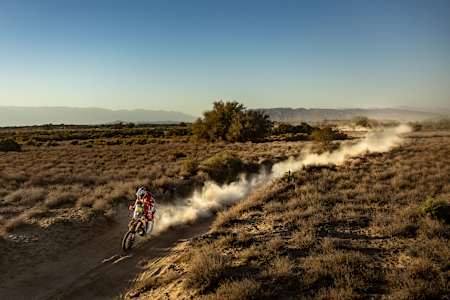
Refuelling with some avocado at the 2019 Atacama Rally
© Edoardo Bauer/Red Bull Content Pool

Sunderland is a two-time winner of the Dakar Rally
© Marcelo Maragni/Red Bull Content Pool
What does a typical day look like in terms of calorie count?
On a normal day, if I'm doing a couple of sessions, I'll burn anywhere from 4,000 to 6,000 calories. I never track intake, I just eat when I'm hungry and after training.
I used to stick to a much more regimented nutrition plan, and I always ended up coming unstuck one way or another with feeling tired or bloated. Over the years I've learnt what works for me, in terms of how much I need to eat, so I don’t count calories.
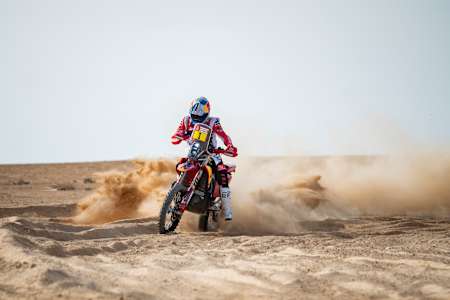
Hydration is also extremely important during long days in the desert
© Marcelo Maragni/Red Bull Content Pool
What does a Dakar Rally look like for you in terms of food and hydration during the day?
The alarm goes off around 3.30am. I get dressed and take a few vitamins, and then normally I'll eat quite a big portion of porridge and sometimes cold pasta. I won't take any caffeine at that time because with it being so early, and with a long road liaison to do to get to the start, I don’t want to “peak” too early.
I’ll take a can of Red Bull in my back pocket, as well as my other snacks for the day like nuts, bars, jelly babies and dried bananas, which I stuff into my jacket.
When we get to the start, which can be as much as three hours away, I’ll get my jacket off, clean my goggles, and have my can of Red Bull to help me get focused and alert. This is usually around the time it’s getting light, and you’ve already been up for a few hours and ridden to the start, so I need to get switched on as the racing is about to start. I’ll eat an oat bar to give me some carbs, too.
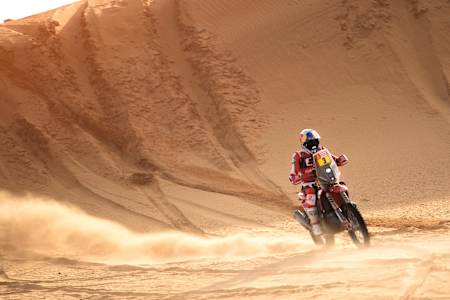
The special stage can run for around 200km until we have the first bike refuel. There, we only have 15 minutes, and it goes by in the blink of an eye. You have to fuel the bike with 34 litres of gas, check the bike over for damage, clean your goggles, and get some food down fast, so I’ll quickly eat some of my snacks, plus a caffeinated gel. Then we’re back into it, racing full gas for hundreds of kilometres.
On the bike, I can’t eat, so it’s just about staying hydrated and I’ll drink from my CamelBak. I’m always conscious about drinking enough but not too much because with my hyponatremia it’d basically be like flushing my system. Usually, my CamelBak will last me the day – it carries 2.5-3 litres – and I’ll sip some water bottles at the refuel stops, too.
More Dakar Rally content


Sam Sunderland in Dubai
© Kin Marcin/Red Bull Content Pool
We’re not just racing the Dakar, we’re also racing to eat and to sleep
What do you eat to recover after such a long day?
As soon as I arrive at the finish I'll always try and get a bit of protein in me straightaway. This is where I'll rely on a powder because then we have another liaison section to get to the bivouac for the evening, and that can be anything up to 300km. The days at the Dakar are long ones.
When I get there, I just start eating straight away, getting some fruit and some carbs in. I’ll debrief with the mechanics, then go and eat dinner – which will usually be pasta – and I try to be in bed by 9pm. We’re not just racing the Dakar, we’re also racing to eat and to sleep.
What’s your favourite meal of all time?
It would have to be the sushi. I started eating it to help with my dietary requirements, but I love it and I can get through a fair amount of it!
Sushi is a go-to meal for Sunderland
© Flavien Duhamel/Red Bull Content Pool
If we’re heading over for dinner and you’re cooking, what’s on the menu?
I am hopeless at cooking! I'd keep it simple and Italian-themed – a nice ravioli with a ready-made carbonara sauce.