

Gaming
Games
Calculated! How Rocket League came to Switch
Even as Rocket League enters its third year, it’s still launching on new consoles. We speak to the team at Psyonix to find out what else is new at the studio.
Rocket League was never meant to be on a Nintendo console, never mind a handheld one. But last year, long before the public unveiling of the Switch, Nintendo came knocking on the developers’ door. Would Psyonix be interested in bringing their hit multiplayer sports game to Ninty’s new console?
“Sure,” said Psyonix’s vice-president, Jeremy Dunham – but only if Nintendo would support cross-platform play, if Switch players could play against PC and Xbox One players.
Nintendo agreed immediately.
This is not, typically, how partnerships between Nintendo, known for being opaque and frustrating and brilliant, and small studios, have gone in the past – in that for a long time there was no dialogue at all. That Nintendo made this sort of pledge to a small team with only one major game under their belt, and not a giant publisher like EA or Activision (and a pledge Sony still won’t make for PlayStation users), shows just how much gaming has changed in the last generation.
Yang lainnya
“[Nintendo] made no bones about saying ‘We want Rocket League on this platform as soon as possible. What do you guys need?’” Dunham tells Red Bull in an exclusive new interview.
“The very first thing I asked Nintendo when we spoke with them was ‘Will you allow us to do cross platform-play?' and they told us ‘Sure, whatever you need’. The fact there was no hesitation, they told us yes immediately the very first time we asked, was a really good olive branch. It showed us they were serious about Rocket League and the platform, and that we should take them seriously.”
Even so, Dunham reveals, the San Diego studio, in its new-found position of power, didn’t sign on right there and then. In fact, the contracts weren’t signed until just seven months ago.
“We didn’t commit to the platform in that first meeting,” he says. “Many, many months went by as we started to evaluate what we had to work with as well as our own workflow and ambitions. We wanted to make sure we could actually do it and release on the platform on time and without sacrificing anything. It was only late March or early April of this year that we committed with Nintendo that we were going to do it.”
Watch the trailer for Rocket League on Switch:
Since then, though, the studio have been working non-stop, and the game is now scheduled for release on 14 November. “It’s been all hands on deck making sure this runs as smoothly as possible and making sure that people who get it on Switch are happy with it and see very little difference between it and other platforms.”
Don’t fix a rocket that ain’t broke
Nailing that experience is crucial for Psyonix. As Dunham knows better than anyone, you don’t tinker with the formula of rocket-propelled cars smashing a giant ball around an even bigger football pitch lightly. Earlier this year Rocket League passed 25m players, and the number is still climbing, two and a half years after the game first launched on PS4 and PC.
“We have more players than before, more games being played – it’s unstoppable, the amount of enthusiasm people still have for Rocket League,” Dunham says.
Even so, being able to nose in an aerial from the halfway line while sitting on the toilet requires some compromises, however small. The Nintendo Switch is not as powerful as rival systems. More convenient, yes. Hell, maybe even more fun. But mobile gaming does mean mobile graphics.
“In terms of scaling things back, resolution is definitely one thing we had to consider, because the Switch has a different native resolution than the PS4 and Xbox One, and also it doesn't have as much horsepower,” Dunham explains, though he says that outside of playing the game while docked on a 4K TV, you probably won’t see much difference.
The only feature that might actually be missing? Transparent goalposts, which were introduced after the Switch port’s announcement. “That’s something that we don't think will make it in the Switch version, we’re still double checking but there might not be enough horsepower to do it.”
That’s bad news for top-flight RLCS players hoping to play away from the TV, perhaps, but Dunham is adamant that otherwise this is the Rocket League we know and love, just portable. “The number one thing is it plays well and as for the visual sacrifices we have to make on the platform – we’ll make those as long as people feel like they’re playing Rocket League.”
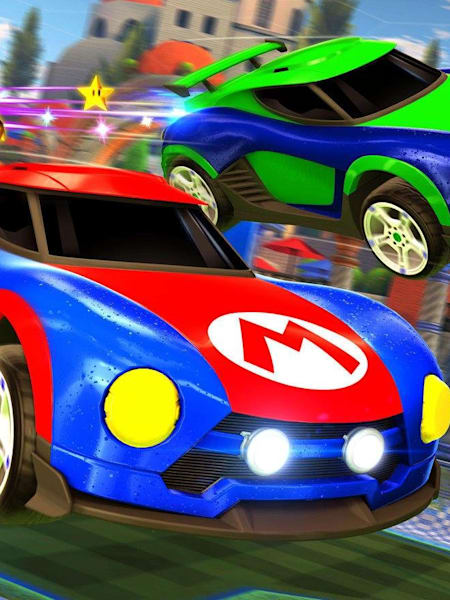
Check out the Switch's Battle-Cars:
And Rocket League itself is still evolving. New game modes, like Hoops, have entirely changed how the game plays for a dedicated core of players, while a steady influx of new arenas (six in the latest Autumn Update) and items (more than 90) keep players coming back for more.
New features boosting in
Psyonix aren’t done yet either, Dunham says. Never mind new ideas, “we haven't got all of our old ideas in there yet. We have long syllabus of things we wanted to put in the game from launch that we couldn’t. That list still hasn't been exhausted.”
As the game has taken off (excuse the rocket pun), Psyonix have also learned to cater to the needs of their growing fan base also. Tournaments are up next, Dunham says, and will allow players to create their own elimination competitions right in the game itself. That’s coming at some point in 2018.
“Originally we knew we wanted them, but the scope was unknown and our ambitions were a little bit ahead of what our capabilities were at the time. But over the last several years, as we’ve learned more about the game and our audience, we've been able to make more changes to our original design for tournaments. It’s a big beast and it’s going to be an ongoing feature that we’re going to be constantly updating. But next year when we introduce that feature, that’s going to be really good proof of the way we continue to evolve an idea as time goes on,” Dunham says.
Rocket League’s players continue to improve in the meantime, in part thanks the professional esports league, the Rocket League Championship Series, that Psyonix set up, now in Season 4.
Dunham thinks the league has more than delivered a return on investment – it turns out that when you pay the best players, sure enough they find new ways to play and become even better.
“I think it’s had a major impact,” he says. “If you go back and watch some of the early competitive Rocket League, like and the sorts of skills you see on display then versus now, it’s completely different.”
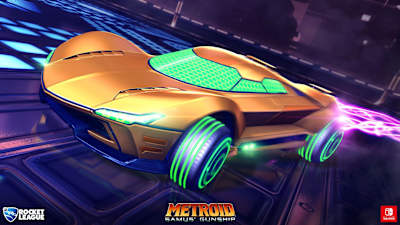
An exclusive Metroid car is available on Switch
© Psyonix
Dunham points out how early play at the top of the ladder focused on rushing the ball, before a strategy emerged around hanging back and countering – and then aerials came into play. “Now you’re seeing all those different styles meshing – it’s very interesting.”
One challenge cross-platform play between Switch, PC and Xbox (not PS4, sorry) presents is addressing that skill gap. Playing Rocket League on your Switch against someone on Xbox One will be a breath of fresh air, but not if they’re repeatedly spanking you, having had a year’s head start.
Dunham acknowledges this is a problem that the team will have to counter when the servers go live. “Sometimes you gotta get burned before you know how to control the fire,” he admits. “There’s going to be a skill gap, because you have lots of long-term players out there who know a lot about the game, hopping into play against these guys... But that’s okay, because we want you to have fun if you’re losing or winning. We think the game is set up and our matchmaking is smart enough to put you with players of the appropriate skill level, but it’s possible that you could place with someone in a match who’s a lot better than you expect. But that’s all part of getting better.”
Right now we're considering the future and what that means besides Rocket League.
This time, Dunham says that they’re now looking more actively to a time not so much after Rocket League, but when Rocket League is not Psyonix’s only big game.
“We’ve definitely started looking past Rocket League’s singular success. Right now we're transitioning to a point where we continue to grow and support Rocket League but also start considering the future and what that means besides Rocket League. We want to make sure we have other opportunities. We have a dedicated prototype team internally where we work on ideas.”
Dunham is evasive as to what those might be, beyond telling us that besides Rocket League the developers at the studio have been playing a lot of hit battle royale and car horn honking simulator PlayerUnknown’s Battlegrounds. He won’t exclude any type of game or genre.
“Anything’s possible – before Rocket League, Psyonix developed a lot of games for a lot of people. They almost always had a multiplayer slant, we know multiplayer very, very well here. But we’ve worked on shooters in the past, we even worked on puzzlers and strategy games. I would say no idea or genre is off the table at this point.”
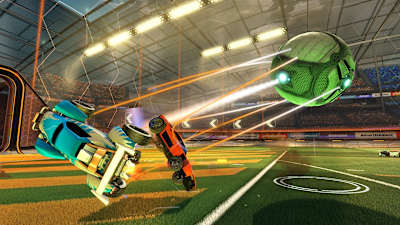
Cross-platform multiplayer means big competition
© Psyonix
For a cash-strapped Psyonix, after the flop of their PS3 predecessor, Supersonic Acrobatic Rocket-Powered Battle-Cars, Rocket League was a last throw of the dice, one the team won big on. Much of that was down to the word-of-mouth buzz achieved by giving away the game for free for PlayStation Plus subscribers.
Life after Rocket League
Dunham says that given the studio’s growth (Psyonix have tripled in size since launch in 2015), as well as shifts in the industry since 2015, one thing he can be sure of is that any hypothetical next game would not have this same, staggered roll out.
“Now we’re at a point where we do have the infrastructure to support marketing and PR and community and every element to maintain a game from a public-facing front. Our next game, barring some kind of unforeseen development, would definitely be on as many platforms as we could make it, and it would definitely be something we would release with a more ‘traditional’ strategy than [Rocket League].”
Whether Psyonix’s next game will launch on Switch on day one is another matter. That all comes down to how well Rocket League performs on the console, but if there’s one thing Psyonix have learned, it’s to prepare to be surprised by players’ enthusiasm.
“It always feels strange, because every time I talk to anyone about how Rocket League is doing, it’s better than the last time we chatted,” Dunham says.
Nothing lasts forever, not even football with cars, but so long as the studio keep their focus, that’s all that counts.
“I just never want to lose sight of our promise to our community ourselves, which is to make Rocket League as cool as we can, consistently. As long as we do that we sleep comfortably.”
Rocket League is released on Nintendo Switch eShop on November 14.
For more gaming coverage, follow @RedBullGames on Twitter and Instagram and like us on Facebook.
