

Tennis
How to win a match: a complete guide to tennis
Tennis is an exciting sport to watch – it’s fast, it’s mental and sometimes hard to follow. What are the basic rules and who are the most important tennis players to watch this season?
Getting into tennis is easy, all you need is a racquet and some balls. The traditions, rules and scoring system of the sport are slightly more complex – but we’ve got you covered! Here are answers to some of the most searched questions on tennis and its most important players.
01
What is tennis and what are its origins?
Tennis has royal roots: It started in the 12th century as a handball game called 'jeu de paume' in France and was first played by aristocrats before it evolved into the racket sport with mass appeal that we know today. In tennis, two (one versus one, called 'singles') or four players (two versus two, called 'doubles') hit a small, yellow ball over a net into the other player's side of the court using racquets.
The aim is to hit the ball in a way that the other player can't return it, thereby scoring points. The game is played on different surfaces like grass, clay, or hard courts, and the first player to win a set number of games and sets wins the match.


Players compete on a rectangular, flat court which is about 23.77 metres long and 8.23 metres wide for singles, with extra lanes on each side for doubles, making it 10.97m wide. In singles matches, it’s considered out of bounds ['out'] if the ball bounces on those lanes.
The court is split in the middle by a net, and each side has a baseline (back line) and service boxes near the net where serves must land. Serves must be performed from outside the baseline diagonally, taking the centre mark on the baseline as the reference.
02
How do you score in tennis?

Dominic Thiem of Austria prepares to serve
© Joerg Mitter/Red Bull Content Pool
The scoring system in tennis is based on four levels: points, games, sets, and match. Points are won towards games, and games are won towards sets. Usually, 4 points are required to win a game, scoring in a sequence of 15, 30, and 40, before finally winning the game.
If both players reach 40-40 or 'deuce', whoever wins the next point will have the 'advantage'. If that player manages to win the next point, he or she wins the game. If the player fails, the score goes back to deuce, until one of the players first scores the advantage and then wins the game [in many doubles matches now, the deuce point is the deciding point, which is designed to speed up the match].
Usually six games – seven if both players are tied 5-5 – are required to win a set. If both players are tied 6-6, a tie-break is played. The first player to get to 7 points wins the set [in certain situations, longer tie-breaks are played, called 'champions tie-breaks']. The tie-break must be won by a two-point difference, with no limit for the final score of the tie-break.
Finally, the first player to win either two or three sets – depending on the rules of each tournament – wins the match.
03
How do you win a tennis match?

Jakub Menšík is one of the rising stars of the men's game
© Lukáš Wagneter/Red Bull Content Pool
Tennis doesn’t directly proclaim the player who scores the most points or games as the winner. While the quantity of points scored certainly does matter – otherwise it would be impossible to score games and sets – it’s the ability to secure key points in the decisive part of games and sets that really makes the difference.
For example, if Player A wins the first set 6-0, but loses the next two sets in tiebreakers (6-7, 6-7), Player A will lose the match despite having won more games, because his opponent won the key points that decided the outcome of the last two sets.
Games start 0-0, or 'love all'. The term 'love' is believed to have evolved from the French word 'l'oeuf,' meaning 'egg', resembling a zero.
The origins of the 15-30-40 sequence that mark when a player scores their first, second, and third points in each game, respectively, are uncertain. One of the most popular theories sustains that the numbers equal the quarters of a clock face until a game is over by completing the four quarters, and that the 45 changed to 40 for unknown reasons.
04
What are the Grand Slams?
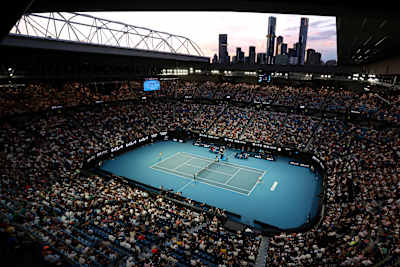
The Australian Open's number one show court, the Rod Laver Arena
© Kelly Defina/Getty Images
Every year, there are many large scale tennis tournaments within the professional male (ATP) and female (WTA) tennis tours. However, four tournaments that aren't part of either the ATP or WTA tours stand out because of their significance: the Grand Slams, which are overseen by the International Tennis Federation [ITF].
The Grand Slams are the highest-ranked tournaments and offer the most ranking points, prize money and media attention.
Australian Open
Held in Melbourne in January, the Australian Open kicks off the Grand Slam calendar each year on hard (concrete) courts. It's known for its high-energy atmosphere and extreme weather conditions - it's a test of endurance and skill for the world's best players.
French Open
Also known as Roland Garros and held in Paris, it's the premier clay court tournament in the world. Taking place in late May to early June, its slow-playing, high-bouncing courts demand exceptional stamina and tactical abilities.
Wimbledon
Held in London in July, Wimbledon is the oldest and most prestigious tennis tournament. Known for its grass courts and strict dress code – all players must wear all-white outfits, it embodies tennis's classic elegance and competitive spirit.
US Open
Held in New York in late August to early September, the US Open is renowned for its vibrant, energetic atmosphere and hard courts that favour powerful and aggressive play.


05
What are the different types of tennis surfaces?
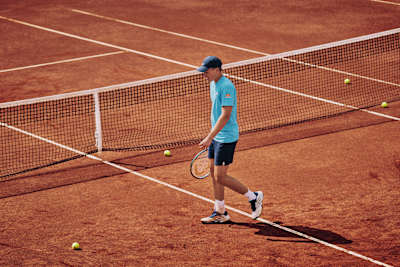
Clay courts suit players who impart plenty of spin on the ball
© Nikolas Tusl/Red Bull Content Pool
Tennis is usually played on one of three different surfaces: hard court (or concrete), clay, or grass. Depending on the surface, players need to adjust their playing style and strategy.
Hard courts are made of rigid materials like asphalt or concrete and covered with an acrylic layer. They provide a consistent bounce and medium speed, making the game balanced for various playing styles.
Clay courts are made of crushed brick, shale, or stone. They are known for their slow playing speed, as the clay surface reduces the ball's speed and causes a high bounce. This surface favours players with strong endurance and tactical strategies, as matches tend to be longer and more physically demanding.
Grass courts are the original surface of tennis, and the rarest ones today. They are made of natural grass grown on hard-packed soil. The ball moves quickly and skids, resulting in a low bounce. This surface benefits players with a strong serve and quick reflexes, as the game is faster, and points are generally shorter.
06
What are the basic shots in tennis?

Dominic Thiem prepares to hit a single-handed backhand
© Mirja Geh/Red Bull Content Pool
In tennis, players use a variety of strokes to control and manipulate the ball. The serve is the shot to start each point in tennis. A player tosses the ball into the air and then hits it over the net into the opponent's court.
The forehand is a shot played with the dominant hand's front side. The backhand is executed with the non-dominant hand's back side. There are two types of backhands: one-handed and two-handed. The volley is a shot where the player hits the ball before it bounces on the ground. It is usually performed close to the net.
07
Required skills: why is tennis a mental sport?
Tennis is a physically demanding sport that requires endurance, strength and the ability to move around quickly. Good hand-eye coordination is as essential – and so is having technical proficiency and mastering the basic forehand, backhand, serve, volley, and slice.
To succeed at the highest level, being mentally strong becomes more and more important. Tennis is a game of ups and downs, and the ability to handle setbacks and maintain composure is crucial for success. Tennis players need to think strategically and make quick decisions under pressure.
08
Who are the most exciting tennis players in the world?

Iva Jovic is one of the most exciting talents on the WTA Tour
© Nick Brown / Red Bull Content Pool
Tennis is a highly competitive sport and the best players in the world are determined by their placement in the ATP (male) and WTA (female) rankings. In 2026, these are the names to watch:
Male players
Novak Djokovic
The Serbian is the most decorated tennis player in history with 24 Grand Slam titles. Despite being towards the tail end of his career, his mental strength and all-around game make him a force on any surface.
Carlos Alcaraz
The Spaniard is a star known for his fearless aggression and exceptional court coverage. The youngest man to be ranked number one in the modern era at just 19 years old, Alcaraz has already completed the career Grand Slam, adding an Australian Open crown to his titles at Wimbledon, Roland Garros and the US Open.
Jannik Sinner
Jannik Sinner is one of the sport’s most exciting players. Known for his icy composure and laser-precise baseline hitting, he combines calm intensity with ruthless consistency. Already a multiple-time Grand Slam champion, he is a defining figure of tennis’s new era.
Female players
Iga Świątek
The Polish ace is ranked among the best and is known for her fearless attitude and dynamic shots. She is a multiple Grand Slam winner with ruthless control from the baseline.
Aryna Sabalenka
One of the most powerful hitters on the tour, Sabalenka has dominated in recent years thanks to her aggressive style of play. Consistently at the top of the world rankings, she already has multiple Grand Slam titles to her name.
Iva Jovic
Despite still being a teenager, American Iva Jovic has already broken inside the top 20 in the world rankings and is considered the next superstar in women's tennis. A quarter-finalist at the 2026 Australian Open, it seems only a matter of time before she's contesting for major titles.