
Travel
How to take the perfect adventure photograph
From desert and jungle to surf and ski, three expert photographers reveal the secrets behind the perfect all-action snap.
With an ever-expanding population, cheap airfare and the fact that everyone who’s ever headed out on a gap year suddenly thinks they’re Indiana Jones, discovering the great unknown is getting harder and harder.
But if you do happen to get off the beaten track, you'll be wanting to take a proper photograph. Which is why we've enlisted the best of the best, snappers who are as at home heading into remote jungle as they are toiling through some of the world’s most inhospitable desert. You name it, these guys have been there, seen it and got the snaps to prove it.


In order to help you perfect your own photographic endeavours, we picked their brains on how to capture the perfect image, whatever the environment.
Thiago Diz
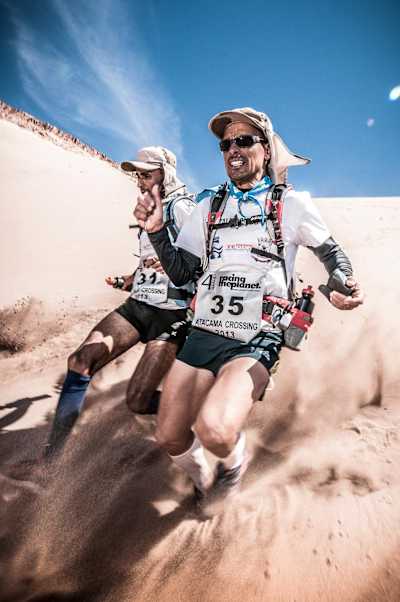
Participants descend a dune in the The Atacama Crossing
© Thiago Diz
Born in Rio de Janeiro and raised in six different countries before the age of 15, photographer Thiago Diz has long had adventure in his blood. He began shooting in 2001, focusing on adventure sports and exploring the unknown. His mantra is ‘Go live life.’ Here he talks us through shooting The Atacama Crossing – South America’s toughest ultra marathon.
Protect your equipment
“In desert conditions [like the Atacama], you have freezing nights, extremely hot and dry days, and massive, sudden sandstorms. The biggest challenges in these situations are sleep deprivation and managing to keep the equipment intact. Wherever you are, problems like sand, rain and condensation are the most critical issues."
Pack accordingly
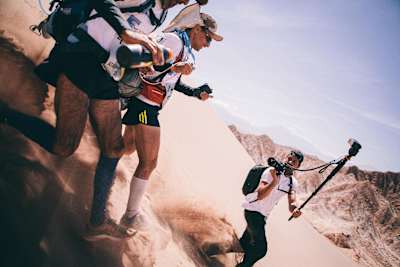
Behind the scenes as Thiago Diz's captures the dune descent
© Thiago Diz
“When it comes to deciding what gear to take into a desert, I take two cameras and all my lenses, including 14-24mm, 50mm, 24-70mm, 70-200mm, 300mm. There is nothing more frustrating than envisioning a shot and not being able to execute it. It has happened once and I never let it happen again. You will never be at that same place at that exact time with that exact light again. You need to make it happen right there and then."
Stay the course
“Fitness is a must. Walking for long distances in the hot or cold and carrying all the gear including a decent stock of water and food, can be tough if you are not physically prepared. Cardio is essential, but a strong core [legs, abdominal and back] will take you further. Climbing up mountains and dunes to get the open landscape shot is essential to telling a story."
Accept the risk
“You have to understand that you are in a position of risk. The harder and more difficult, the better. Uncommon places will give you an uncommon photo. It's what drives me. It's what we photographers set out to capture and what the world is interested in seeing. No matter the effort, the final results are always worthwhile."

Greg Funnell
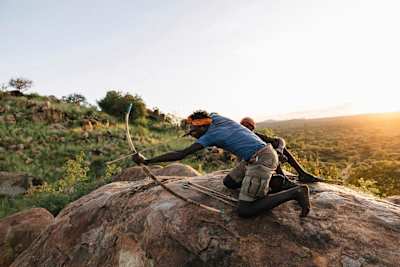
Northern Tanzania's Hadza tribe has a population of over 1,000
© Greg Funnell
Alongside his work with high-end editorial and charity projects, there’s nothing British photographer Greg Funnell likes more than going off the grid – be it capturing Israel’s biggest bicycle race on the Syrian border, or spending time with some of the last hunter-gatherer tribes in the world. Here, he talks us through the challenges of tracking down the Hadza, of Northern Tanzania, a tribe whose way of life has remained unchanged for 10,000 years.
Do your homework
“There's plenty of challenges when it comes to photographing a remote tribe: language, inhospitable climates and terrain, sickness, critters, logistics, access, the list goes on. Though I think the main challenge, as it is with photographing anywhere or anyone, comes down to trust; being invited in and accepted so that you can do your job.”
Find a fixer
“The best way to manage assignments and projects in remote locations is to find a fantastic producer or fixer, preferably more than one, and certainly someone local that knows the customs, the language, the local politics. With some tribes it may be hard to find translators that speak the local dialect. For example, on a job I had in Guatemala several years ago we had to have one translator for the English to Spanish and then another from the Spanish to the local Native American dialect."
Choose some reliable kit
“[When shooting the Hadza] I was shooting with my normal digital equipment on this (Canon 5D mk III’s) but I also took a Widelux, which is a discontinued Japanese panoramic camera from the late 20th Century. It takes 140 degree panoramas hand as rotating lens, so it takes really unique photos. Sadly the lab I was using at the time developed the film but then in a moment of pure incompetence, binned all of the negatives. All I have are some low res scans, which aren’t good for much…”
Treat everything with respect
“Their bows and arrows are fantastic to behold and they are relatively unique to each hunter. They also have a multiple of uses. For example they are able to create friction fire by just rolling an arrow between their bare hands, a skill that is much harder than it looks. With anything you’re shooting you need to approach it sensitively in the way that you would approach anything new to your world, making no assumptions and treating everything with respect.”
Embrace the journey
“I love learning new things, and I love being introduced to new cultures. As a photographer I am used to being an outsider looking in. The joy in these situations is that you have privileged access and you also have a responsibility to communicate what you are witnessing and bring it back to show people who weren’t there, to share with others what you got see and the experience and in doing so hopefully spread a little more humanity.”
Christoph Jorda
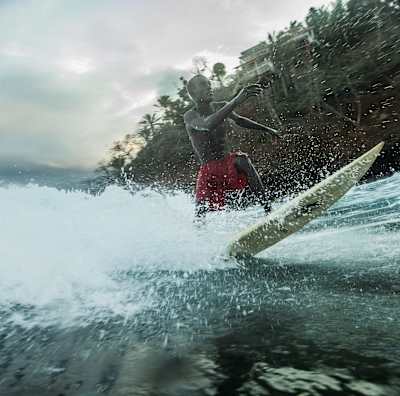
155 miles off the coast of Gabon, São Tomé is an African surfer’s paradise
© Christoph Jorda
German photographer Christoph Jorda enjoys diving into any given situation as much as he enjoys capturing one-of-a-kind, eye-opening imagery of his adventures. A few years ago, his urge for adventure took him to the island of São Tomé, an African surfer’s paradise approximately 155 miles off the northwest coast of Gabon. Visitors to the islands are so rare that locals often surf on re-purposed canoe bottoms, and battered hand-me-down boards. Here, Jorda talks us through ingratiating himself with the keepers of a surfer’s paradise...
Respect the elements
“I always say: Bad weather makes good photos. But bad weather is the natural enemy of the camera equipment. It does not matter if you photograph a skier jumping into a crevasse in the middle of a snow storm, or a surfer in the extreme humidity and salty air of Sao Tomè. It is always a question of when the batteries will die, the lenses fog, or the camera starts to rust. You have to get the shot while you can.”
Waterproof your camera
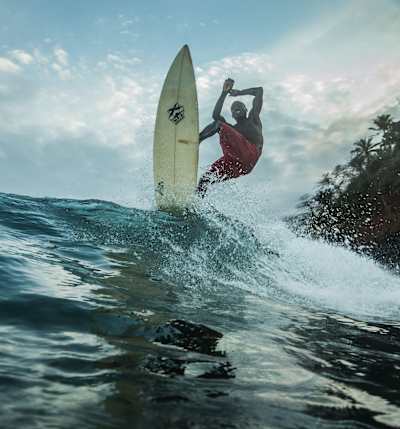
"You need to know where the wave is breaking and what is the current doing"
© Christoph Jorda
“It does not matter on what job I´m on. I always carry the same equipment: mostly 2 Canon EOS Bodies: The 1Dx Mark II and the 5DS R, plus 3-4 Sigma lenses. Then some lenses with fixed focal length. When shooting around waves you need to be as close to the surfer as possible so you’ll need an underwater housing for the camera. On this shoot I just had a kind of waterproof plastic bag. A big wave came through, took the camera out of my hand, smashed it against the reef. The bag got ripped and filled with saltwater. Somehow, the camera survived."
Know your quarry
“To shoot a surfer in a constantly moving environment like the ocean you have to be a surfer yourself to understand what is happening. You need to know where the wave is breaking, what is the current doing, how shallow is the water, where to get in and out of the water, and more. Being an experienced sportsman in this discipline and surviving the shoot is the toughest part.”
Good things come to those who wait
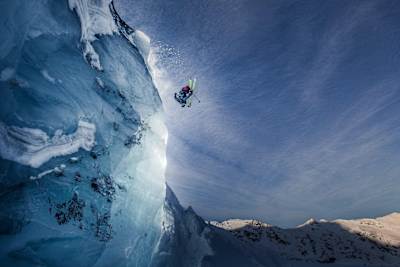
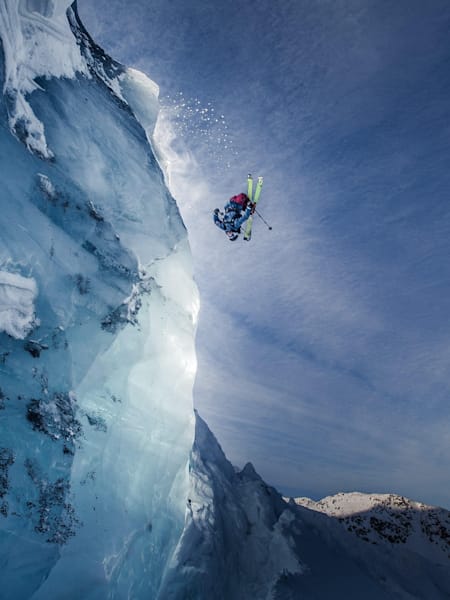
This shot was achieved by using a series of well-placed lights
© Christoph Jorda
"After a long hike with all the skiing and photogear we found this crevasse high up on the Pitztal Glacier at about 3000m above sealevel in Tyrol, Austria. The rider is Germany´s best Freerider and a long time friend, Konsti [Konstantin] Ottner. I installed three strong Profoto B1X Flashheads for this photo. One is right behind the skier. On is on the bottom of the crevasse facing up towards the skier. For the last one I had to dig a little cave with my ice axe into the ice. I wanted to light the ice edge from behind to have a nice contrast to the dark sky."
Earn your stripes
“It does not matter if you’re in a conflict area in Africa, a studio in Munich, photographing surfer in Sao Tomè, or way up on an icy mountain. you have to have their trust. The have to be comfortable to be photographed by you. In my opinion, this separates a good photographer from an outstanding photographer. You will never get a good photo of somebody who does not like you.”