





Breaking

Dance
Shake it off: dance tips for flexibility
Want to supercharge your skills on the dancefloor? Limber up with these flexibility tips and you'll achieve lift-off in no time.
If you've been lucky enough to catch any of Red Bull Dance Your Style Ireland, the globally popular freestyle dance event which popped up on Irish shores this summer, you might still be wondering how these dancers can do what they do.
In a word: flexibility. And in case you've never twigged the connection between flexibility and dance performance, we've enlisted a dance fitness expert to get you up to speed.
01
The importance of flexibility in dance
“First of all, flexibility is important for everyone, not just for dancers," says Katrin Van Krause, founder and director of InDance, a Dublin-based stretching studio with an array of classes running the gamut from "hip-hop to high heels".
Katrin believes that good flexibility is one of the key tools that helps dancers to achieve better performance. "If you look at dancing from the physical aspect, it's very hard work, so your body strength and your muscle flexibility is just as important as your dance skills."
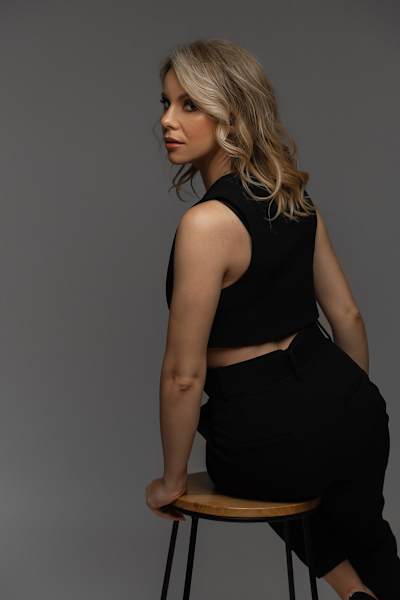
InDance founder Katrin Van Krause
© InDance
And flexibility is so much more than stretching: “It’s a type of strength, it's power, a fitness attribute. In fact, we use stretching to improve our flexibility. Dancing, from a physical perspective, is all about the coordination and power of your muscles."
One way dancers can improve their flexibility is with stretching practices, where we have static and dynamic exercises- but what's the difference?
Dynamic stretching usually comprises of swift movements: “It's what you do at the start of your fitness class or before running a marathon, and, of course, before dance class," says Katrin. "Dynamic stretching helps to increase your muscle temperature and decrease muscle stiffness. It improves speed and acceleration. In other words, it's a very good warmup."
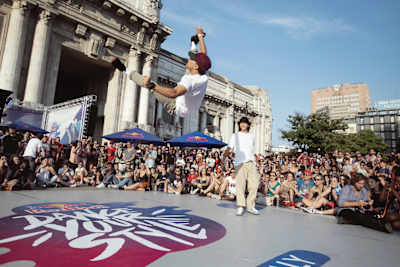
A competitor finds air at a Red Bull Dance Your Style event
© Red Bull
Static stretching, on the other hand, involves keeping the body grounded while holding a stretch that can last for up to a minute or longer. Think a hamstring stretch, where you're sitting on the floor, one leg fully extended while you attempt to touch your toes. "It requires us to move our muscle as far as we can and we then fix them in that position for, let's say, 30 -40 seconds. The aim is to do it without feeling any pain. Static stretching in particular is an effective way to improve your flexibility."
02
Tips to increase your flexibility for dancing
1) Find a routine
If you don't use a wide variety of movement in day-to-day life, such as anyone stuck behind a desk working in an office, it's even more important for you to find ways to move as part of your daily routine, says Katrin: "You need to stretch every day if you want to improve flexibility – it could be carrying out a few stretches at home in the morning or evening. Or, you can attend stretching classes, if you'd like to do it as part of a group with a teacher. In both cases, implementing stretches into your daily habit will gradually have a good impact on your dancing and lifestyle in general."
2) Listen to your body
Don't just listen to the music, but keep an ear out for discomfort in the body, too, making sure you're in tune with your muscles and don't overdo it. "If you feel pain somewhere while stretching, stop," says Katrin. "It's very important to respond to body pain. If your body says it hurts, believe it. With any dance style you need to have a decent amount of strength in your core – a crucial part of any dancer's skillset, so don't ignore soreness."
How to improve your dancing
3) Injury prevention
There are so many benefits with stretching and building up a greater physical flexibility, but perhaps the handiest for dancers, or any type of performer or athlete aiming for dynamic movement, is the reduction of injury and wear and tear. "The more stretches you do, the more you'll protect yourself from injury and pick up less knocks that can develop into something more serious,” says Katrin. Building muscle will lessen your chance of injury."
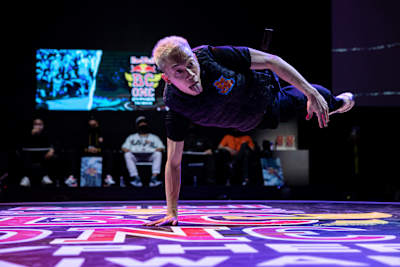
A B-Boy performs at a Red Bull BC One event
© Garret Clarke/ Red Bull Content Pool
4) Don't forget strength exercises
"Stretching alone is pointless," warns the stretching instructor. "It’s best done alongside strength exercises, such as push-ups, pull-ups and squats. A few stretches will increase your range of motions, decrease the stiffness, and make your muscles and soft tissues longer, but adding the strength component will fortify these changes. Only you know what your body is capable of, so start off with a couple of reps and build up from there."
The level of endorphin that you can reach while dancing and being active to music is near limitless.
5) Target weak areas
Strength exercises may also help you to better understand your body and correct any weaknesses, reckons Katrin. “Performing certain exercises, for instance, you may find you don't generate the same power with one leg as you do the other. Well, there's still time to re-compensate by focusing on one side. Even the most athletic dancers can be highly flexible but still have areas for improvement."
6) Eat well, move well
Much like professional dancers, we all require a good sense of balance. "By introducing some better nutritional habits you'll see a difference in your physical prowess and control on the dance floor," says Katrin. "If you are on your dancing journey and keen for a healthier lifestyle, review your eating habits and look for ways to improve. You don't need to go crazy with it, but as the saying goes: you are what you eat."
7) Don't stress
Life isn't always easy and external factors can get in the way of your personal goals. That said, Katrin believes dancing is the ideal way to leave your worries at the door: "If you have loads of stress through your work, for example, dance classes, or even just dancing at home, is a great way to put yourself in a better mood. The level of endorphin that you can reach while dancing and being active to music is near limitless."
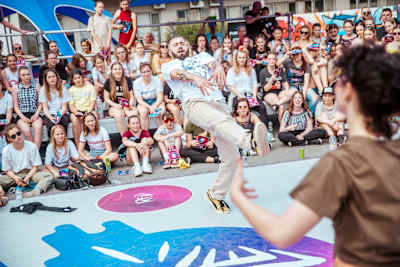
A competitor entertains the crowd at Red Bull Dance Your Style, Zagreb
© Tomislav Moze
8) Take a deep breath
One thing typically forgotten by people who sign up to stretching classes is the importance of breathing. Steady breath work helps you to control the tension in your muscles during any exercise and helps you manage moves better. Before any exercise, lay down on your back, place your hands along your body or above your head, and take three to five deep breaths, five seconds to inhale, five seconds to exhale."
03
Best stretches to improve dance flexibility
"Before my classes I like to have the students stretch every muscle starting from their neck to their toes," says Katrin. "It’s very important not to use just one exercise, but two or three different exercises to that specific area that you want to improve – ie. If you want to get better at the splits then include butterfly, pigeon and kneeling hip flexor moves into your stretching routine.
While she caveats that these aren't necessarily 'the best' stretches, as every type of stretch is useful and important for your body, here are some to start with...
1) Neck rolls
"Be very gentle with your neck. Make some round circles with it in one direction before going the opposite way. Keep the rest of the body straight, shoulders down, and gently pull your head diagonal and keep it for five to eight seconds, stretching those muscles. And then repeat on the other side. It pays to get your neck ready for dynamic movement because when you are dancing your head is flying."
Regular stretches will gradually have a direct impact on your dancing and lifestyle in general
2) Shoulder stretch
"Stand or sit up straight. Bring your affected arm straight up in the air. Keeping your elbow in place, bend your arm and reach your hand down behind your back. Apply gentle pressure with your other hand to the bent elbow. You will feel a stretch at the back of your upper arm and shoulder. Hold for 15 to 30 seconds."
3) Pigeon stretch
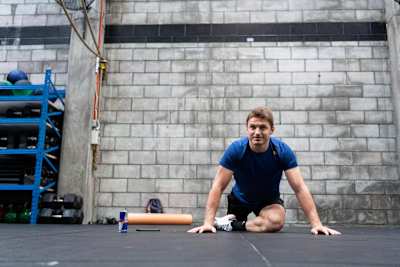
Rugby player Beauden Barrett performs the Pigeon Stretch
© Brad Hanson
"Square your hips toward the front of your mat. Once you feel stable, bring your torso down into a forward bend over your right leg. This helps to improve the range of motion in the hips, and that translates well into dancing because you're using so much of explosivity with the lower body and are twisting parts of your body you may not be used to moving in that way all the time. Place both hands under your shoulders, then elongate your spine and lift your chest." This isn’t an easy stretch, so listen to your body and if it’s too painful then stop. The more flexibility work you do, the easier it becomes.
4) Cobra stretch
"While lying on your abdomen on the floor, feet close together, elbows tucked into the sides, raise your upper body while keeping your pelvis on the floor, making your neck as long as possible. From your toes to your midriff you're still on the mat. Breathe in when you push upwards, holding the breath until you slowly lower yourself back down. In this move it's very important to tense your glutes, which reduces tension on the back."
5) Frog stretch
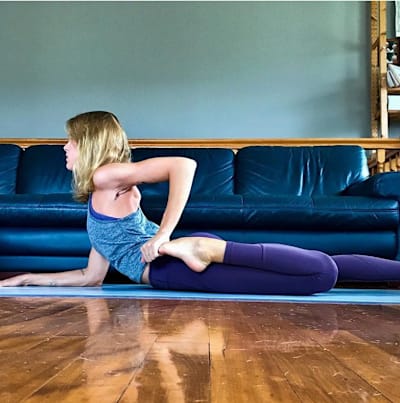
One-sided frog stretch
© 04
This is a more advanced stretch that must be done slowly and gradually: "Start in a tabletop position or on all fours, now hold your arms in front of you like a plank, but palms down, and now spread your legs out by 90 degrees from the hip, the body becoming flatter as you sit back into that 'frog position', toes pointed to either side. You should be on all fours and moving the knees away from each other to really achieve that hip stretch. It's very important not to bend anything that shouldn't be bent. You're not raising your head up or down. You don't bend your lower back. Just move with the hips and use your arms in front of you for balance. This will stretch the inner tights, groin and hips, while keeping the core engaged." Once you've nailed this advanced pose, you can mix it up and go one-handed, as seen in the image above.
04
Do I need flexibility for all dance styles?
Yes. Mostly all dance styles require some degree of flexibility, and while this can vary depending on the discipline (the gravity-defying routines seen in breaking or explosiveness of ballet will use more kinetic energy than line dancing), the more flexibility you can incorporate into a performance the more in control you'll be.

Madmax realised the benefits of workouts to improve artistic performance
© Little Shao / Red Bull Content Pool

B-Girl Madmax
© Little Shao / Red Bull Content Pool

B-Girl Madmax
© Little Shao / Red Bull Content Pool

B-girl Madmax
© Little Shao / Red Bull Content Pool
05
What are the benefits of greater flexibility for dance
There's much more to flexibility training for dancers than simply looking great at Red Bull BC One or Red Bull Dance Your Style. There's injury prevention, an improvement of posture, slower degeneration of joints and increased movement for other sports as well – just a handful of reasons why it's worth taking stretching seriously, before and after dance.
FAQ
How do beginners become flexible like a dancer?
Not to dash any hopes, but dancing at a high level requires hard work, dedication and a skillset that only comes with experience. The same goes for flexibility, as unless you're naturally in shape and regularly work out all your major muscles, it's going to be about building up a tolerance to stretching. As Katrin already pointed out, beginners in particular must be careful not to overdo it and know their limitations, particularly early on as they strive to become a better, more powerful dancer.
How can dancing improve flexibility?
Quite simply, dancing is one of the best ways to get physically fit that there is. It's no secret that music can provide motivation for training, and when it comes to getting flexible, throwing some shapes in whatever style or setting you like is always going to be a big help, working muscles you might not ordinarily activate during a normal day. Freestyle dancing is particularly effective in this regard.
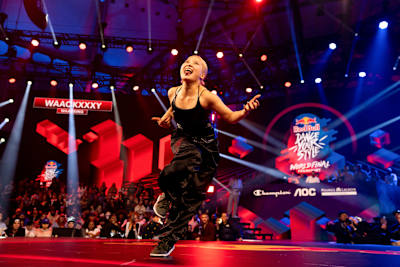
Waackxxxy is a 2023 champion of Red Bull Dance Your Style
© dieserbobby/Red Bull Content Pool
What are ways to improve flexibility?
A mixture of stretching and strength exercises will do it. Along with the moves and lifestyle tips outlined above, why not take your dancing to the next level by signing up with a dance class? That way you'll learn new skills while building up flexibility. Contemporary? Breaking? Ballet? Whatever gets your engine running there will be something for it. And even if you don't want to put yourself out there, you'll find plenty of tutorials on YouTube to copy at home and get flexible that way.
Red Bull Dance Your Style National Finals took place in Dublin this July. If you missed the action, catch up here.
Dublin-based fitness studio InDance has a variety of dance classes specialising in dancehall, contemporary, high-heels, stretching and hip-hop. Find out more at Indance.ie
