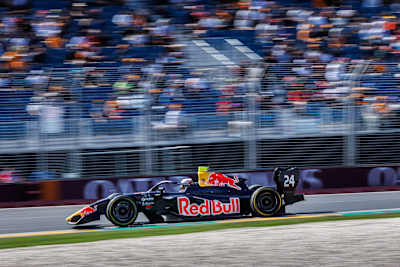
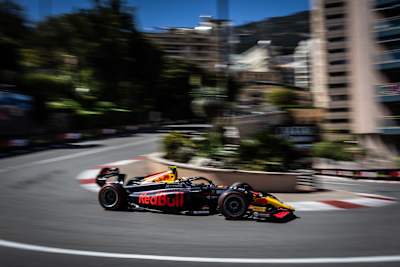
Ever wondered what four-time F1 World Champion Max Verstappen is getting out of his car compared to a rising star in F3 such as Ireland’s Fionn McLaughlin?
Are they miles apart in terms of performance and engineering, or is the answer actually closer than you might think? And then of course there's the championship that separates them: F2. Where does this sit in the grand scheme of things?
Brick by brick, wheel by wheel, we’re going to break down the FIA single-seater pyramid, from performance to philosophy to race-day format and top speed. Strap yourself in...
Formula 1, Formula 2 and Formula 3 make up the top tiers of single-seater motor racing. Governed by the Fédération Internationale de l’Automobile (or FIA for short), the term ‘Formula’ refers to the strict set of regulations that every car on the grid must follow.
At the top of the pile sits F1 – the very pinnacle of motorsport, where cutting-edge engineering meets the world’s finest driving talent. Drivers don't reach this promised land overnight. Typically they first emerge through the junior karting scene, building a reputation that gets them into the cockpit of a Formula 4 car, and, if they’re successful enough and catch the eye there, they then might find themselves climbing through the increasingly high-speed, high-downforce arenas of F3 and F2.
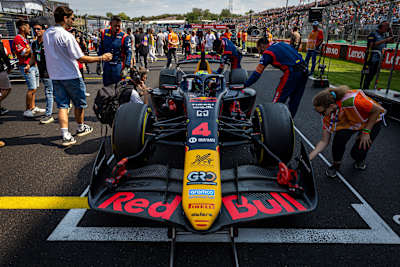
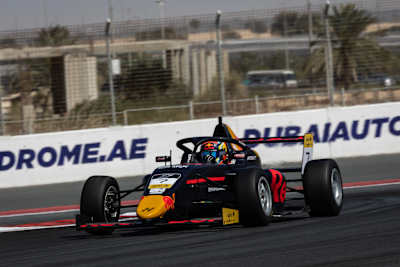
Arvid Lindblad on the grid in Budapest 2025 - Formula 2
Every rung of the ladder brings a higher level of speed, quality and global exposure. Granted, F3 and F2 are effectively talent pipelines for F1, but to compete in any of these championships usually means having elite race IQ and Jedi-like reflexes. Only truly exceptional athletes make the grade in any of these cars.
02
Engineering Ideology: Open Development vs. Spec Series
Utilising the latest advances in engineering, F1 teams develop highly specialised cars in the constant pursuit of victory. For it’s as much a constructors’ battle as a drivers’ one, where even the smallest aerodynamic tweak can deliver significant gains and potentially influence those all-important championship standings by season’s end.
Modern F1 cars are powered by hybrid power units producing around 1,000 horsepower, making them some of the most technologically advanced racing machines in the world. For historic automotive brands such as McLaren and Ferrari, this cutting-edge development can also have a trickle-down effect that impacts road car technology of tomorrow.
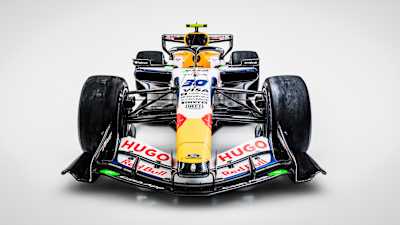
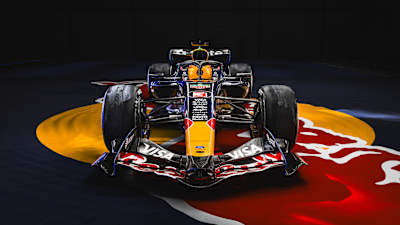
Looking cool: The new Racing Bulls livery for 2026
Further down the pyramid, F2 cars produce around 620 horsepower, while F3 cars are in the region of 380 horsepower — a significant step down from F1, but still extremely quick in their own right.
Another factor that separates F2 and F3 from championships from its bigger brother is that these are spec series, with all teams using identical chassis, tyres, and engines supplied by manufacturers such as the Italian outfit Dallara. Setups can be tinkered with, but this equal footing means that driver skill arguably counts for more than in F1.
There will always be debate whenever F1 authorities introduce a new set of regulations, but everyone must comply. Heavy fines and an outright ban from competition awaits any team that doesn’t. For 2026, a fresh wave of changes have been ushered in, including Overtake Mode and new fuel units, which you can read more about here, and you can bet every team will be pushing the limits of what's possible within the permitted framework.
By contrast, as spec championships, F2 and F3 teams are more likely to recieve new rulings on cost control, safety, and driver development than major technological innovation. Teams must still adapt to new cars, tyres, and sporting regulations, but engineering breakthroughs take a back seat in favour of pure racing. In this regard, it is F1’s constructors who continue to push the envelope of technological advancement.
04
How do F1, F2 and F3 teams operate?
That depends on the level of racing.
In Formula 1, the teams are called constructors for good reason. These are the organisations given licence to design and build their own chassis and key components within strict technical regulations set by the sport’s governing body. Many a championship has come down to not only who has the fastest driver, but also who has the fastest car – which in many ways is part of the appeal of the sport, with all manner of storylines written by both man and machine.
F2 and F3, on the other hand, are different beasts. Because every team uses the same sort of chassis, engine and other features, the emphasis shifts onto driver skill and execution, with teams working overtime to extract the maximum from a tightly controlled package across every session.
Not every team is represented across all three tiers of this single-seater ladder. Teams such as PREMA Racing and Campos Racing, for example, operate in F2 and F3, but they are not F1 constructors. They are independent racing outfits, often running drivers who are affiliated with Formula 1 academies or serving as important stepping stones for young talents on their way up to the top. Speaking of which…
05
Driving the Ladder: Red Bull’s Junior Progression
Many of F1’s biggest outfits also run junior driver programmes, placing promising drivers with teams across the feeder series to accelerate youth development. And look no further than the massively successful Red Bull Junior Team, long overseen by Dr Helmut Marko, under whom it became one of the most effective talent pipelines in modern motorsport.
Dr Marko stepped down at the end of 2025, but his legacy will be felt in the paddock for decades to come. Earlier this year, Arvid Lindblad became the latest Red Bull Junior alumnus to reach the hallowed tarmac of F1, making his debut with Racing Bulls. Having cut his teeth in karting before progressing through various F4 series, the Formula Regional Middle East Championship (a useful bridge between F4 and F3) and then enjoying a season apiece in F3 and F2, Arvid is proof of what can happen when a racing organisation identifies talent early and supercharges it.
Right now, Ireland’s newest racing star Fionn McLaughlin is keen to make a similar impact in the Red Bull Junior Team. After a strong campaign in British F4, he's stepping up to the FIA F3 paddock with Hitech TGR, where he'll be looking to make a statement as he furthers his development.
Certainly, from a driver perspective, Irish motorsport is in good health these days. Rallying has produced a number of Irish champions, while Cork native Conor Shanahan continues to dominate the drifting world. Exactly how far McLaughlin can progress in FIA single-seater racing will depend on a number of factors, but with the right development there is every chance he could progress into F2 and potentially F1.
06
Learning curve: What does the pyramid look like for drivers?
Across the FIA single-seater pyramid, drivers typically progress through the junior ranks after first making their mark in karting, where many first attract the attention of major teams. To earn the trust of constructors in formula racing, they are then given opportunities in F2 and F3, where the spec nature of the series is often seen as a clearer test of driver skill, consistency, adaptability and smarts.
If they continue to show world-class potential through podiums, victories and titles, they may eventually reach F1. But this isn’t always the standard route. Red Bull’s Max Verstappen, very possibly the very best racer of them all, famously skipped F2 altogether, moving directly from F3-level competition into F1. In the wake of his debut the Dutchman was fairly bullish, claiming it was much easier than he'd imagined: "The step from karts to F3 was bigger than the step from F3 to F1. At the end of the day a racing car is a racing car."
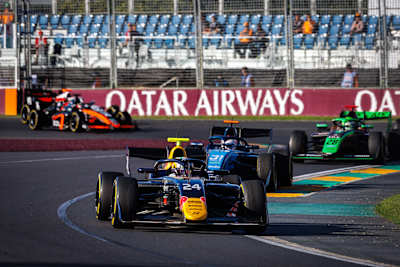
Fionn McLaughlin in action on his F3 debut at Albert Park
Like any rookie though, Max had a few learning curves in his early F1 seasons, but he's proof that, much like former Red Bull mainstay Daniel Ricciardo, who sharpened his skills in the now-defunct Formula Renault 3.5 Series before progressing into Formula 1, there is no single pathway for drivers chasing their dreams. In some cases, if you're fast enough, you're old enough.
07
Raw performance: How do the cars differ on the track?
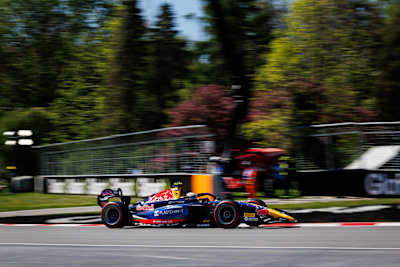
Will 3 be the magic number for Max Verstappen in 2026?
These numbers paint a vivid picture: from 0–100 km/h, an F1 car is typically around 0.3–0.5 seconds quicker than an F2 car and 0.4–0.6 seconds quicker than an F3 car, while F2 only edges F3 by about 0.1 seconds. Ramp that up to 0–200 km/h, and the difference becomes even wider as F1 cars hit 200 km/h in around 1.1–2.1 seconds faster than F2 and 2.2–3.2 seconds faster than F3.
To get a clearer sense of the speed difference between F1, F2 and F3 machinery on the same circuit, watch this video from Formula 1's official social media channels, which shows all three race cars travelling in quick succession down the same stretch of track.
Of course, speeds are also affected by where the races take place. Expansive circuits such as Monza, nicknamed The Temple of Speed, for instance, reward fast drivers. Whereas a tighter track like Monaco offers fewer opportunities for drivers to really put the foot down.
Another thing to bear in mind is that, under Formula 1's 2026 regulations, power units are designed so that roughly 50 percent of their output can come from electrical energy — a significant increase compared with 2025, as explained here. In short, there is now a greater focus on kinetic power, with drivers having to maximise energy recovery under braking and then use that energy strategically, deploying extra power on long straights and opting to take corners more slowly than in previous years.
The 2026 cars are also smaller and lighter than their predecessors, while operating with reduced aerodynamic load in certain conditions. As a result, teams face a different performance balance, and many observers expect energy management to play a much larger role in race strategy. Early projections suggested lap times could be slower on some circuits, although the exact impact will vary depending on the track and how effectively teams adapt to the new regulations.
08
FAQs
Was Max Verstappen ever in F3?
Yes. Max made his debut in FIA F3 at just 16 years old, winning 10 races (six consecutively) and finishing third in the overall rankings. In that same year, 2014, the Dutchman also won his first major race on home soil in Masters of Formula 3 – two decades after his father Jos found victory at the same event.
Do F3 drivers earn money?
With such high operating costs involved in F3, running into the millions of euros for some teams each season, the vast majority of F3 drivers are either self-financed or sponsored by academies and junior programmes. There isn't usually much of a return on that investment unless they can make it up the ladder and into F2. No doubt the prize money helps too, with a €1 million fund split between the five highest-placed drivers in the final F3 standings.
Do F3 drivers get to F1?
Absolutely. F3 is one of the first major stepping stones on the path to the F1 grid, giving young drivers a platform to demonstrate that they have what it takes to go wheel to wheel with the best. There are great drivers who have been known to skip the second and third tiers completely (Kimi Räikkönen with F3; Max Verstappen with F2), but these are usually the outliers. F3 remains a vital cog in elite driver development.
How old are drivers in F2 and F3?
Drivers in the FIA F3 Championship must be at least 16 years of age, and at least 17 years of age in F2. While there is no maximum age to compete, the high-stakes format of these championships and the talent pipeline structure is the reason why those on the grid are usually in their late teens or twenties.