






Gaming
esports
Soe and Malik reflect on the first season of the Overwatch League
After the inaugural season of the Overwatch League shattered all expectations, two of the game’s biggest names discuss the last year and what lies ahead in the game’s competitive future.
It may have had its fair share of problems – including a breathless DJ Khaled floundering on stage at the Grand Finals and an infamous inappropriate hand gesture to the camera – but for all intents and purposes, the inaugural season of the Overwatch League could be considered a success. With so much stacked against it, Blizzard’s ambitious plans for a big franchise league for their fledgeling team shooter came together amid the doubt and the stumbles to create a thrilling six months of competition.
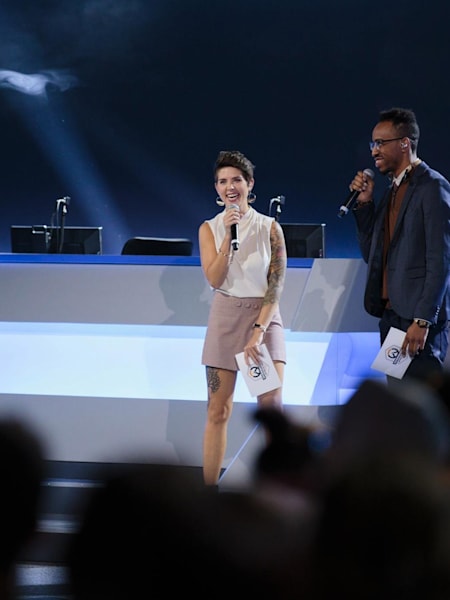
Guiding us through each week of matches and picking apart the stories as they developed were two names that have since become important voices in the Overwatch League: Soe Gschwind-Penski and Malik Forté. Both have a rich history within the world of video games and esports. The former as a caster, analyst and host across a vast number of competitive titles, while the latter carved out a career in games journalism via his YouTube channel and as a presenter for Nerdist.
Over the past year, though, the two have stepped up to be the hosts of the Overwatch League for those watching at home and in the arena. They’ve channelled their enthusiasm for the game, esports, the players and the fans to deliver exciting shows week after week – whether at the Blizzard Arena in California, the Barclays Center in New York, or at various stops throughout the Overwatch World Cup. With all that insight and experience, who better to ask about the last year in competitive Overwatch and everything that went down in the Overwatch League, including that first grand final? And how about the future?
Coming into it, it was meant to be massive. And it was massive.
“Game-wise, I think it was amazing how everything played out in the end,” enthuses Gschwind-Penski. “Because coming into it, we looked at Seoul Dynasty, we looked at NYXL, London Spitfire, everyone just assumed they're going to stomp it, but it was still everyone's game.”
Heading into the Playoffs, it seemed almost certain that New York Excelsior would emerge as victors after their dominating runs through league play. However, there were signs the team were slipping during the closing matches of Stage Four, while the underdogs London Spitfire and Philadelphia Fusion had found a run of form. It would be the former who, after emerging as champions in Stage One, would find success once again when it mattered the most.
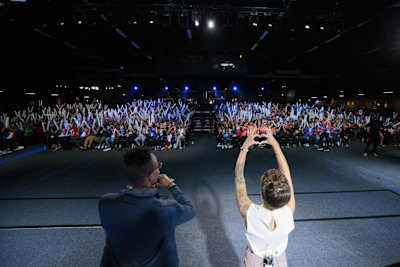
Sharing some love with the crowd
© Robert Paul
“We saw how much of a marathon this really is and not a sprint,” says Malik. “So much of esports is just these one-off tournaments, whereas this is a league that takes place over a series of months. You have to continuously train. You have to continuously make sure you're pacing yourselves, you're not over-exerting yourselves. Burnout was something that people had to learn to deal with.”
An ambitious start
It’s a different mentality to settle into, and for Soe and Malik, it was interesting to see how each team approached the unique challenge ahead of them. It was also interesting for them to see the differences between organisations who had worked exclusively in esports, compared to those who had come from a more traditional sporting background. Philadelphia Fusion, for example, who are backed by sports entertainment company Comcast Spectacor, has a big house for the team, a nutritionist and a gym schedule for players – it’s not just about grinding in front of a keyboard and mouse all day.
Yet, while in retrospect, the inaugural season was a triumphant debut for the game’s esport intentions as a sustainable and professional league, there was never the guarantee it would be from the start. When Blizzard’s plans first became clear for their hopes with the Overwatch League, there was a flood of optimism, but also a torrent of doubt. Could this new shooter inspire such a commitment from outside investors to back teams? Would the audience embrace the game’s esports scene just as much as the game itself? Would the thing even come together, as time steadily passed after all the major announcements?
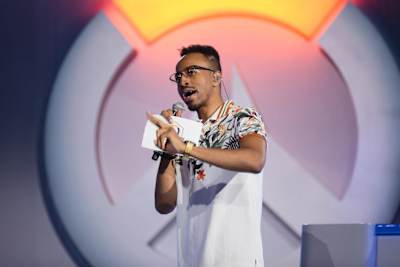
Hyping up the crowd
© Robert Paul
“Yeah, there were a lot of question marks,” agrees Soe. “We didn't quite know what to expect because I don't think any of us were ever part of something like that. A lot of people involved. A lot of people to work with and around. So, obviously, there were a lot of hurdles. There was a lot of stuff to figure out. This was a huge learning experience for everyone involved.”
Malik agrees that in those early stages there were a lot of unanswered questions. Seeing other peers in the esports world try their best to make a dent in the scene and fail made it clear that there was definitely a big element of risk in setting up the Overwatch League. Nevertheless, he’s glad he was able to be a part of that journey.
“To have a whole entire season, have our ups and downs, and then come out and see so many people be so supportive. It's been really invigorating for me, personally. You know, I always thought esports would be here one day. To be on the ground floor of the actual thing that happened, when it happened, it's been cool!”
What’s coming next
So, that brings us to the future of the Overwatch League. Blizzard has already announced that eight new teams will be joining the league for the second season, bulking the roster up to a total of 20. Once again, each will be given a home location from across the globe, pushing to build local support and move the league closer to having home arenas for each team – though that is still some way off. Those new teams, however, should really revitalise the league for season two.
I honestly think it's too big to fail at this point.
“I'm super excited because at the end of the season it was kind of clear who were the top dogs and who was more on the bottom. I can't wait to give new players which we followed in Contenders or even in the Overwatch World Cup, seeing all those fresh faces, and give them a platform to perform and throw their name out there.”
As for Malik, he’s looking forward to seeing how the competition evolves between regions: “For me, it's going to be seeing the gap between the South Korean players and the rest of the world continue to close. We saw last year that all South Korean rosters aren't necessarily invincible. Mind you, the London Spitfire did win the championship!”
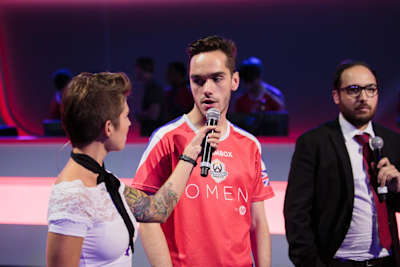
Asking Boombox if he’ll smile – he won't
© Robert Paul
And as for much further in the future, does the Overwatch League have the sustainability to see it go past season two and onto a season three, or four? For Soe, the answer is obviously yes, especially with Blizzard’s approach to inclusivity and diversity inside and outside of the game world. On top of that, there’s just too much invested in the Overwatch League for it to crumble.
“I honestly think it's too big to fail at this point,” Soe continues. “Like, right now, there are too many people involved to let it crash. I think a huge bunch of people need to mess up royally to actually dumpster this one. I do sincerely believe that it's going to continue its growth and I do think we're going to see a lot more expansion, more teams, maybe more local arenas or something along those lines. I think this is only going to get bigger.”
With how the game was able to fill the Barclays Center for the Grand Finals and the enthusiasm on display at events like the Overwatch World Cup playoffs, it’s easy to agree with Soe at this point. All eyes will be turned to the Overwatch League Season Two when it begins in early 2019.
