
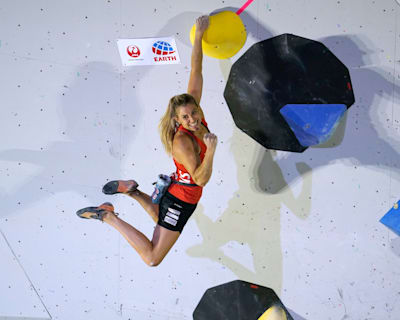
Bouldering
Bouldering star Petra Klingler will never back down
Swiss bouldering world champion Petra Klingler has emerged as one of the world's best climbers thanks to an iron will to overcome even the toughest obstacles.
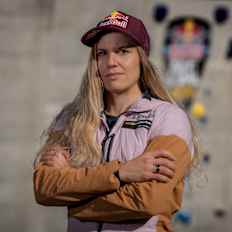

Born in Switzerland in 1992, Petra Klingler has been climbing since 2004. Despite overcoming a childhood abnormality and later mental challenges, she’s emerged as one of the strongest climbers in the world, with a love for her sport that helps her overcome seemingly anything.
She’s been doing this a long time, too, having won her first competition almost accidentally at the age of 12. Since then, she’s gone on to become World Bouldering Champion, Swiss champion (Speed and Bouldering) and a European bronze medallist (Bouldering), as well as bagging fourth place with her team-mate Louna Ladevant at Red Bull Duel Ascent in 2022.
Never give up is her motto. "Even if the next move seems impossible. If you think you can do it, you'll better prepare for it,” she says. “That can be decisive."
01
An accidental win
For Klingler, there is no before climbing. “I grew up climbing on account of my parents and grandparents being climbers,” she explains. “We spent our weekends and vacations climbing outdoors. I started outdoors multi-pitching and was introduced to it at a really young age. I literally didn’t even know I was climbing the first time, though I can remember the first time I was leading multi-pitch and actually fell, at the age of six. That was kind of scary, but I went on and I was so proud of myself for leading.”
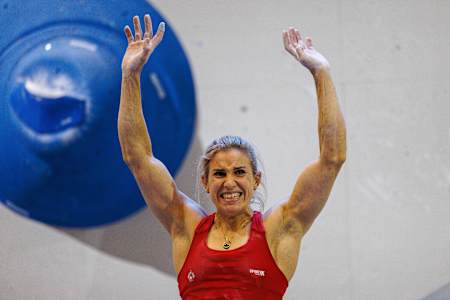
Klingler has been climbing for as long as she can remember
© Marco Kost/Getty Images
Climbing, then, was an intrinsic part of the fabric of Klingler’s early life, and continues to be so. “When we were younger, my parents, brother, grandparents and I would all go to the mountains together,” she continues. “And then it was my dad, my granddad, and either my mom or my grandma going for a multi-pitch. The other person would watch me and my brother, then they came down at noon, and then my mom and grandma would switch. They would then go again. And at some point, when we were old enough, we also wanted to climb a bit. Later on, we got into indoor climbing for a bad weather option.”
Her older brother started going to a climbing gym, so naturally Klingler wanted to join in. They entered a local competition when she was 11 or 12, not realising it was a national comp. Klingler won, but, by her own assessment, she still had some way to go. “I was so frustrated, so angry because I didn't reach the top of the roof even though I won, but my brother was fine with his fifth place. That was also the start of my competitive career.”
02
Strength in numbers
Today, Klingler is renowned for her strength. Growing up, she says, this wasn’t so unusual. “I had my first victories in Swiss championships pretty early and then kind of dropped a bit throughout puberty,” she says. “There were like five of us girls who were super strong in my year, and for international comps, it was just four athletes, which normally meant all four girls could go, and it was always me staying back.”
Being left behind, despite her talent, was super hard for Klingler, but she used her disappointment to keep getting better and better. “Now, I’m basically the only one of the five still competing,” she says. “Kathie Choong was one of them. We're the same age and we were competing the whole time together. She came to see me last year, so that was really nice to have her by my side.”
Standing in front of a boulder is like completing a puzzle, it's problem-solving
03
Smashing it
Despite suffering a slower start than her immediate peers, Klingler was still smashing it from a young age. She says a highlight is climbing – and winning – her first international competition in Marseille, when she was 13. “I remember standing on this podium with no words, I was just so happy,” she says.
In 2015 she won her first World Cup, in China. “I never thought I had the ability to win a World Cup,” she says. “Shauna [Coxsey] came up to me like: 'Petra, congratulations! You won!’ What? I couldn't believe it. And Mélissa [Le Nevé] was in the finals as well, it was unbelievable, I don't know how I managed.”
After that, she won her first finals in Vienna, Austria, going on to sign with Adidas as a result. Ten years on, the relationship is going strong. Now, she is climbing with Kevin Hemund, the national team coach. “He said ‘Okay, what is our goal?’ And I said ‘I would like to be in finals in Paris.’ He said ‘Okay, we're gonna win Paris, then.’ And I was just laughing.”
Klingler says Hemund gave her the energy to believe in herself. “For the first time, I felt like ‘OK, now I'm like a real athlete,’” she says.
04
Icons of the sport
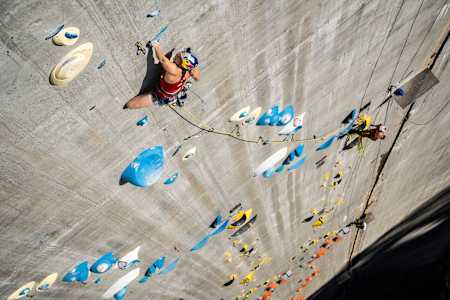
Klingler in action at Red Bull Dual Ascent
© Stefan Voitl/Red Bull Content Pool
Alongside her peers like Shauna Coxsey and Mélissa Le Nevé, Klingler says her main inspiration was her grandmother. “She inspired me just by her style of living,” she says. “I always wanted to be good for her. That was more important as she taught me to always see the bright side and how the little things matter. Even if it was a hard time, she found something which is positive. And I always try to find that as well.”
Outside of family, she’s inspired by boxing coach Marco Witzig. “Even though we are not in close contact, I know if there is something I can always call him,” she says, explaining that having that outside perspective can be vital.



Emotions running high at the IFSC Climbing World Championships
© Marco Kost/Getty Images
I’ve enjoyed this transition from being this really focused younger athlete to someone relaxed and a little more appreciative of what I have
05
Getting motivated
Outside of her family history in the sport, Klingler says she is motivated to climb from the pure love of the sport. “I love the energy of a competition, working out to a certain point and getting stronger and stronger, learning to know your body and how it works and how it changes, and battling these challenges,” she says.
Routine is an important part of training. “I like to plan,” she says. “I like having a schedule. Climbing is my work and I have a schedule – I have to be there, it's an appointment.” The new challenge of climbing keeps the routine fresh. “You always have a new challenge. You always have new moves to work on,” she says. “Route setters come up with new moves all the time and it's a mixture of dynamics, fast pace, slow pace, balance, flexibility, power, endurance, and all of that combined, and you have to kind of be strong in all aspects for comps. Standing in front of a boulder is like completing a puzzle, it's problem-solving.”
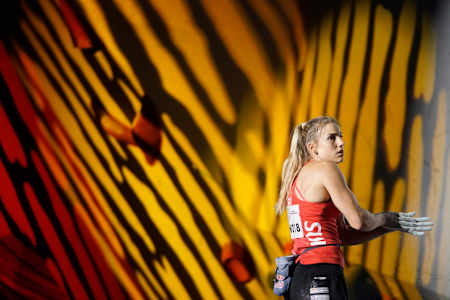
Klingler has earned a reputation as an extremely versatile climber
© Toru Hanai/Getty Images
As for strengths and weaknesses, determination and power are among her favourite attributes, along with stubbornness when faced with a difficult climb. Flexibility is a weakness. “Sitting easily in a split is hard for me,” she says. “High feet can be hard going, too. I tend to power through these coordination moves and I'm not loose enough, so I can work on that as well.”
06
Overcoming obstacles
Clearly, Klingler is someone with a strong work ethic, a great degree of talent and physical strength, and also mental toughness. “I’ve had a mental coach for the last couple of years,” she says. “Because I studied psychology I had a hard time loosening up. For me, mentally, the best method was just to talk with my coach. I learn by doing; every comp is different, every situation is different, and, in my opinion, you must learn what to do in the moment.”
She also had to overcome a physical difficulty, having been born with twisted feet. “It's called clubfoot, so I had a cast for nine months to bring my feet out and then I had extra shoes, night shoes from birth until nine months,” she says. “I needed to have an awareness of my feet when climbing,” she continues.
Today she says her feet are often stronger than most people born without clubbed feet. “I truly believe that climbing helped me to get over it, to increase or to make the process of healing faster. And when I performed badly, I reminded myself: 'Okay, if I were born in another country, or 100 years earlier, I wouldn't even be able to walk'. I'm happy to just be here as I am."
07
Switching it up

Klingler has enjoyed success in bouldering, lead, speed and ice climbing
© Marco Kost/Getty Images

Klingler on an ice climbing adventure in Canada
© Drew Leiterman/Red Bull Content Pool
As well as having to be extra aware of her feet when she started out, Klingler had to be ultra-aware of her body as she switched from ice climbing to rock. “It’s really challenging because even though we use the same muscle groups for ice climbing, I prefer dry tooling,” she says. “You use similar muscles, but it's still totally different – you have a bigger arm span with the ice axes and you can hold smaller holes, but at the same time it's like you're not as direct on hold as with climbing; you don't have the same sensation.”
She no longer boxes anymore, but loves mountain biking, skiing and cross-country skiing, naturally. “Anything without a ball,” she laughs. “In soccer, for example, I would have the ball, see someone, kick the ball and then the guy wasn't there anymore. 'Oh my gosh, he's over there now'. The anticipation in a team is very hard for me, so I'm happy in a single sport.”
When she isn’t moving, she likes to cook and bake at home. “It’s my time to just relax,” she says. “I barely use recipes, or if I use one, I'll change it. I love also eating, it gives me peace.”
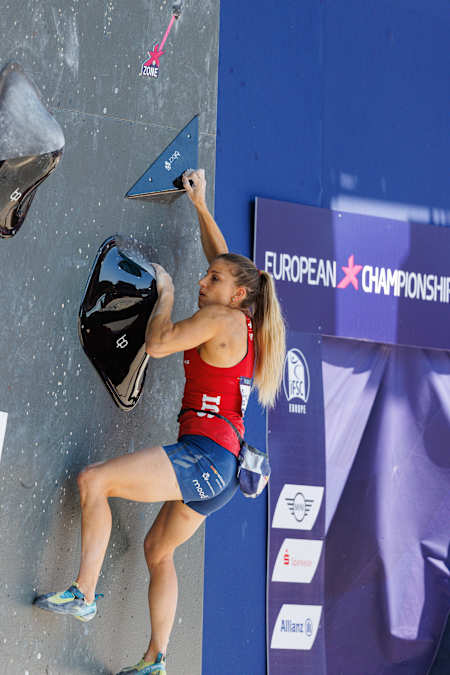
Klingler is unsure whether she will try to compete at the Games in Paris
© Marco Kost/Getty Images
08
The future
With Paris on the horizon, most climbers are setting their goals on that gold medal attempt. Klingler has mixed feelings. “It's hard for me, because on the one hand I'm getting old as an athlete and then there are all these new-style boulders and climbs,. They come naturally to the younger kids, but are harder for me.”
Klingler has been in training to learn the newer moves to qualify for Paris. This will be her last major goal in competitive climbing before she changes focus to outdoor climbing and pursuing new goals.
Outside of climbing, she says there are many things that she’d like to do in the future, but for now: “I'm just so happy where I’m at; I love my life how it is. I’ve enjoyed this transition from being this really focused younger athlete for whom results were everything in life, to someone relaxed and a little more appreciative of what I have."