





Gaming
Games
The Tetris games no one remembers
On the 30th anniversary of Tetris, we look at the spin-offs that didn't leave a lasting legacy.
Part of this story
Tetris
© [unknown]
Tetris is 30 years old this week. Ever since Russian programmer Alexey Pajitnov released the first Tetris game way back in 1984, Tetris has been released on nearly every games system known to man, with more than 500 million copies of the game sold to date.
To celebrate, we could have taken a look back at the Tetris games we love from the good old days – the Game Boy classic, Tetris DS, the more recent iPhone and Android versions – but you all know about them. So, instead we decided to tell you about the Tetris spin-offs that tried to capture the success of the original but, for whatever reason, couldn't quite replicate it. These are the Tetris games that no one remembers fondly.
Welltris (PC: 1989)
Welltris
© [unknown]
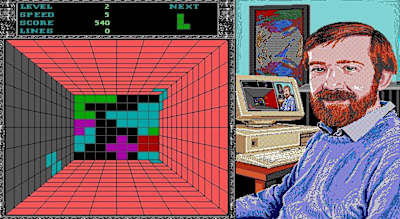
Over the years there were a few different games that tried to show Tetris from a different perspective. One of the first of these was Welltris, which was originally released for DOS in 1989 and came to Amiga and Mac a year later. It had the same basic objective as the original game but the player looked down into the well instead of viewing it from the side. This meant you had to drop blocks down into a 3D space, making sure they not only stacked properly on top of each other but alongside each other too. It was a decent enough game but Tetris was a success because it was so simple: Welltris was more complicated and that's why nobody remembers it.
Hatris (1990: NES, Game Boy)
Hatris
© [unknown]
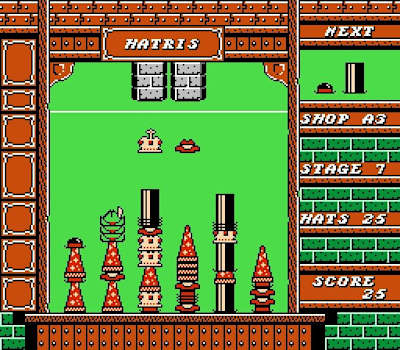
Welltris was just the first of a series of games that seemingly plucked random words out of the air and put 'tris' after them. The next was Hatris, a puzzle game that – you guessed it – had you stacking hats instead of blocks. It actually had more in common with colour-matching games like Columns because you had to make sure specific hats were stacked on top of each other to clear them. The twist was that each hat was a different size, adding an extra layer of strategy: you could stack loads of small bowler hats on top of each other without worrying about reaching the top of the screen, but throw in just a couple of top hats and you were in trouble.
Faces... Tris 3 (1991: Amiga, MS DOS)
Faces... Tris 3
© [unknown]
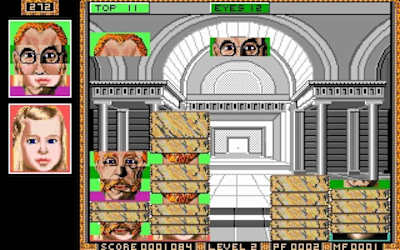
Giving up on the whole 'tris' naming scheme almost as soon as it had begun, Faces (not Facetris) had a similar idea to Hatris but took it a stage further. Instead of stacking items of the same type together, players had to place specific face parts on top of each other in order to make a face. If you successfully managed to stack a chin, mouth, nose, eyes and forehead, the face would be complete and would disappear, with extra points given for stacking all the features from a single person's face. It was a fine idea in theory but, because it was much more difficult than other Tetris games, most people lost patience with it fairly quickly. We suppose you could say they couldn't face it. Sorry.
Wordtris (1991: PC, SNES, Game Boy)
Wordtris
© [unknown]
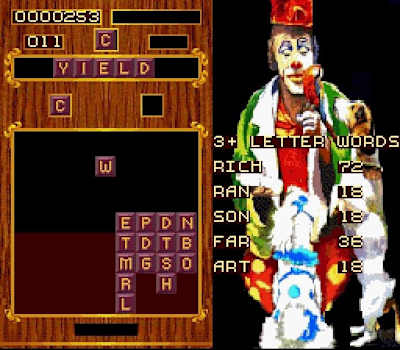
By this point you can probably work out what this game is about before we even tell you. Still, for those not sure what Wordtris entails, it involves dropping letters into the playing field and trying to use them to spell out words, which in turn would make them disappear from the well. Naturally, the bigger the word the more points you'd get and you'd also get bonus points for spelling out specific words. Wordtris was perhaps a little too complicated for its own good but years later, another game called Bookworm borrowed the same general idea and applied it to a 'match three' style control method instead. The game was a success, and all was right with the world.
Tetris 2 / Bombliss (1991: Game Boy, NES)
Tetris 2
© [unknown]
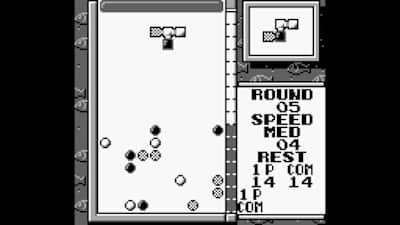
Despite all these mad Tetris variations, Nintendo decided to pretend none of them existed and instead released Tetris 2 on the Game Boy in 1991. It too owed more to colour-matching games than the original Tetris, with players using Tetris shapes to line up blocks of the same pattern in order to make them disappear. To make things more interesting, Nintendo also introduced bombs into the mix. These would blow up certain blocks, which was either a blessing or a curse: either it would help you clear annoying blocks that were in the way or ruin the perfectly constructed combo you had been preparing.
Tetrisphere (Nintendo 64, 1997)
Tetrisphere
© [unknown]
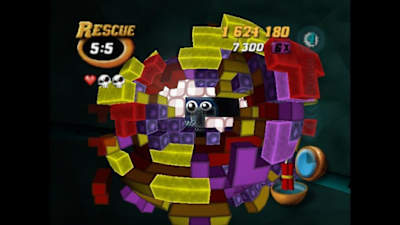
Released on the Nintendo 64, this bizarre little spin-off was about as different from the original Tetris as you could get. As the name suggests, Tetrisphere didn't take place in a well but instead had players rotating a giant ball. Armed with an array of Tetris blocks, the aim was to drop them onto the Tetrisphere and use them to chip away parts of its surface until you eventually reached the core in the middle. When the core was freed, that stage would be cleared and you'd move onto the next stage. It obviously never became as popular as the original classic but it did get a bit of a cult following at the time.
Do you remember any of these games? Let us know your memories of playing them in the comments below. Or leave your tributes to Tetris...
Part of this story

