
Music
How Compass Box Studio has championed Gujarat’s indie music scene
We talk to Raag Sethi, founder of the Ahmedabad recording studio, which has given indie artists a space to perform, record and document their music.
In just a little over a year and a half, Compass Box Studio has emerged as the most important platform in Gujarat’s independent music scene.
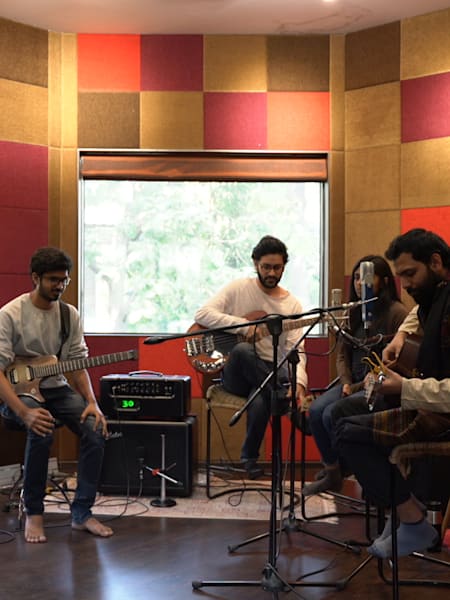
Since September 2018, the Ahmedabad-based enterprise has been producing for Indian indie acts from across the country a series of one-take video recordings of their tracks, which are published on its YouTube channel. And it does it all for free.
“It’s a way to support people who are making amazing music but don’t have the means or the knowledge to put it out there,” said founder, multi-instrumentalist, teacher and producer Raag Sethi.


He started the sessions because he wanted to fill the down time at Compass Box and simultaneously give independent musicians – who lack the resources to rent a studio – the opportunity to make a demo, which they could use to promote themselves. The series, as explained by the artists, has enabled them to gain new fans, score gigs and hone their skills.
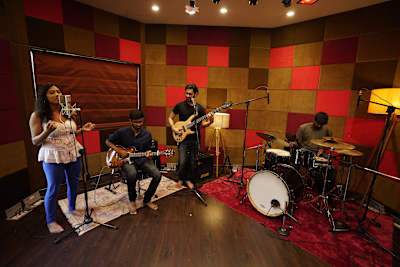
Compass Box Studio
© Siddharth Nair | Compass Box Studio
In March 2020, Sethi went a step farther and packaged and released on audio-streaming services an album called Compass Box Music – Unboxed Vol.1 featuring eight of the earliest recordings. It’s the first in a planned series of compilations that he aims to issue every three to four months.
Neither genre nor language is a criterion for Sethi, who initially tapped his network of local musicians for the series and now receives about a dozen requests from artists wanting to be featured. Among Compass Box’s alumni are neo-soul project Second Sight, the blues duo of Reema and Younglee, and jazz band Golden Monkeys.
Notably, the majority of the acts could be classified as singer-songwriters, the list of which includes fast-rising stars such as Aditi Ramesh and Hanita Bhambri. Sethi believes there are a couple of reasons for this. Not only is it easier for solo artists to travel to Ahmedabad, they’re also more likely to cover their expenses by landing a show in the city, where the live music circuit is dominated by cafes, he said.
Bengaluru, Bhopal, Delhi, Jaipur, Kolkata, Mumbai and Pune have all been represented in the series but over half of the performers – 19 out of the 37 so far – have hailed from within Gujarat and no less than 15 are from Ahmedabad. For young indie talent from the state, the studio “has been a game changer,” said Adhirath Sitoke, vocalist and bassist of Vadodara Hindi rock band Sulphur Snow.
Sitoke said that the group, which has been playing the country’s college competition and festival circuit for the last two-and-a-half years, didn’t have the means to make a video. After hearing about the sessions from previous participants like The Malakar Experience and singer-songwriter Shashwat Bulusu, they reached out to Sethi.
For their session, they laid down “Ho Tum”, a track which they’d already played at “over 50 gigs” and therefore “already had a fan base”, said Sitoke. With more than 20,000 views, the tune, uploaded in March 2019, is by far the most watched video on Compass Box’s YouTube channel. The recording equipped them with their first piece of audio-visual content and eventually helped them finalise gigs with venues such as Finch in Mumbai.
In other words, it served the very purpose for which Sethi created the sessions. Perhaps even more significantly, the series is one of the few ways independent musicians can test material in a dry state that lacks the pubs and nightclubs that make up the bulk of live venues in most other Indian cities. “Weddings, Bollywood and corporate events are a big part of a musician’s job here,” said Sethi. “They survive by doing commercial work.” His own band Heat Sink has performed in Ahmedabad only twice in two years.
For Vadodara and Delhi-based Bulusu, Compass Box provided the validation he was looking for after he decided to change course from a stripped-down style to a fuller sound played with a band. After he heard the final mix of his recording, he felt more confident that he was moving in the right direction and [that] “when we hit the road, we could pull this off easily”.
The session familiarised his existing fans with his fresh approach and introduced his music to uninitiated listeners. “Once in a while I go through the comments [under my video], and I realise there are [those from] people who haven’t heard any other music [of mine],” said Bulusu, who learned about the series before it had launched, from a common friend of Sethi and his, Meet Bhatt of Ahmedabad-based event company Fangirl Live. Today, Bulusu calls Compass Box “a rite of passage” for artists from Gujarat.
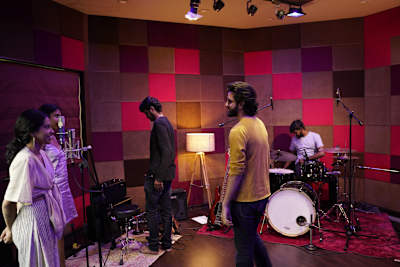
Aarifah Rebello and Ramya Pothuri in Compass Box Studio
© Siddharth Nair | Compass Box Studio
In exchange for the free demo, the visiting musicians sign a non-exclusive licensing agreement with the studio, which allows Sethi to distribute the tunes on various services. Because everything is done pro bono, Sethi, who arranges, engineers and produces the songs and regularly plays bass or guitar on them, relies on a team of volunteers to execute the sessions.
The crew includes mixing engineer Protyay Chakraborty, who also serves a violin player; Aaryaman Trivedi, who manages the social media accounts; singer-songwriter Meera Desai, who coordinates the recordings and occasionally renders backing vocals; assistant engineer Shankar Iyer; and guitarist Chirag Todi. Given how almost everybody in the Gujarat scene is connected in some way, it’s no coincidence that a lot of them are band mates or have worked in each other’s projects.
Todi, who learned to play guitar from Sethi, is the frontman of progressive rock and jazz group Heat Sink whose members include Chakraborty, Desai and Sethi. Chakraborty and Sethi were also part of the folk-jazz quintet Random Gyan. Sethi produced the debut EPs by Heat Sink and Random Gyan as well as that of Desai, who he performs with whenever she plays live.
The crew films three sessions in a day, each of which require varying levels of involvement and take three to four hours to nail, including about an hour or so of practice. “For singer-songwriters, if they’re coming as soloists, I’ll typically rearrange the track, either I’ll re-harmonise it or orchestrate it differently,” said Sethi. “I’ll add a drummer, a bassist and a violin player on top of it. For bands, they come and perform the song exactly the way they [originally] recorded it.”
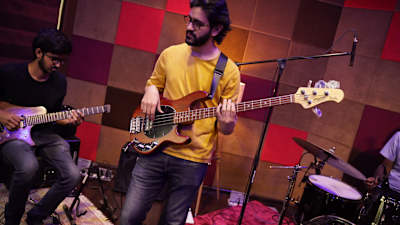
Raag Sethi in Compass Box Studio
© Siddharth Nair | Compass Box Studio
Apart from a brief stretch of five episodes from January to April 2019 which were bankrolled by Arman Financial Services – “the founder was deeply interested in indie music”, said Sethi – the sessions have been self-funded. Sethi’s looking for a sponsor and is considering crowd-funding the next season.
The money would be used to pay volunteers, for artists outside Ahmedabad to travel to the city, and for social media promotions. Despite the high-quality production, most videos have less than five thousand plays. “I don’t have a budget for ads,” said Sethi. “[All the views] we’ve got are completely organic. We’re starting to see the limitations of that. We need to push this out to more people. Our biggest issue is visibility.”
When he’s not in the studio, Sethi, who has a bachelor’s degree in Integrated Educational Studies, teaches English literature, global perspective and music at The Riverside School, which is run by his mother. The studio is located on the premises of the institute. He called it Compass Box because “it refers to the fact we’re in a school plus everything I needed [for my lessons] was in my compass box [like] my scale, my pencils, my pens”. “We want to be the compass box for artists,” he said. “We’ve got all the essential tools.”
The newest component in Sethi’s stationery kit is the Unbox compilations. “For those [acts] that don’t have any other recordings, it’s such a big deal for them to have their music on Spotify,” said Sethi who added that the collections are also a “way to show that you can have well-known indie artists and upcoming ones in the same album and support them equally”.
For bands, besides being a promotional vehicle, the sessions offer a rare chance to record live. “This is the old-school way of doing things with everybody in the same room,” said Sulphur Snow’s Sitoke who found the process fun as well as educative. “Raag has a lot of experience,” he said. “He had very good inputs for us.”
A key factor that makes Compass Box special is that Sethi and company have an insider’s perspective of the Indian indie music industry. “It’s an informal sector so a lot of [other] producers don’t take it seriously,” said Sitoke. “These guys understand the scene and what an artist goes through.”
Applications for the Compass Box Live Sessions are open. Click here to submit an entry via their Google form.


