











Red Bull Motorsports
F1
How fast can F1 cars go?
Formula One cars are built to push the limits of physics in the pursuit of faster lap times and a place on the podium. We dive into the breathtaking lap times at the pinnacle of motorsport.
Part of this story
Ever since 1950, Formula One has been the pinnacle of motorsport; an irresistible mix of high-speed action and engineering brilliance. The quest for speed is integral to the competition: a relentless pursuit of shaving milliseconds off lap times and pushing the limits of automotive engineering.
But how do F1 cars achieve high speeds, how fast do they go and what lies down the road?
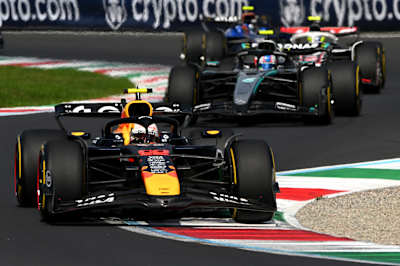
With fast straights and rapid chicanes, Monza is the Temple of Speed
© Getty Images/Red Bull Content Pool
01
What speeds can F1 cars achieve?
In 2025, Max Verstappen set the fastest-ever lap at the Italian Grand Prix, lapping Monza in 1:18.792 at an average speed of 264.681 kph (164.465 mph). It’s the highest average lap speed in a World Championship event – although it was in qualifying, so Lando Norris’s time of 1'20.901 set during the race is the official lap record.
The following day, Verstappen won the race in one hour 13 minutes and 24.325 seconds, making it the fastest ever F1 Grand Prix. Verstappen’s average speed was 250.70 kph (155.78mph), beating the previous record set in Monza by Michael Schumacher in 2003 of 247.58kph (153.81mph).
F1 cars can go faster in bursts: in 2016, Valtteri Bottas was clocked at 372.5kph (231.46 mph) racing at altitude in a Williams at the Mexico Grand Prix – the fastest-ever speed in a race. And at the Azerbaijan Grand Prix the same year, the Finn hit 378kph (234.9mph) speeding down Baku’s very long straight in qualifying to set the unofficial speed record.

Fastest of all time: Max Verstappen wins the 2025 Italian Grand Prix
© Getty Images/Red Bull Content Pool

Pierre Gasly wins the 2020 Italian Grand Prix
© Getty Images/Red Bull Content Pool
Meanwhile, the Guinness World Record says the highest speed ever seen in a Grand Prix was set by Juan-Pablo Montoya when he hit 372.56kph (231.51mph) during the 2005 Italian Grand Prix.
For ease of comparison, we’ll stay in Monza. Nicknamed the Temple of Speed, it’s F1’s fastest track, a circuit where cars run with minimal aero and drivers stay on the power. Monza has been the venue for some of F1’s fastest-ever laps. In 2004, Montoya averaged an eye-watering 259.83kph (161mph) in a Williams in Free Practice.
The Colombian’s record stood until 2018 when it was bettered by Kimi Raikkonen with an average speed of 263.59kph (163.78mph) for Ferrari. Lewis Hamilton raised the bar even higher in 2020 with a lap that averaged 264.36kph (164.26mph). And then Verstappen broke that record again in 2025.
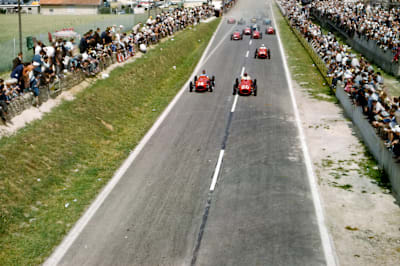
The 1953 French Grand Prix
© Getty Images
02
How do top speeds compare from decade to decade?
The home of the Italian Grand Prix, Monza has been a fixture on the F1 calendar since the first season in 1950, making it the ideal arena to compare lap times down the decades. It’s also been largely unchanged in that time, at least much less than the other original circuits. It was 6.292km (3.91miles) long until 1955 when it was shortened to 5.7km (3.6miles) and the high-speed banking was abandoned in the 1960s.
To compare eras, we’ve gone forward decade by decade, taking the average speed in racing, the fastest lap and the fastest qualifying lap – a single flying lap when usually the cars are quickest all weekend.
Driver
Team
Time
Speed (km/h)
1950
Winner
Nino Farina
Alfa Romeo
2:51'17.4
176.54
Pole
Juan Manuel Fangio
Alfa Romeo
1'58.6
191.23
Fastest lap
Juan Manuel Fangio
Alfa Romeo
2'00.0
189.00
1960
Winner
Phil Hill
Ferrari
2:21'09.2
212.53
Pole
Phil Hill
Ferrari
2'41.4
223.05
Fastest lap
Phil Hill
Ferrari
2'43.6
220.00
1970
Winner
Clay Regazzoni
Ferrari
1:39'06.88
236.70
Pole
Jacky Ickx
Ferrari
1'24.14
246.02
Fastest lap
Clay Regazzoni
Ferrari
1'25.2
242.96
1981*
Winner
Alain Prost
Renault
1:26'33.897
209.05
Pole
René Arnoux
Renault
1'33.467
223.39
Fastest lap
Carlos Reutemann
Williams
1'37.528
214.09
1990
Winner
Ayrton Senna
McLaren
1:17'57.878
236.57
Pole
Ayrton Senna
McLaren
1'22.533
252.99
Fastest Lap
Ayrton Senna
McLaren
1'26.254
242.07
2000
Winner
Michael Schumacher
Ferrari
1:27'31.638
210.29
Pole
Michael Schumacher
Ferrari
1'23.770
248.95
Fastest lap
Mika Häkkinen
McLaren
1'25.595
243.65
2010
Winner
Fernando Alonso
Ferrari
1:16'24.572
240.85
Pole
Fernando Alonso
Ferrari
1'21.962
254.44
Fastest lap
Fernando Alonso
Ferrari
1'24.139
247.86
2020
Pole
Pierre Gasly
AlphaTauri
1:47'06.056**
171.83
Winner
Lewis Hamilton
Mercedes
1'18.887
264.36
Fastest lap
Lewis Hamilton
Mercedes
1'22.746
252.03
2025
Winner
Max Verstappen
Red Bull Racing
1:13'24.325
250.71
Pole
Max Verstappen
Red Bull Racing
1'18.792
264.68
Fastest lap
Lando Norris
McLaren
1'20.901
257.78
* In 1980, Monza was closed for refurbishment, so we’ve taken Renault’s turbo-powered win in 1981 as our 80s example. ** Pierre Gasly took a superb win for then AlphaTauri (now reborn at Visa Cash App RB Team) but only after the race was red-flagged for 30-minutes after Charles Leclerc crashed out.

World champs: Sebastian Vettel and Max Verstappen in 2019
© Getty Images/Red Bull Content Pool

Two of the fastest drivers in history, Verstappen and Lewis Hamilton
© Getty Images/Red Bull Content Pool
03
How do F1 cars go so fast?
Top speeds and faster lap times are influenced by an array of factors, including quicker acceleration, stronger and more lightweight materials such as carbon fibre and better tyres.
Aerodynamics play a crucial role in determining the speed and performance of F1 cars with front and rear wings and the chassis shape pushing air down on the car to generate more grip. Downforce allows for higher cornering speeds and improved stability.
Fuel load also has an impact as the less fuel, the lighter and faster the car. The Brabham F1 team pioneered the tactical pitstop in 1982, realising it was quicker to do two low-fuel stints on low fuel and stop to take on more petrol and fresh tyres. When refuelling was banned, it put more emphasis on fuel economy and using hybrid technology to generate power.
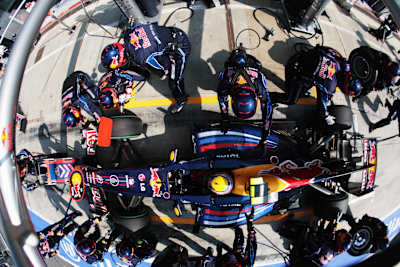
Tactical pit stops can help F1 cars pass on and off track
© Getty Images/Red Bull Content Pool
F1 cars can accelerate quickly thanks to turbocharged hybrid engines, known as power units. These power units consist of a 1.6-litre V6 internal combustion engine coupled with an energy recovery system (ERS). They are small, lightweight and powerful, producing around 1000hp.
Technical breakthroughs like computational fluid dynamics (CFD), skilled test drivers working in car simulators and AI that can reproduce numerous conditions, set-ups and scenarios all help teams and drivers maximise performance on race weekends.
04
What will happen next?
F1 in 2026 is run to a new set of regulations that will test the teams and drivers to the limit as they try to get to grips with the new technology. The power units now use internal combustion to produce 50% of their power and hybrid technology to generate the other half.
The tech is very hard to master. In the short term, lap times will get slower but as teams master the technology, lap times will fall and racing will get closer.
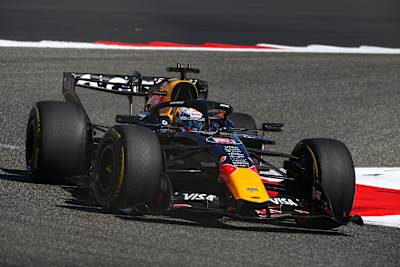
Max Verstappen puts the RB22 through its paces
© Getty Images / Red Bull Content Pool
To explain why the FIA and F1 changed the rules we can look again at that 2025 Italian Grand Prix where the top seven finishers all beat Schumacher’s 20-year record. With cars lapping at record times and the field incredibly close, it was time to shake up the rules.
Performances are now very spread out and there’s even a risk that back markers like Cadillac and Aston Martin may even break the 107% Rule. The rule says that every car’s best lap time must be within 107% of the fastest time set in Q1.
But this should all be temporary: the new cars are faster, lighter and more agile still with around 1000hp at their disposal. Most teams are already lapping faster than expected and as they unlock more electrical power, we could soon see the fastest cars in F1 history.
Part of this story


