
Basketball
Red Bull Half Court’s enduring gift to Chandigarh city
Built to host the India final of Red Bull Half Court, a state-of-the-art basketball court is now a new venue for city ballers as a public playground.


Design can shape a space – not just its physical form, but also the social milieu of the community around it.
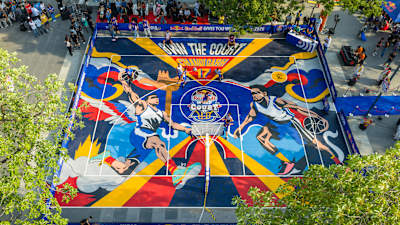
One such cultural moment is underway these days in Sector-17 of Chandigarh where a basketball court built to host Red Bull Half Court 2026 India Finals is now a new landmark in the city’s love for the sport.
While the primary purpose for the court – built and styled by Doodle Mapuls – was to host the event, the long-term vision was always to give something back to the basketball community by creating an opportunity for a shared public space that could deepen the city’s love for basketball and help to develop new talent.


The buzz around the court was palpable. What they created dazzled the regulars and lured onlookers to have a closer look, adding to the enduring legacy of the sport in Chandigarh.
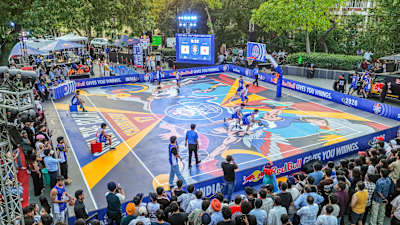
“Two moments took me by surprise. The first was when I saw the stunning mural on the court and realized how good the surface was to play. The second moment was when I realised that over 500 people had gathered to watch us,” says Eknoor Singh Johal, who sank the game winner from distance to help team 911 become Red Bull Half Court 2026 India Champions.
Red Bull Half Court 2026 India Final
© Focus Sports
Chandigarh’s love for basketball
Past the cliches of Mumbai as the Mecca of cricket and Kolkata being the spiritual home of football, Chandigarh has been unassuming about its zeal for basketball.
A rooted culture amid a tightly knit community, where the foundation of the sport is laid out in schools and honed at the various academies around town. And a comprehensive system in place to help promising talent make steady progress.
It has produced the likes of international players such as Amyjot Singh, Sartaj Singh Sandhu and Ravi Bhardwaj. The latter fondly remembers his school coach, Sardar Manjit Singh, gently prodding him to show up at practice. Once he decided to switch over from cricket, he graduated up the ranks to turn out for the university and city, before representing India at the Commonwealth Games in 2018.
“Chandigarh is not too big, so the courts are very accessible. Players get together regularly and there’s a lot of talent to watch and learn from,” Ravi says.
The artwork on the court
© Focus Sports
Designing the artwork
Once they jumped into the research, it took little time for Doodle Mapuls to make the connection between basketball and the city. They discovered a community-driven sport with a strong grassroots culture. Then, there was the legend of French-Swiss architect and urban planner Le Corbusier, who built the blueprint for Chandigarh city back in the 1950s.
All these elements were at the heart of their design, seamlessly blending basketball, Chandigarh’s city identity, and a new age artform.
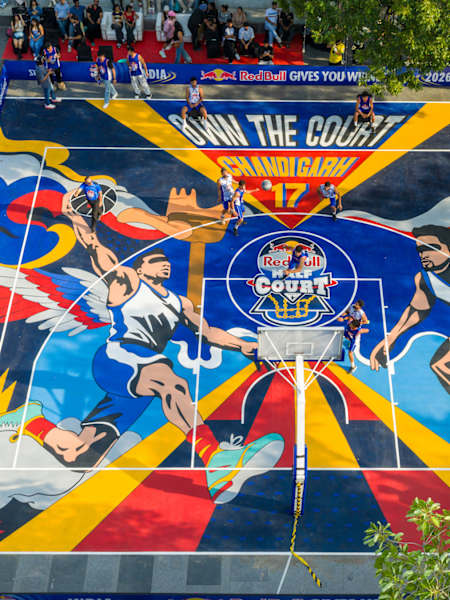
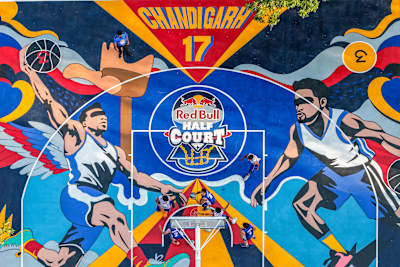
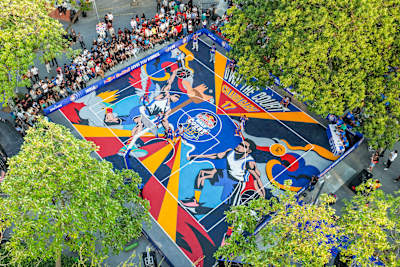
Their half court creation is striking, sitting pretty amid a canopy of trees. The mural depicts two ballers at play – one readying for a crossover; the other set to soar, buoyed by wings. The artwork also depicts Corbusier’s iconic Open Hand in one corner, and solid monochromes of red, blue and yellow that characterizes his art.
And towards the top of the design is a heartfelt message for Chandigarh hoopsters to ‘Own the Court’.
The court at Chandigarh sector 17
© Focus Sports
“The artwork combines geometric structures inspired by the city’s planned architecture, with fluid graphic movements inspired by basketball. We wanted the court to feel dynamic from every angle, so elements were designed to interact with player movement, speed and perspective. The palette was created to feel energetic, youthful and bold, something that reflects the intensity of basketball and the colours of Red Bull,” says Yash Shetty, who co-founded Doodle Mapuls with Kirthi Pillai and Amal Nair.
During the 10 days that they worked on the court, the neighbourhood would stop by to observe their skills, curious inquiries often extending to meaningful conversations. Local players who would play at a neighbouring rundown court hung out in anticipation of getting in a game on this spanking new facility.
“What stood out was the passion people have for the game at a neighbourhood level. The court isn’t just a sports facility, it’s a social and cultural space where communities gather, compete and connect,” Yash says.
“Hearing that the court made the entire space more alive and inspiring was probably the most meaningful compliment. As public artists and architects, creating that emotional connection with a space is always the goal,” Amal adds.
Long-lasting effect
The impact was clear. About 300 enthralled spectators lined up along the perimeter of the court on 16th May to watch the Red Bull Half Court 2026 India Finals – the first time the court was ever played on.
It was unlike anything that Jai Sachdeva had seen in the past, having travelled across the country as a basketball content creator and founder of No Look Nation.
“Basketball is a street sport and the vibe was very apparent court side. It’s bang in the middle of the market, so people would just stop by and get drawn in. A cheering crowd watching a handful of players is genuinely big for the basketball community,” Jai says.
Red Bull Half Court 2026 India Final
© Focus Sports
Teenagers walked up to Eknoor after the sweet revenge they exacted on John Deere, whom they had lost to earlier in the qualifiers. The interaction surprised him, unfamiliar with the world outside of the Panjab University courts in Chandigarh where he’s currently a student.
“Red Bull Half Court had a lot on offer for younger players in terms of exposure. Their interest in the sport is incredible to see. I had some really good interactions after the final,” Eknoor says.
Post event, the court now belongs to the city’s ballers. A public space to hone their skills and meet their match. Or just shoot hoops with the rest at the end of a long day. Uday Singh knows a thing or two about it, having heard all his life that basketball doesn’t have a future in India.
“Besides four public courts, Chandigarh only has private facilities where you need to either join coaching or get membership. A court as fancy as this one, created especially for an event, gets kids to realise that there is recognition for basketball and a platform to excel. That’s enough motivation for them and their parents to continue pursuing it,” says Uday, who turned out for Hoop Noobs and trains youngsters as a passion project.
In the time ahead, Jai wants to return to the court for a park takeover. He’s aware of the quality that awaits him.
“A good-looking court with a quality hoop where anyone can play safely. It’s a great way to make friends and build a community. And that’s how it all starts – you show up, then fall in love with the game and work until you are good enough to consider chasing it competitively. This is what courts like this enable,” Jai says.