When you think of ice skating, your mind likely conjures images of gravity-defying axel jumps and graceful forward spins. But what happens if you want to go faster than ice skating allows? If you’re like Dutch legend Kjeld Nuis, speed skating is the answer.
This ice skating discipline has a long history, from 13th-century Scandinavia to the world stage. It remains one of the most adrenaline-pumping events on the ice (or on the edge of your seat if you prefer to be a spectator). Read ahead for a guide to speed skating, from the science behind the high velocity sport, to the top speed skaters today.
Speed skating is a winter sport that, as the name implies, puts racing on the ice. Skaters sprint around an oval-shaped rink, hoping to claim victory as an individual or as part of a team relay. You’ll find both short and long-track speed skating events – and the difference goes beyond race length. While short-track speed skating is about crossing the finish line first, long-track races are time trials that are more focused on beating the clock.
Speed skating traces its roots back to Scandinavia and the Netherlands. While recreational speed skating likely originated around the 13th century, the first race wasn’t recorded until 1676. Official competitions didn’t kick off until the late 1800s in Norway, but by 1924, speed skating had gained enough popularity to earn a spot on the world stage.
All speed skating was what we know today as long-track skating until short-tracks were introduced in the 1960s. The International Skating Union (ISU) held the first short-track competition in 1976, and by 1992, short-track skaters were welcomed onto the world stage.
03
How fast do speed skaters go?
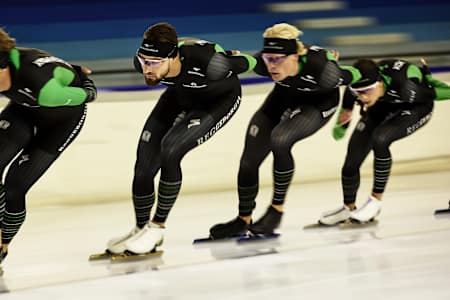
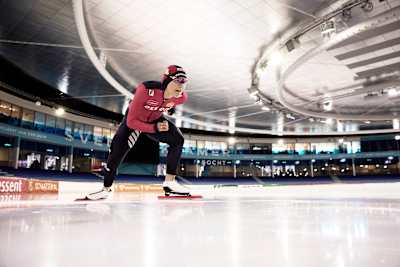
Joep Wennemars leads the team in a training session
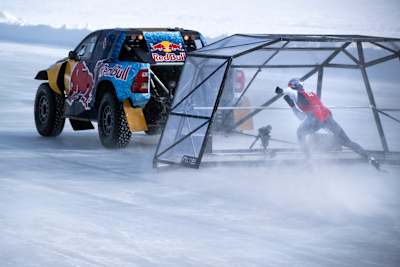
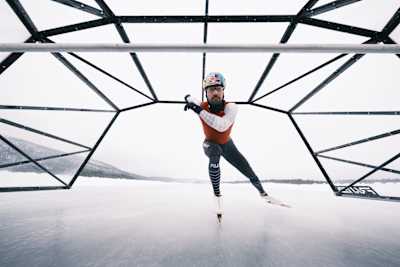
To say that speed skaters zoom around the track feels like an understatement. Skaters on short tracks usually reach about 48kph (roughly 30mph), while long-track athletes average 56kph (35mph). The current world record for fastest speed stands at more than double that, when Kjeld Nuis reached 103kph in 2022, beating his own previous record of 93kph, or nearly 58mph.
So how do speed skaters get so fast? The science of speed skating involves a combination of factors. First, the thin blades of their ice skates produce far less friction than the rubber soles runners use on a regular dirt or paved track. With less surface area impeding their momentum, skaters inherently glide pretty quickly. Professional skaters cut down on friction even more with specialised aerodynamic racing suits. Next is a good, old-fashioned technique. Speed skaters start with a strong push to propel themselves forward. The curved design of the track also adds the power of centripetal force.
Get to know speed skating's king of speed, Kjeld Nuis, in Winter Heroes below:
12 min
Kjeld Nuis
Get up to speed with the sporting phenomenon who has skated faster on ice than any human being in history.
English +6
04
The physical demands of speed skating
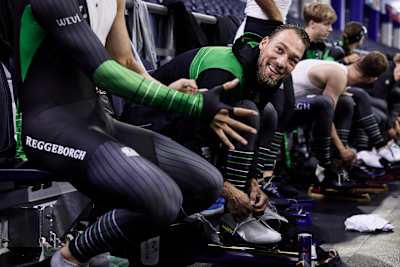
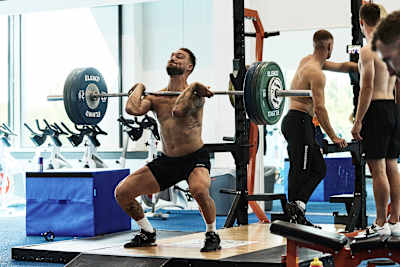
Weightlifting plays an important role in Kjeld Nuis's training
Skating as fast as a tiger can run doesn’t happen without a lot of hard work. Speed skaters train both on and off the ice to achieve the trifecta of strength, endurance and flexibility that’s required to win a race.
The key is a routine with a lot of variety. If you want to prepare for the full-body workout that is speed skating, you need to use all of those muscle groups from head to toe.
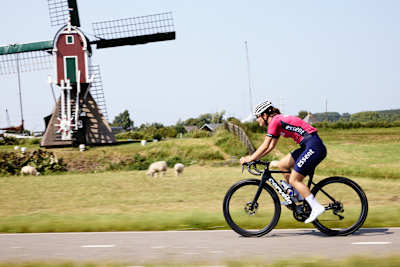
Long-track skaters in particular have to build stamina, so long runs and bike rides are often part of a professional speed skater’s workout regimen. Maintaining balance at that level of speed takes an intense amount of strength, so speed skaters will often include exercises like deadlifts and squats to build muscle mass. One-legged squats are also a great way to develop the muscle memory you’ll need to pivot on those corners.
It’s also important to work on drills that refine your racing technique. Once you’re comfortable with single-leg squats on dry land, try them on the ice – it’s OK if you need to stabilise yourself on the rink’s barricade at first.
Powerpushing drills are great for practising correct posture, as you won’t get far if you don’t keep your shoulders square and weight shifted to your hips. Slalom drills that have you manoeuvering around obstacles like cones will also get you accustomed to quick turns and shifting your weight at a moment’s notice.
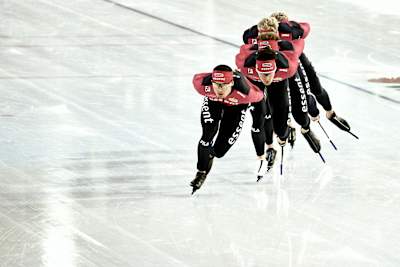
Speed skating on the modern world stage involves nine short-track heats and 14 long-track races. There are four individual men’s and four women’s short-track races, and as of 2022, a mixed-team relay event. Short-track competitors line up in a mass-start formation of four to eight skaters. Each race consists of multiple heats, blazing toward the finish line in hopes of advancing to the final round. So, for example, when Cathy Turner won the 500m gold in 1992, she raced multiple 500m-distance heats until she was in the final pair of skaters.
Long-track skating, on the other hand, only requires competitors to race that distance once.
There are seven races for men, ranging from 500m to 5,000m in length, while the seven events for women range from 500m to 3,000m. In addition to five individual heats, in which competing skaters race in pair formation, those seven events include one mass start and one team pursuit. The three skaters to cross the finish line first are awarded gold, silver, and bronze in order of who had the fastest time – which is measured down to one 100th of a second.
Speed skating has been part of the Winter Games since the Games’ inception in 1924, but women weren’t allowed to compete until 1960. German skater Helga Haase took home the first gold medal in the women’s event at the Squaw Valley Games. At the following Games in 1964, Lydia Skoblikova set a record that has yet to be beaten today, claiming gold medals for all speed skating events. Since then, athletes follow in their footsteps, paving the way for the next generation of women speed skaters.
Meet Winter Hero Angel Daleman in her episode below:
9 min
Angel Daleman
Poised to become the next idol of Dutch speed skating, Angel Daleman is a superstar in the making.
English +7
Speed skating equipment and gear
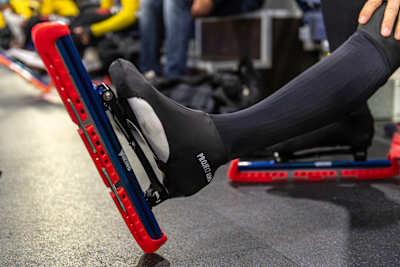
A modern speed skate is a high-tech piece of equipment
No matter how hard you’ve trained, your muscles alone aren’t enough to get you around the rink. Having the right gear is essential for taking those corners and maintaining speed.
Skate blades: Speed skates are specially designed with taller blades for added stability. Long-track skaters need the most support for the longer strides, with blades ranging from 40cm to 50cm. They’ve also got a hinge system that allows skaters to lift their heels while keeping the blade on the ice. Short-track skates are made for shorter steps and typically measure between 30cm to 45cm.
Skate boots: Crafted from carbon fibre leather, speed skating boots are made to fit like a glove. While the heel stays stiff, the rest of the boot comfortably conforms to your foot.
Suits: The goal of racing suits is to reduce drag, so they fit as skintight as possible. This aerodynamically designed uniform includes a hood and thumb loops for an even greater decrease in resistance.
Safety gear: When flying at high speed, safety protection is a must. A helmet is arguably the most important piece. Eyewear can also keep your eyes shielded from the wind, so your eyes don’t water up and obstruct your field of vision.
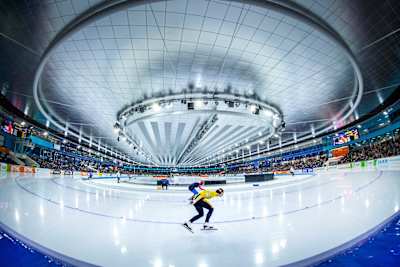
Long-track rinks are 400m. Some smaller or unofficial training events may be held on tracks of other lengths, such as 250m, but that isn’t the ISU standard. Skaters will have to navigate turning through curves of about 25m in radius and stay in lanes up to 4m in width.
Short-tracks, on the other hand, measure at just over 111m, the same length as a world stage figure skating or international-sized hockey rink. You won’t find delineated lanes on a short-track, but every corner is outlined with seven markers.
07
Top speed-skating athletes
Kjeld Nuis
Kjeld Nuis on his way to another skate speed record
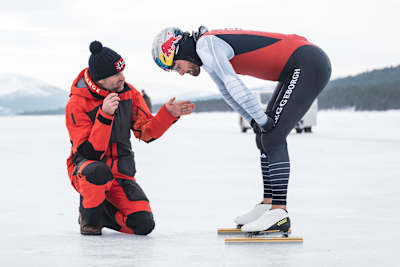
When Nuis set his first speed skating world record in 2018, things got a little hairy when he hit speeds of around 90kph. He later revealed it was hard to control his skates when he got to that point. But as Nuis himself has said, "what's dangerous is beautiful.” That attitude explains why Nuis decided to push his record even further just four years later – and that’s just one chapter in Nuis’ prolific skating career.
The Dutch skater’s quest for speed started at age seven. Not long after the precocious skater landed a spot on Brand Loyalty, a speed skating team led by esteemed skater-turned-coach Jac Orie. He started racking up wins early on, winning silver and bronze in the World Championships. Today, the fastest man on ice’s medal count includes four World Championships, three world stage games and 36 World Cup golds.
Joep Wennemars
8 min
Joep Wennemars
Speed skater Joep Wennemars has come into his own with titles like the 1000m World Champion.
English +6
Joep Wennemars’s career only began in 2021, but his rise has been almost as fast as he is on ice. Just a year later, he claimed victory at the World Junior Speed Skating Championships. At the end of 2022, Wennemars made his World Cup debut, placing high enough to advance from Division B to Division A. The Dutch athlete has both the speed and endurance to power through every distance, whether a race is 500m – his specialty – or 5,000m.
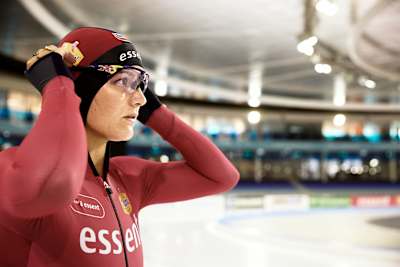
Firmly in the 'one to watch' category, Angel Daleman has surpassed even the loftiest expectations with her trajectory to date. With its rich tradition of speed-skating success and an unparalleled track record for producing stars of the sport, even her home country of the Netherlands has never produced a junior world champion as young as Daleman was when she became overall Junior World Champion in 2023, aged just 15 years and 327 days. Since then, she's pretty much swept the board at world junior level and is beginning to make her mark among the World Cup elite.
Speed skating may be one of the oldest winter sports around, but it continues to be one of the most exciting. Whether taking on a short or long track, today’s speed skaters are pushing the limits and inspiring fans along the way. Where will you be when the next Nuis defies the odds and breaks another world record? You’ll have to keep an eye on the world of speed skating to find out.