
Climbing
Reach new heights with these incredible climbing shots
Get ready to scale some of the world's most stunning rock faces, as these adventure photographers take you to the limit of the climbing world.
Red Bull Illume showcases the most captivating action and adventure photography on the planet, while illuminating the passion, lifestyle and culture behind the photographers who shoot them. With submissions for Red Bull Illume 2021 now open, we chalk up and follow the photographers capturing climbing in its rawest form and hear how they got their amazing shots.
A break in the weather
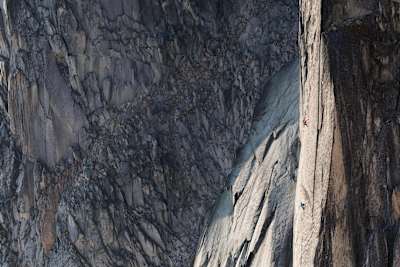
Jon Walsh and Michelle Kadatz climbing at Bugaboo Provincial Park
© Paul Bride/Red Bull Illume
- Photographer: Paul Bride
- Athletes:Jon Walsh and Michelle Kadatz
- Location: Bugaboo Provincial Park, British Columbia, Canada
The Shot: The warm sun was baking the inside of my tent and as I crawled out, Jon Walsh and his partner Michelle Kadatz were already up, drinking coffee and making breakfast. We were in Bugaboo National Park in British Columbia, Canada, and it was shaping up to be a beautiful day.
Jon and Michelle were putting up a new route on the Pigeon Spires and I was there to photograph their progress over the next week. I love shooting in the mountains, but the weather can change at a moment's notice and the Bugaboos are famous for bad storms.
Sitting atop a cliff I'd scrambled, I had a great view to capture the route, yet could also see a black sky and lightning moving in rapidly. The rain started and in an instant the storm was upon us. Jon and Michelle hunkered down in a chimney on the wall and I scrambled back to the glacier, seeking refuge under an overhang. Everything was soaked, including us. We all met up at the base of the route and thought the day was over.
Sitting on the glacier, we chatted and started to dry out. The sky was still black, but the rain had stopped and high winds blew through the valley, drying an exposed thin crack up the steep granite. The team still wanted to climb and decided to give the route a go. As they moved higher up the wall, I got into position, hoping the day wouldn't be a total loss.
Halfway up the route, a beam of sunlight broke through the black sky, shining directly onto the climbers. It only lasted a few seconds. It never hurts to have a little luck on your side.
Vision of commitment
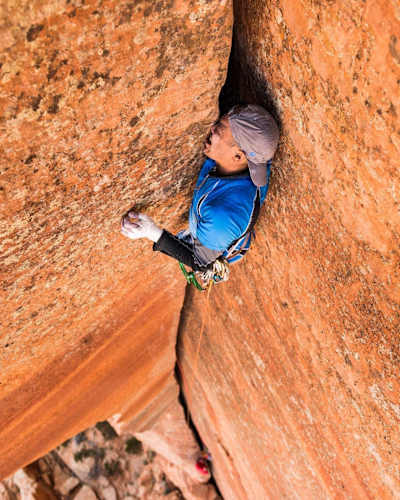
Pete Takeda giving it his all
© Greg Mionske/Red Bull Illume
- Photographer:Greg Mionske
- Athlete:Pete Takeda
- Location: Hildale, Utah, United States
The Shot: My throat went dry and my heart rate spiked as I lowered over the edge, my feet dangling in 200m of clear air. I wouldn't typically have this reaction, but I'd spent the last two years living a soft life in Brooklyn, New York. My prior eight years of alpine, ice and big wall experience was lying dormant somewhere deep inside of me. Lowering over this edge was my spring thaw.
I continued to rappel the slick sandstone face, my hands and feet quickly remembering what they should do. I came to a rest a couple metres above Pete and tied off.
Pete inched towards me. His breath was heavy. He looked miserable as he twisted, contorted and employed every trick in the book to make upwards progress. This image was made with roughly four metres left in the pitch. Unfortunately, in off-width climbing, the proximity of the finish means nothing. Every last move is physical and exhausting.
Pete made the last four metres, though not without struggle, and he arrived at the anchor in a battered state, dry-heaving and gasping for breath. I look at the image now and love how simply pain and struggle is conveyed through his squinted eyes, open mouth and curled hand. This photograph also ended up running in Alpinist, which was really special to me, since I'd spent a lot of time in college thumbing through that magazine thinking about how cool it would be to one day have a photograph printed in those pages.


Falling through the sky
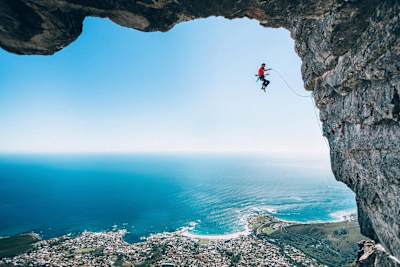
Jamie Smith getting airbourne
© Micky Wiswedel/Red Bull Illume
- Photographer:Micky Wiswedel
- Athlete: Jamie Smith
- Location: Cape Town, South Africa
The Shot: My buddy Jimbo had been opening new hard routes in the area and we wanted to try and capture some of the climbs. With climbing photography, it's not often you can just walk somewhere to get a good angle – most good shots require some form of rigging. The angle of this image happened by chance. We were setting up for another shot, but when I looked back I knew we had to change plans and grab the shot with the sea and horizon in the background, framed by this huge rock roof.
Lighting is also difficult, as climbers prefer to climb in the shade, because cooler temperatures provide more friction between skin and rock. This often means overexposed backgrounds and underexposed foregrounds. The best I could do in this situation was to shoot somewhere in the middle.
The route is one of the hardest on Table Mountain. The last 'crux' section is near the top – you have a few pieces of protection below, but there’s a final jump, or 'dyno', for the last hold. The image captures what happens if you don't manage to stick that hold.
There was always a chance that Jimbo would fall, so I was ready for it. For the couple of seconds leading up to the big move, I was holding my breath and ready to fire. I could definitely feel the adrenaline pumping. It's a pretty big and impressive fall, but luckily far from the ground – that doesn't make it any less terrifying.
We had planned to grab some cool climbing shots, but in the end, this image of Jimbo mid-air was the shot we felt captured the intensity of the climb. Jimbo did send the route that day – after a few more falls.
Canyon chasms
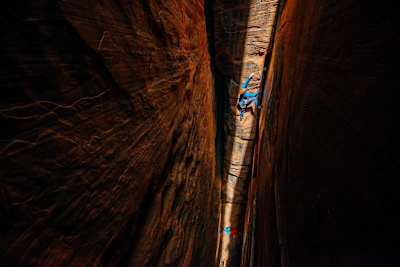
Rob Pizem illuminated as he climbs in Zion
© Jeremiah Watt/Red Bull Illume
- Photographer:Jeremiah Watt
- Athlete:Rob Pizem
- Location: Zion National Park, Utah, United States
The Shot: Rob Pizem has an eye for solid routes, so when he called with an especially wild line in mind, I was intrigued. What might lie in store this time? Meeting in the Zion visitor centre parking lot, we plotted. Apparently, this line was deep inside the mother stone, with a wide crack behind the climber and the face of the canyon wall.
Hoping the sun would be high enough to illuminate the dark chasm, I wanted to hold off on departing. A leisurely morning and a long hike found us above a black hole (twice the size of a body), rimmed with shrubs and small aspen, a crack flowing out to the canyon wall.
Roping up, I rappelled into the unknown with zero expectation. After dropping through darkness I slid into a wild chasm, wider at the top, pinching to a few feet at the bottom. A few hundred feet behind, light poured through a crack in the canyon wall illuminating the back wall.
At first, the ray of light was less pronounced on the climber's left. While we waited it began to focus and strengthen. Hoping it would become a solid band I could frame Rob in, we waited. As it hit the left side of the back wall, it focused into the ray seen in the photo and Rob headed up. A few moments later he and the light crossed paths. I hammered on the shutter, working at balancing exposures and hoping for a usable frame. A few minutes later it was gone. The phenomena lasted but a few minutes and we were lucky enough to bathe in it.
Into the crack
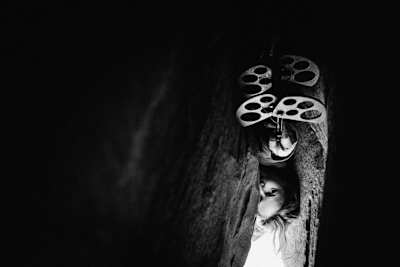
In the slot
© Jeremiah Watt
- Photographer:Jeremiah Watt
- Athlete: Pamela Shanti Pack
- Location: Indian Creek, Utah, United States
The Shot: The North Six Shooter is a sliver of sandstone in Indian Creek, Utah. Two classic rock routes adorn its east face – Liquid Sky and Lightning Bolt Cracks. Lightning Bolt is an all-time classic on most desert rats' bucket list of desert towers. Liquid Sky is its infamous brother, widely known for its suffocating squeeze in a roof and sustained off-width climbing.
Pamela Shanti Pack is an off-width aficionado who's made her mark putting up wide first ascents. The standard path on Liquid Sky entails a tight squeeze up the inside of the tower, avoiding the Bombay-style roof that juts over space a few hundred feet above the jumbled talus cone and a high over the desert floor. Pamela wanted to change that. Enrolling Scott Turpin's help for rope work and logistics, Pamela headed south.
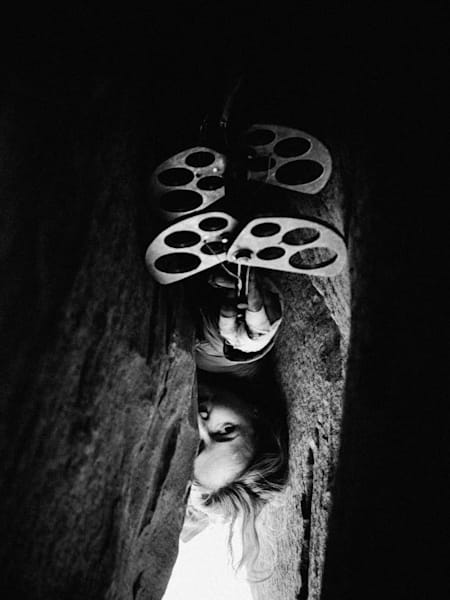
My hope in documenting the attempt was to catch her somewhere in the slot, upside down, with the desert floor in the distance. Unfortunately, lines didn't work for what I had in mind. As I was hanging above, with Pamela struggling below, I pulled into the wide crack looking for possibilities. As she pulled into the roof, there was a moment where I could make out a face and eyes. I pushed the shutter hoping for the best. This image was one of the few that came through.
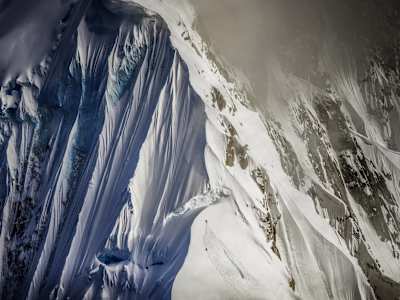
Dramatic climbing on Mount Huntington
© Tim Kemple/Red Bull Illume
- Photographer:Tim Kemple
- Athlete: Unknown
- Location: Mount Huntington, Alaska, United States
The Shot: Alaska's Mount Huntington may not have the altitude of nearby Denali, but it more than makes up for it in steepness and technical difficulty. In all directions the peak climbs 2,000m in less than two kilometres. This dramatic climb from the glacier below creates some of the most technical and difficult climbs in the entire Alaskan range.
The peak was first climbed via the Northwest Ridge, aka the French Ridge, in the 1960s and while experienced climbers climb it a couple of times a year, I've never seen an image that captured the exposed nature of the peak. It's been a dream photograph of mine since I first laid eyes on it in a magazine as a child.
While working with the National Park Service in 2014, I was lucky enough to explore the entire range over several days, while shooting from a helicopter. To capture this image, I was on an aerial flight in the afternoon. Wearing a harness for safety, the helicopter circled the climbers on the peak and I opened the door, leaned out and snapped this shot.
The whole world in his hands
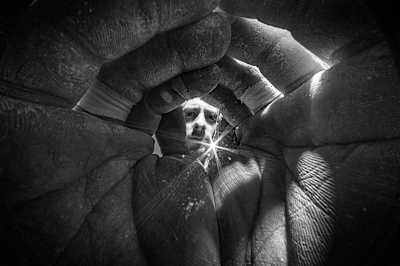
A handy portrait of Nacho Sánchez
© Oscar Carrascosa/Red Bull Illume
- Photographer:Oscar Carrascosa
- Athlete:Nacho Sánchez
- Location: Albarracín, Spain
The Shot: The day I took this photo, I was in a village near to El Escorial near Madrid, spending a weekend with the climbing team of Trangoworld.
After two days of shooting in the Spanish bouldering paradise, I decided that this time I didn't want to limit my work to doing action shots. I felt that I needed portraits of the athletes, so I decided to try to mount the tripod with the camera pointing at the sun and my fisheye lens. I asked the whole team to pass by pretending to look into a hole, to infinity.
Undoubtedly, I got my objective with the help of Nacho Sánchez, his weather-beaten skin, the serious look, the sun at the perfect height and the tape on his fingers showing the effort that they make to conquer those routes.
Red Bull Illume is currently open for entries. Submissions are due by July 31. Click here to learn more about the 2021 competition.


