





Bike
MTB
8 tips to help you prepare for downhill mountain biking in India
If you want to get started in downhill mountain biking but don’t know how to train for it, read these tips from some of India’s best in the sport.
India has a wealth of natural resources and opportunities when it comes to downhill mountain biking (DH MTB).
A typical downhill mountain biking run is 2km in length and strewn with obstacles like rocks, jumps, drops, berms, roots, mud, etc.
We spoke with some Indian experts in DH MTB – Vinay Menon and Gautam Taode from Pune, Tenzin Jampel from Leh, and Ismamul Howk from Guwahati – for their tips on how someone could get started in downhill mountain biking in India.
1. Setting up your bike

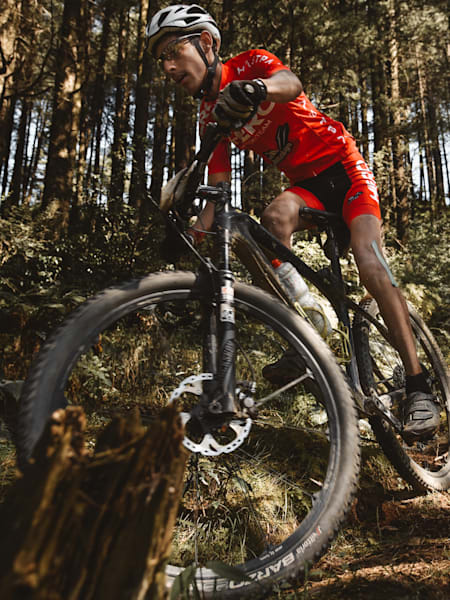
Set up your MTB according to what feels comfortable
© Sreerag KB
Bikes for DH MTB tend to be heavy with big rotors, wide handlebars (730-810 mm wide), larger tyres (2.5-2.7 inch width), and more suspension (up to 215 mm). Every rider adjusts the setup according to their personal preference.
“The saddle is lower than the handlebar level to keep better control on the trails and to move the bodyweight around easily. The traction of pedals is important. There are two kinds of pedals – clipped-in and platform. Riders use them as per their preference and expertise level. Suspension sag is 2.5” usually. General rule of thumb is to keep a 10% suspension sag,” says Vinay Menon, a veteran of downhill mountain biking in India.
“[It is important to adjust your] tyre pressure as per the terrain conditions. The pressure is usually kept around 22-25 PSI and goes all the way up to 40 PSI for big jumps,” adds Vinay.
2. Practice your body positioning while riding
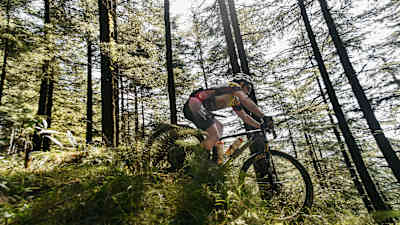
Shift your weight behind the seat on a steep downhill
© Sreerag KB
It is extremely important to have control of your bike when riding downhill mountain trails. To do this, you will need to learn how to shift your bodyweight on the bike. Practicing on a pump track before you hit the downhill trails is the best way to learn how to shift your bodyweight on the bike.
“Body position and stance on the bike is very critical for downhill mountain biking for every obstacle,” says Gautam Taode, the 2021 National Downhill Mountain Bike Champion.
“You need to know the centre of gravity from the bottom bracket of your bike, and then you play around that area to overcome obstacles on trails. For example, on a steep downhill, you will need to shift your bodyweight behind the saddle and towards the rear wheel. [When riding downhill] the key is to learn to distribute your bodyweight using your hips,” says Gautam.
3. Learn how to feather the brakes
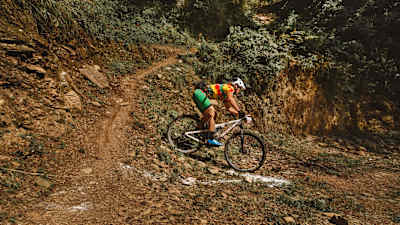
Feather the brakes on turns and around obstacles
© Sreerag KB
Feather-touch braking, aka one-finger breaking, is most used on downhill trails. Practice this braking technique before you hit the trails. Also make sure the brake levers are comfortably positioned for you and the brake system is working perfectly.
“The brake levers need to be correctly positioned as per the personal preference. Some like it closer to the bar grip and some prefer it to be farther. Identify what suits you best. Also, modulate the front and rear brakes as per the terrain conditions and challenges. Use front brakes more often to keep the bike in control before the corner and steep sections,” says Tenzin Jampel, who runs a company called Explore Ladakh to promote bike tourism in the region.
4. Study the trails before you ride them
Downhill mountain biking can be a very fast sport. You could hit an obstacle before you realize it if you don’t spot it fast enough. The best practice is to look four-five meters ahead of your bike instead of focusing on your front tyre.
“Before riding your bike on the trail, take a walk on the trail. Visualize how you will run the bike through various obstacles and which line you will take if there are choices,” says Ismamul Howk, the 2020 National Downhill Mountain Bike Champion of India.
“I always walk the trail a couple of times and visualize myself riding it. Then, I ride the sections in training and practice a few of them over and over to improve my timing,” he adds.
5. Identify the best regions to go downhill mountain biking
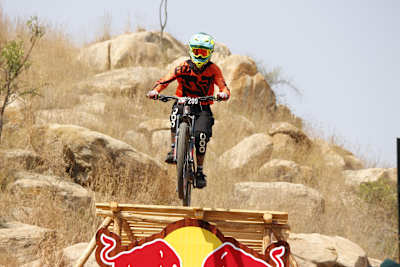
Downhill biking at Bangalore Mountain Festival 2018
© Unknown
India has a lot of options for mountain biking. Some of the top MTB events in India take place in Shimla and the rest of Himachal Pradesh, Pune, Bengaluru, and Northeast India. These are also usually the best locations for downhill mountain biking, however the terrain and weather in each region differs extensively.
“Pune offers a tropical climate terrain with tight mud, loose sand, and volcanic rocks during summers, and it changes drastically in monsoon when it becomes too slippery. Bangalore also offers the same terrain conditions but with huge rock faces to tackle,” says Gautam, who has been riding in Pune for a decade.
“States like Arunachal Pradesh, Assam, Shillong and Nagaland offer untamed and wild downhill terrain conditions. There are sniper roots you will have to keep an eye on, slippery soil almost all through the year, and moisture in the air throws a different set of challenges altogether as compared to the other regions in India,” says Ismamul, who is a native of Guwahati and enjoys exploring trails in the north eastern states.
Manali is one of the primary downhill mountain bike destinations in India and has similar conditions as Northeast India. Additionally, the Higher Himalayas of Leh and Spiti are also great destinations but are cold and dry, and require acclimatization before you can ride.
6. Get all the necessary safety gear

Wear helmet, goggles, gloves, and other necessary safety gear
© Sreerag KB
Body protectors and guards are mandatory before you go for a ride.
“There are severe falls in downhill mountain biking. Things can easily go sideways. A full-face helmet with a non-removable chin guard, knee and elbow pads; these are very important. Wear comfortable clothing that won’t hinder your downhill runs,” says Ismamul.
“You will also need full-finger gloves, goggles, sturdy trousers and protective shorts. Some people also use back and neck braces, which I think are very important for beginners,” he adds.
7. Develop your riding skills
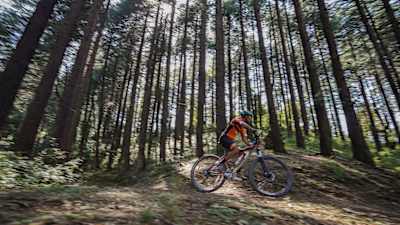
Watch videos of your rides to see where you can improve yur technique
© Vikas Balram
The best way to develop your riding skills is to spend more time on the bike on trails. You could ask someone you record a video of you riding the trails to see where you could improve your skills. If you are having trouble with a particular section of the trail or a particular type of obstacle, practice that as much as possible.
“Move your hips around to distribute your weight on the bike. Do it on a flat section first before hitting the trails. Pump track is a good place to teach yourself how your bike behaves on corners and berms, and what should be your pedal position on turns. Practice these until it becomes second nature when you’re on the bike,” suggests Gautam.
8. Do some strength training
Work on strengthening the body parts that get fatigued during downhill mountain biking. This will help you keep control of the bike, give you mental clarity, and help you avoid injuries.
“I usually stick with bodyweight training like pushups and squats. I do not lift weights. I like to do sprints on the bike at the end of my long endurance rides to develop my cardiovascular and anaerobic system,” says Ismamul.
“Weight training and core exercises are the way to go. My workouts include bench press or push-ups, deadlift, squats, planks, superman, shoulder raises and glute bridges,” says Gautam.
