
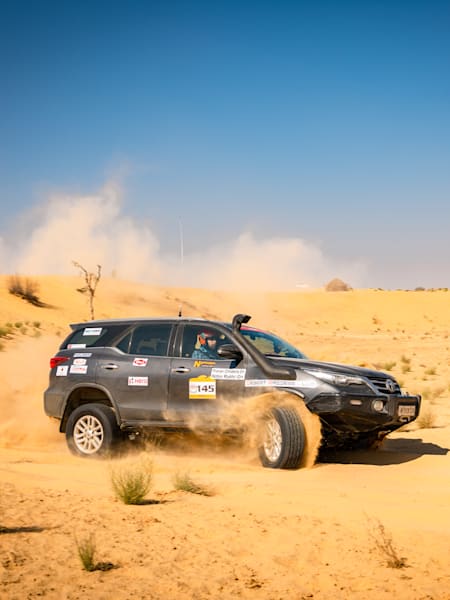
Rally
8 tips for off-roading in the sand dunes of Rajasthan
The organizer of Ultimate Desert Challenge 2021 and the rally winner list out important advice for newbies planning a drive in Rajasthan’s deserts.
Off-roading has picked up as a sport and leisure activity in India. And the sand dunes of Rajasthan are sought after for being a special challenge.
Keeping this in mind, Arvind Balan started conducting the Ultimate Desert Challenge (UDC), a rally for off-road enthusiasts who don’t necessarily harbour professional dreams. The rally had its seventh edition in February 2021 when it was conducted at Bikaner.
“There is a huge upcoming population in India that has 4-wheel drive vehicles, and who want to venture out and test themselves against desert,” says Arvind.
“But at the same time, they are not professionals, and they don’t even want to be. For them, we thought we should come up with a format that gives everyone with a four-wheel drive vehicle an opportunity to have a taste of motorsport.”
Kabir Waraich had first gone dune-bashing in 2008, as most tourists in Rajasthan do. But unlike others, Kabir was hooked. After that point, he would often hire local 4x4 vehicles and go out in the desert with a group of friends.
The Chandigarh-based driver, who first participated in UDC in 2015, clinched his fourth title at the 2021 edition.
Arvind and Kabir list out a few tips on how to tackle the sand on four wheels and how to go off-roading in Rajasthan.
1. Start with a stock vehicle

Beginners can learn with stock vehicles
© Work 360
One of the unique things about the Ultimate Desert Challenge is that drivers can attempt it without any modification to the vehicle.
And both Arvind and Kabir believe that that’s the way to go for drivers who want to go off-roading in the desert for the first time – start with a stock four-wheel vehicle.
“Don’t do too much modification. Use your skill, not the vehicle’s upgradation or modification. That will help you hone your skill. I started out in 2008 in a Gypsy that wasn’t specifically modified for off-roading,” says Kabir.

2. Take on smaller dunes
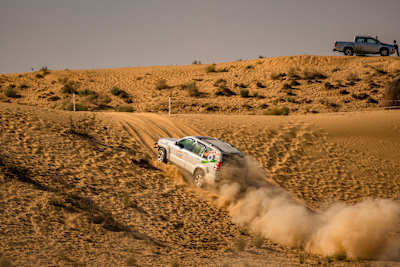
Smaller dunes for beginners
© Work 360
For beginners attempting driving in sand in Rajasthan, the undulating dunes of Jaisalmer may not be the way to go.
Arvind, who was born and raised up in Rajasthan, believes that Churu, which is a three-hour drive from Jaipur, and five hours away from Delhi and Chandigarh, could be an ideal place to start. Churu is located near the Shekhawati region, which is considered as the gateway to the Thar desert.

3. Take the appropriate safety measures
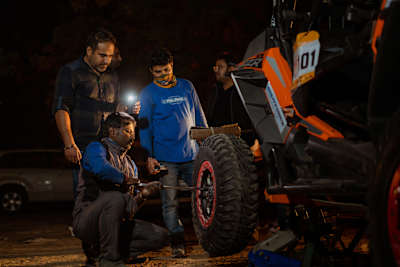
Kabir Waraich and team conduct a safety check on the car
© Work 360
For off-roading in general, and going out in the unmapped vast expanses of sand in particular, safety measures should be a priority.
“If you are venturing into unknown sands, unknown areas, you should never try it alone,” says Arvind.
“It is very important that your vehicle is properly prepared. You should have some recovery equipment with you, some shovels, sand ladders. You should have emergency rations if you get stuck, lost. You should carry a lot of water. You should try to have some kind of communication equipment, usually there are no phone networks there. If you are in a convoy, a group of vehicles, usually carry free frequency. It is always better to attempt it in groups, of at least two-three vehicles, so that if one vehicle breaks down, another can either help or can get help.”

4. Reduce the air pressure in your tyres

Lower tyre pressure will help on sand
© Work 360
This is one of the most basic, yet critical things. Reduce the tyre pressure before embarking on a drive over sand.
“The more the surface area, lower the chances of getting stuck,” says Arvind. “When you reduce the pressure, the tyre flattens, so more surface area of the tyre will be in touch with the sand and less of it will go inside the sand. It will almost float on the sand. It is also important that you don’t reduce it too much. If you do, when you are turning, the tyre may come off the wheel.”
The ‘ideal’ tyre pressure will vary according to the car and the model. But Kabir says that he reduces the tyre pressure by almost half when hitting the dunes.

5. Understand the terrain and what sand is good to drive

Kabir Waraich at Ultimate Desert Challenge 2021
© Work 360
Not all sand is made equal. You should always look for more settled, ‘harder’ sand to reduce the chances of sinking in it.
“If you are going for the first time, or attempting off-roading in an absolutely new area, it’s always better to try and find a tyre mark, even if it is from a camel cart,” says Arvind.


“But if there’s no tyre mark and the sand dunes are completely fresh, then it is very important [to understand] what kind of sand it is. What you can do is, park your vehicle before entering the sand and simply walk a few steps over the sane so you know how soft it is. However good the driver or the vehicle, if the sand is too soft it will be tough for beginners.”

6. Pay attention to the power-to-weight ratio of your vehicle

Kabir Waraich displays the perfect use of power-to-weight ratio
© Work 360
More than engine power, it is the power-to-weight ratio of the car that determines the drive.
“A Polaris has only 800 or 1000cc engine, but it goes very well over sand when compared to cars with much bigger engines because it has is low weight,” Arvind explains.
“So while the engine is small, the weight is also less. Power-to-weight ratio of a Polaris is much higher than an Endeavour or Fortuner. At the same time, it doesn’t mean you can’t drive in the sand with bigger cars, but you should understand your power-to-weight ratio before doing so.”

7. Take on dunes where the angle isn’t too steep and visibility is high
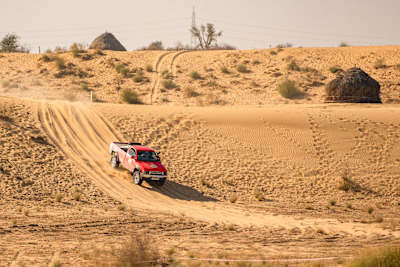
Make sure you can see where you are driving on dunes
© Work 360
It is very important to understand the angles when you are driving on sand. You should always look to drive on an angle that is not too steep.
Every sand dune will be smoother to climb on one side and steeper on the other. If the angle is too steep and you can’t see what’s on the other side, you may be in for a drastic drop. That can break or overturn the vehicle, so make sure to avoid such dunes.
It is important to be comfortable with the angle. You should try and drive on angles which are smoother and visible, most importantly. Ideally, you should follow your line of sight. You should not venture into something that you can’t see.

8. Maintain momentum instead of driving fast
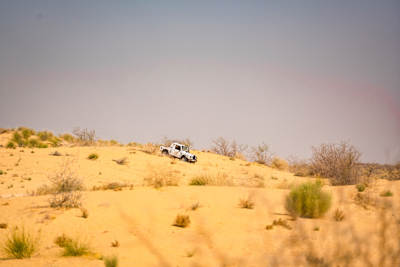
Don't try to go too fast on sand dunes
© Work 360
Momentum, rather than speed, should be the element you should be focusing on when driving on sand.
“If you stop or hit the brakes in very soft sand, there are higher chances of you getting stuck,” says Arvind.
“We never park our vehicle in such positions where it will be difficult to move again. We always park on a forward slanted (downhill) surface. When you enter sand, it is critical to move at a constant speed, which does not necessarily mean you have to be very fast.
“[A constant speed] will help your car move smoothly and your tyres won’t get stuck. If you apply brakes or hit the accelerator too hard, then the car gets stuck. As soon as the wheel spin starts, the tyre gets stuck. Not too much, not too less, a constant, consistent momentum is critical.”