






Gaming

Games
Here are 5 things we want to see in Beyond Good and Evil 2
Pigs, monkeys, and an entire solar system to explore. Here’s our wish list for Beyond Good and Evil 2.
When the original Beyond Good and Evil released in 2003, it flopped. It's difficult to get a brand new intellectual property off the ground, let alone one starring a photojournalist and a pig. The game tried to do a lot – too much, in some people's estimates. There was third person combat, stealth, vehicular combat, aerial combat, dungeon crawling, photography, and action RPG elements.
But what some see as scattered, others see as diverse. Beyond Good and Evil developed a large cult following – large enough that the game was remastered for Xbox Live and the Playstation Network in 2011.
In 2007, sequel rumours materialised. But the development of that sequel has been fraught; we still don't have a release date, though we've seen trailers and gameplay demonstrations. And, perhaps in fitting fashion, this game, likes its predecessor, suffers from its own identity crisis. What Beyond Good and Evil 2 is, versus what long-time fans want it to be, seems at odds. But development is still in progress, and it's not too late to find consensus.
Here are five things we want to see in Beyond Good and Evil 2:
1. A consistently detailed world
The most recent Beyond Good and Evil 2 gameplay videos take place in the city of Ganesha, on the continent of New India on the moon of Soma. Soma orbits around the gas planet Dyaus, which is part of the System 3 solar system. The demo showed the player/character exploring buildings, rising above the buildings, and escaping the moon's atmosphere without a single load screen. Ubisoft claims that Ganesha is merely one corner of an entire system we can explore. There are other cities on Soma, not to mention on moons and planets beyond Soma.
It begs the question: how big, exactly, is this game? To imagine multiple cities, on multiple moons and multiple planets, that are as populated and detailed as Ganesha, is a high bar. World of Warcraft takes place on Azeroth, a single planet in a larger solar system. Even the upcoming, ambitious Cyberpunk 2077, which this game has been compared to, to depicts a single city – Night City – on a dystopic planet Earth.
If this staggering scale becomes a reality, it will be a groundbreaking, unprecedented achievement. But if there’s any chance that the developers will fall short of these lofty objectives, then Ubisoft should scale down expectations and keep this game's universe dense, yet detailed.
If there are only a few planets and moons that are inhabitable and explorable, and not an entire solar system's worth? Then tell players, explicitly. Let them anticipate something they'll love, rather than be disappointed by something they were never going to get in the first place.
2. A linear, explicit, single player narrative
Beyond Good and Evil 2 will take place years prior to the first game. They've also told us that Jade and Pey'j will appear in the game, but in non-player roles.
Instead, you'll play as a space pirate captain, who you design and customise as a clone/hybrid of other humans and animals. You'll be paired, via multiplayer, with other player-customised space captains to complete missions; you'll move from the bottom rungs of this society to legendary space pirate. A solo playthrough is possible, but that does not appear to be the focus.
The first game was an intimate journey. Everyone played as and followed Jade from beginning to end, and emerged with a similar, shared emotional experience. The sequel's focus, upon a character that will be customised to fit hundreds of thousands of people's tastes, feels ironically more impersonal.
Perhaps we're wrong, and there will be a relatable, heartrending story about this cloned space pirate, and his/her misadventures with other cloned space pirates. But based on what has been revealed to us, thus far, this story feels like the frame narrative for an MMORPG, rather than the focused, single player character arc. It's not bad, per se, but it's different from what many people were expecting. It feels less like Beyond Good and Evil 2, and more like Beyond Good and Evil Online.
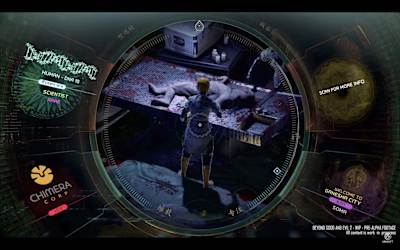
Analyse who will make an excellent crew member
© Ubisoft
3. Dungeons
Dungeons with platforming puzzles, levers and gears that turned other gears, were a key part of the prior game. But the time and consideration these types of puzzles require are not well-suited to multiplayer chaos. Lots of players want to progress as quickly as possible, without observing which ropes raise which bridge.
Ubisoft have stated that co-op players will not need to stick together. But hopefully, there will be some dungeons that are complex enough to demand it. There needs to be some nonverbal way for strangers to communicate in-game. Perhaps through emotes? Not every player has a microphone or wants to communicate via headset.
The multiplayer puzzles should require both players. Perhaps, one needs to push a button while the other turns a crank. Otherwise, there's a limit to how interactive, and how complex, these puzzle dungeons can be.
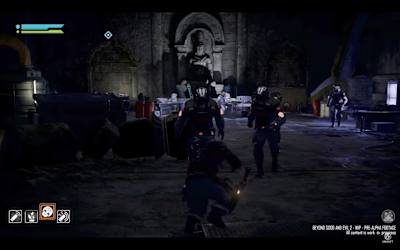
You're armed with a sword, a gun, and a jetpack
© Ubisoft
4. Passive combat options
The first game had stealth sequences that could be completed with minimal combat, so long as Jade stayed in the shadows and out of Alpha Section's line of sight. Even her primary weapon, a staff, was in line with this ethos. It felt more defensive and less offensive than, say, a sword or a gun.
In this sequel, however, your character starts with a sword, a gun, and a jetpack, which can later be augmented and enhanced. It implies that combat is a greater focal point this time around.
When playing co-op, particularly drop-in co-op where anonymous strangers can come and go, it's difficult to approach a situation in a stealthy manner. One player might want to charge in guns blazing. And even if all players decide, independently, to go with the more patient, time-consuming strategy, all it takes is one wrong move from a single player, and the entire strategy is blown.
Hopefully, the sequel hasn't abandoned its stealth mechanics or made them a prelude to the 'real' action. Part of what made Jade relatable was that she was always a bit overmatched. If the end game to this sequel is becoming a super space pirate, who tears through enemies like tissue paper, the franchise will lose its underdog vibe.
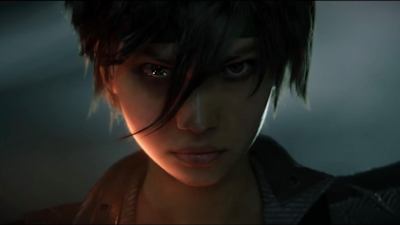
Jade is back, but not as the main character
© Ubisoft
5. Offline capability
This is the big controversy on social media right now. Ubisoft announced that playing Beyond Good and Evil 2 will require a persistent internet connection, even if you're playing the solo campaign. Not everyone in the world has the means for a solid high-speed internet connection, or lives in a place where one is available. If the servers go offline, the game becomes unplayable. And enough fans complained that David Jaffe (God of War, Twisted Metal), tweeted about the Beyond Good and Evil fanbase on Christmas:
"Maybe w/everyone off work, the gamers who are super entitled babies now have more time to complain!"
He later rolled back these comments and clarified, stating:
"But I also think gamers in 2018 acting surprised that games from most major third party publisher are GaaS/always online are either really gullible and/or naive. That's all those types of companies make these days and to act like you thought BGE2 was going to be an old school PS2 era single player game? I mean, I get you want that, but when was the last time Ubisoft made that sort of title? Any why would they? Have you seen the money they make (and all other third party pubs) are making off the open world, internet connected, GaaS titles?!"
There are benefits to 'always online' games. It's easier to patch and update them. It's easier to organise live events. It creates a more cohesive game community. But in 2018, numerous A-list, third-party games had single player campaigns without an 'always online' requirement. Spider-Man. Red Dead Redemption 2. Shadow of the Tomb Raider. Even Super Smash Bros Ultimate, which is chiefly a multiplayer experience, had a single player campaign that worked without a persistent internet connection.
Players still want and desire quality single-player content, separate from multiplayer and co-op. And developers should feel empowered to shape their industry with the choices they make.
