
Cycling
How Demi Vollering turned time trial disappointment into road race success
Discover how the most dominant rider of 2026 recovered from an uncharacteristically shaky start to her UCI Road World Championships campaign to win her first world title.
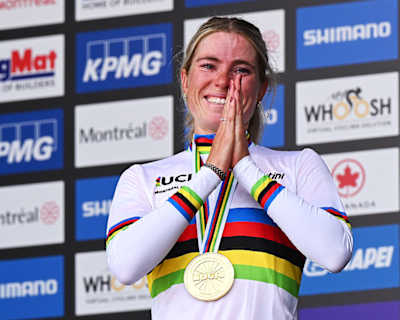
Demi Vollering claimed victory in the road race at the UCI Road World Championships in Montreal, Canada, capping a remarkable season that ranks among the finest of her generation. Victories at the Tour of Flanders, Giro d’Italia and Tour de France Femmes avec Zwift had already established her dominance, but the manner of her first rainbow jersey triumph showed that her strength extends far beyond raw physical power.
01
Disappointment in the individual time trial
Vollering’s World Championships got off to a rocky start as she finished in eighth place in the individual time trial, almost two minutes behind eventual winner Marlen Reusser. The result left many experts believing that she had finally reached her limit and succumbed to the fatigue of a long season.
Before the time trial, the FDJ UNITED-SUEZ rider was seen as one of the favourites on a 39-kilometre course that was the longest in the history of the women's event. Having placed third in the time trials at both the Giro d’Italia and the Tour de France Femmes earlier in the season, it seemed inevitable that the Dutch star would be vying for a place on the podium.

However, when Vollering passed the first timing point just after 10km, it was clear it was not going to be her day as she recorded a time more than 30 seconds adrift of leader Zoe Bäckstedt. As the race progressed, the gap to the leaders continued to grow and she was eventually caught and passed by Reusser in the final kilometers.
This setback, although not how Vollering would have liked to start her World Championships, was something she had dealt with before, and her success throughout 2026 gave her plenty of confidence ahead of the road race.
02
A season defined by success
Omloop Nieuwsblad, the Tour of Flanders, La Flèche Wallonne and Liège-Bastogne-Liège. Four of the most prestigious one-day races on the WorldTour calendar, and Vollering won them all. Any one of those victories would be enough to define a career, yet for Vollering they were merely the opening act. She had claimed all four – along with more major victories – before the end of April.
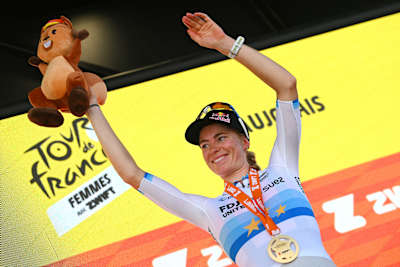
Vollering won the Tour de France de Femmes for a second time in 2026
© Getty Images/Red Bull Content Pool
Fast forward to early June and the Giro d’Italia; the first Grand Tour on the calendar. With just one stage remaining, Vollering sat second overall, 49 seconds behind the race leader and four-time Giro champion, Anna Van Der Breggen. Vollering had won two stages, but to overturn nearly a minute on the final stage to Saluzzo was a tall order.
Vollering took the race on and managed to isolate and drop Van Der Breggen, escaping with a select group of riders, before extending her gap to take the overall victory and win her first Giro d’Italia title.
In doing so, Vollering completed the Grand Tour set, adding a Giro to her 2023 Tour de France Femmes title and her pair of Vuelta victories. This statistic alone is enough to cement Vollering as one of the most accomplished riders in history, but she wasn’t done yet.
The Tour de France Femmes is the biggest bike race in the world. Vollering won the race in 2023 and had never finished lower than second place. She started the 2026 race as the outright favourite and went into the final stage nursing a slender eight-second lead over a flying Kasia Niewedoma.
The easy option would have been to ride defensively on the final stage around Nice to protect her lead and secure the overall general classification victory. However, Vollering rarely takes the easy option. After a thrilling duel with Katarzyna Niewiadoma up the final ascent of the Col d’Eze, the 29-year-old broke clear with 16km remaining and rode solo to victory, winning the final stage in the iconic yellow jersey.
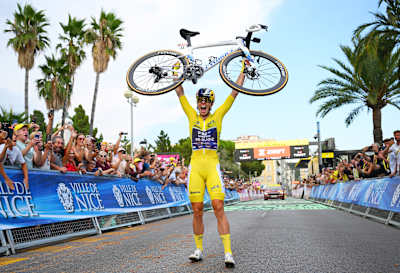
Vollering has enjoyed huge success this year with FDJ UNITED-SUEZ
© Getty Images/Red Bull Content Pool
Following her second victory at the Tour de France Femmes, her focus shifted to the rainbow jersey. Dutch national team coach Laurens Ten Dam told Cycling News: “Two days after the Tour de France, I got the first message already from her: 'OK, job's not finished'. I was like, 'OK, she's on'”.
03
Seeking redemption in the road race
At 180km in length, the road race course was one of the longest the women’s peloton had ever faced, and with more than 2,500 meters of elevation, there was nowhere to hide on the Montreal circuit. The Dutch team’s plan was clear from the start, and they set a blistering pace that prevented any dangerous riders from breaking away. With three laps remaining, Puck Pieterse increased the pace up the main climb of the circuit and launched Vollering, who took off solo in her bid for victory.
However, it was at this point that something happened that we haven’t seen all season. Vollering was caught. After extending her gap to around half a minute, she was gradually reeled in by Niewiadoma, Elisa Longo Borghini and Juliet Berthet with just over one lap remaining.
Longo Borghini then attacked through the finish line into the final lap. Instead of panicking and carrying the burden of the chase, Vollering kept a cool head and ensured that Niewiadoma and Berthet assisted in the chase. In a moment when it would have been easy to give up, Vollering doubled down and came up with a new plan.
Races can be lost in situations like this. Known as ‘group two syndrome’ (when riders look at each other to do the work and let a solo attacker ride away to victory), hesitating at a moment like this is a huge gamble. Vollering waited and, on the final ascent of the main climb, rode a controlled tempo to catch Longo Borghini and attack over the top, taking Niewiadoma with her.
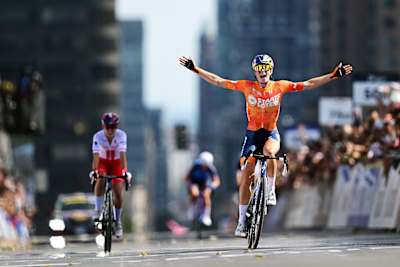
Charging to victory in the road race
© Tim de Waele/Getty Images
Vollering rode the final 10km with a confidence earned through a season of dominance. When Niewiadoma tried a last-ditch attack with a few kilometers remaining, Vollering was able to stay with the Polish rider and bring the race down to a two-up sprint.
With the threat of Longo Borghini coming back from behind within the final kilometer, Vollering didn’t panic. She rode at the front, keeping a close eye on Niewiadoma, and when the time was right, launched her sprint and secured her first World Championship title. It was a ride defined by teamwork, patience, confidence and raw power.
“Now I can almost retire, but for sure I’m not planning that," said Vollering after her victory. "I’m enjoying this year. It’s a pleasure to achieve goal after goal, dream after dream with amazing people around you. It’s incredible.”


04
What made Vollering unstoppable in 2026?
Vollering’s season has seen her dominate the cobbles and climbs of Belgium, tame the mountains of Italy and France, and beat the best in the world in Canada. But this superiority is not simply down to her having more power in her legs; she’s shown a determination this year that has allowed her to push to another level.
When asked about how she can dig so deep, Vollering cited her colleagues in the peloton. “They’re incredible competitors. They make sure you reach your highest goal and push you to become a better rider. We all lift women’s cycling to another level together."
Vollering has shown what she’s capable of time and time again, year after year. With few races left for her to win, it would be fair to assume her motivation would start to wane. But Vollering has shown that her drive comes from something more than just victories; she rides to elevate women’s cycling and inspire the riders who follow her.
About the author


