
Music
Dave Harrington and Sophia Brous on the Dream Machine
The artists speak to Vivian Host on Red Bull Radio’s Peak Time about their new concept show.
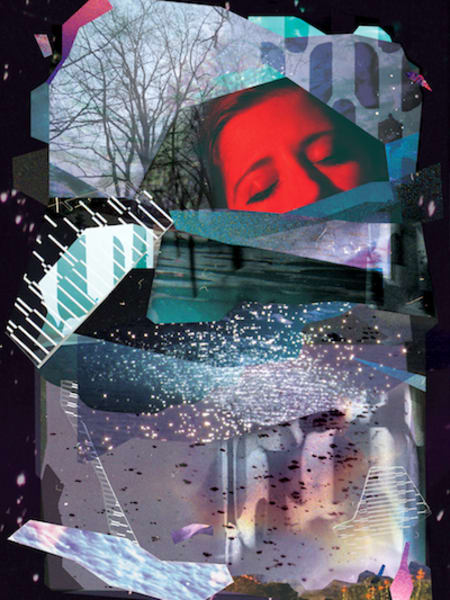
Described as 'the world's first work of art to be seen with your eyes closed,' Brion Gysin and William Burroughs’ seminal invention, the dreamachine, serves as the primary inspiration for Dream Machine. An immersive concert installation developed by multi-instrumentalist and producer, Dave Harrington, musician and curator Sophia Brous and multimedia designer Ken Farmer of Wild Dogs International.
Premiering at Red Bull Music Festival New York, with a special encore performance at FORM Arcosanti presented by Red Bull Music, the event will combine high-intensity strobes, immersive lighting and ceiling projections with a live dream soundtrack. The soundtrack will be performed by an exceptional, once-in-a-lifetime gathering of musical luminaries, including The Master Musicians of Jajouka (led by Bachir Attar), industrial pioneer Genesis Breyer P-Orridge of Psychic TV, British cellist and electronic producer Oliver Coates, drummer Greg Fox and more. In a conversation with Vivian Host on Red Bull Radio’s Peak Time, Harrington and Brous delve deeper into the origins of the historical invention and how they are reinterpreting it for a modern audience.
Tune into Peak Time weekdays at 12pm EST on Red Bull Radio.
What is the dream machine?
Sophia: Our Dream Machine is inspired by the dreamachine, which is an invention that William Burroughs, Brion Gysin and a collaborator of theirs, Ian Somerville, all came up with during this beat hotel, Tangier, post-beat, pre-hippie era of free-wheeling experimentation.
Dave: The story goes that Gysin was having an experience – and we've heard different tellings of this – but that basically he experienced light flickering, either on a bus driving through somewhere, seeing flashes through the trees, or maybe smoking hashish in the desert, staring at a candle. Ultimately, he has this experience where when he closes his eyes and the flicker happens on his eyelids, he starts seeing things. Later, he got together with Ian Somerville to recreate the experience.
S: So the dream machine is basically a device that you stick a light bulb in the middle of and it has slots cut out of it. You then put it on a turntable and as it spins, you stare at it with your eyes closed. So they like to describe it as 'the world's first work of art to be seen with your eyes closed.' What it does in theory – if the turntable's spinning at the right speed and if your brain is in the right place – is trigger a different series of waves in your brain so you start to see things behind your eyelids. That can be colors, patterns, or visions, as it has been described.
How did you all come to reinterpret the dream machine?
D: When we started cooking up this idea, the prompt that we came up with was basically, how do we make the experience huge? And how do we make it something that isn't just three people sitting around a light bulb, but is something that can be impactful for an audience?
S: It also came out of the fact that both Dave and I have a background interest in film music. He's been doing a lot of different live film soundtracks to different movies over the last few years. So the idea was, how would you create a dream soundtrack to the dream machine? That's kind of what established the architecture of creating a dream score and a set of dream chapters using light, sound, immersive projection and film that's suspended above heads. So the shape of the show and the structure it takes is sort of a ten chapter or so cycle through dreams, like a dream cycle. And it literally takes a course through the chapters of sleep: eyes closed, dream one, dream two, wake, night terror, wake, phone.

So this is really going to be an immersive environment that people don't normally experience when they're at a show, i.e. standing up?
D: What it is, is unpredictable.
S: Take the dream machine as the beginning cell that led to all of this different experimentation in film, in sound and in light.
Who was Brion Gysin? Because I think a lot of people know who Burroughs was, especially when it comes to counterculture from the 1950s all the way to the present day. But Brion was actually a huge influence as well.
D: And you know, if you talk to all the people from that era, like Genesis P-Orrrige of Psychic TV, and any of the members of Throbbing Gristle, Gysin was arguably as big, if not a bigger influence on what they did, as Burroughs was. Gysin genuinely had a holistic creative practice in that he was a literary figure, a performative figure, a painter and a calligrapher.
S: Also, he's the link to the Moroccan substrate of this and the Master Musicians of Jajouka. Gysin was an expat in Tangier when he met them and they were able to create this [dream machine] situation.

So the Master Musicians of Jajouka are a group from Morocco and they will be playing traditional Moroccan music at the Dream Machine show. How many of them are there?
S: Well, it changes all the time. It is based around a form of Sufi trance music that originates in the foothills of Morocco and the mythology is that it is one of the world's longest running consistent groups because it has moved through a patriarchal lineage for hundreds of years.
How else has collaboration played a role in your reimagining of the dream machine?
S: You know, Dave and I met through people. I suppose New York really thrives on this, and I think it always has, which is just that it becomes this colony of weirdos who are making the music that they make. Then through conversation and living around the block from each other or whatever, they meet, and these new things happen.
So I think in making Dream Machine as a show, it was very much led by all of those different aesthetics of electric acoustics of musique concrète, of film composition, and letting that be a guide for how we brought all these different crazy people together.
So it will be different combinations of people on stage. It's not just one ensemble that plays through?
S: It's our mega ensemble but organized in a different permutations. So it's like a series of scenes; it's all about the idea of fragments. You'll get an image in your mind that might be the only thing that you take away from your dream, so it's never one clear note. For this, we wanted to be able to cover zones that are very different. At times it could be like a melting noise, rock band. And then at times it could be like a musique concrète, Luc Ferrari piece, using elements of superimposed electronics, or sampling, or feedback loops with tape machines. Or it could move into a chamber space, and speak to the color of a harp, which with someone like Zeena Parkins is polychrome.
D: We want to create that by letting people lie down and actually really let themselves go. And as far the curation of the ensemble goes, the common denominator amongst everyone playing with us is that they're all improvisors. And that's the only thing that matters. And then the next layer is that they all have voices. The creative challenge then is bringing those voices together inside of this world that we're crafting, and the hope is that that creates something new. We’ll pull from noise. We'll pull from concrète, we'll pull from free jazz and chamber music. But hopefully, it won't feel like you're spinning through a jukebox. It'll feel like the jukebox is melting.

Dream Machine premieres May 11 at Red Bull Music Festival New York – more information and tickets can be found here. A unique rendition of Dream Machine will also be presented by Red Bull Music at FORM Arcosanti on May 13.