Back‑to‑back gold: Mathilde Gremaud is changing freeskiing on her own terms
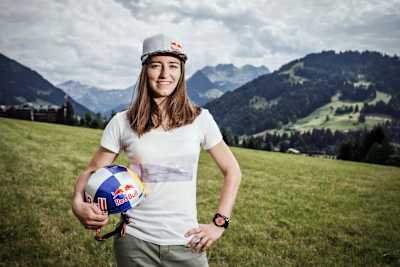
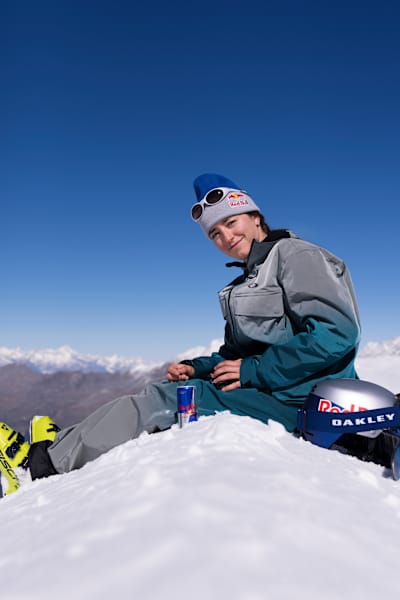
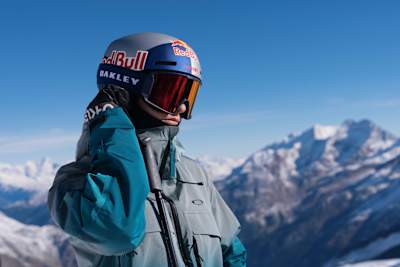
Mathilde Gremaud has won back‑to‑back Olympic golds in freeski slopestyle, pushed trick progression and spoken up for women in sport – all while staying rooted in her Swiss home town of Fribourg.
“I never get bored with freestyle skiing,” says Mathilde Gremaud, Switzerland’s much-decorated freeski icon. “It never looks the same. There's always something new. It can be a trick or a spot. In the end, I have the feeling to do something different every single moment.”
It’s a mantra that has served her well, leading her to defend her Olympic title at the 2026 Games in Milan. With a score of 86.96 in her second run of the final, she narrowly edged out her long-time rival Eileen Gu to claim gold in the slopestyle contest – four years after her first Olympic victory at the 2022 Games in Beijing.
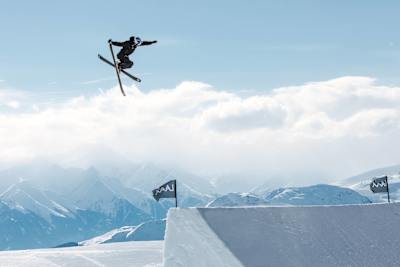
She’s been at the top of the freeskiing world since her first Olympic outing in 2018; racking up medals at World Championships, World Cups and the X Games, becoming the first woman to win three FIS crystal globes in one season, and pushing the sport forward with big tricks – such as her world-first Switch Double Cork 1440.
50 min
She Who Flies
This cinematic journey charts the highs, lows and in-betweens of Freeski World Champion Mathilde Gremaud.
English +8
Watch Gremaud's incredible story in She Who Flies in the player above, and read on for the opening chapters of her journey thus far.
01
Building up to back-to-back: Dominance, injury and resilience
By the end of 2024, Gremaud was sitting pretty with her three history-making FIS crystal globes in Big Air, Slopestyle and Overall. Arguably, these were career highlights in a career full of pretty special moments.
For those following Gremaud’s career, it seemed nothing could derail her. But, then, injury struck, and kind of changed everything. “I was feeling too much stress from different places,” Gremaud said on deciding to take time off in January 2025 following an injury in training. “I may be a daredevil, but definitely not impulsive. I’ve never really been injured [before this],” Gremaud said.
Gremaud kept the nature of her injury to herself, but it’s clear that she mentally needed a bit of a break, too. She ducked out, declining to compete for two months, and spending a week at her parents’ house where her head was “peaceful” and “free” while she healed up.
“I had to find out who I was when I didn't have my skis on,” she said. “I asked my parents about what I was like as a kid so that I could see what might have changed. I realised that I actually love to be around people. I don’t need anyone to hold my hand, but I like to feel safe with people I trust around me.”
I guess I struggle a little with risk management, deciding whether it’s a good time for me to push things or not
After skiing for most of her life, spending time to get to know herself is part of a journey that Gremaud has been on in recent years (and more on this later). It’s all helped her become a happier, more rounded skier, and also, a more rounded person, too.
“I believe I’m always motivated,” she says. “One or two injuries don’t necessarily throw me off, but I do reflect on such issues a great deal. I guess I struggle a little with risk management, deciding whether it’s a good time for me to push things or not. Sometimes I feel it’s a good time to push, but then something happens. Then I reflect on what I did wrong and how I can move forward without making the same mistake again. I firmly believe that I benefit from shaking things up by skiing in powder or taking a break.”
Those who worried that Gremaud was calling it quits full time needn’t have fretted. Her career isn’t one of peaks, it’s a career of sustained excellence – even after taking a short break. Case in point: returning from time off to claim the gold on home snow at the 2025 Freeski World Championships in March 2025 ahead of Austria's Lara Wolf and Canada's Megan Oldham.
The win wasn't just an historic victory, but yet another chapter in the story of an athlete who's come to prize knowing herself even above results. Luckily, in Gremaud’s case, the two tend to go hand in hand.
02
An international star deeply rooted in Switzerland
Growing up in Fribourg, a half hour from the ski Mecca of La Berra, Switzerland, Gremaud was simultaneously immersed in both ski culture and that of the country she represents with such success.
That connection to her upbringing is something still apparent in the double Olympic champion of today; staying in touch with her local culture and traditions helps to keep her grounded, as evidenced in this Instagram reel.
Reflecting on her early days in skiing, she recalls: “I started skiing close to my little village, far from the big snow parks. We used to build our own modules using shovels. We used to build our own spot with what nature had to offer. Of course, landings were not perfect, but I know where I come from thanks to those moments. I grew up as a champion thanks to those roots.”
She was two when she first strapped on a pair of skis. The sport ran in her family. Her father was an ambitious racer and at first Gremaud looked set to follow in his path, spending her younger years fighting for fractions of seconds between the alpine skiing flags.
Her father was a huge influence in her early sporting life. He also took her to do track and field, and for a time Gremaud was hugely invested in athletics, but in the end, the slopes won out. “I used to run a lot, I had some skills for that. But as soon as the sessions became more regular including interval works and hours turning around the stadium, I understood this sport is not made for me. I had more fun with skis,” she says.
I first started with alpine skiing… I didn’t go further because then I fell in love with tricks
Her skiing future looked mapped out, but here’s where that rebellious individuality comes in. “I first started with alpine skiing, I’ve participated in a local competition. I didn’t go further because then I fell in love with tricks and freestyle,” she laughs.
A cousin was a big freestyle fan and began whispering temptation in Gremaud’s ear. “He kept on telling me about some Andri guy [Andri Ragettli] and his cool tricks,” Gremaud laughs. “That kind of introduced me to the idea.” The temptation of Slopestyle and Big Air tricks was growing stronger, and Gremaud couldn’t resist its pull.
“I got my freestyle skis and started experimenting with small jumps,” Gremaud remembers. “Then I joined my cousin and his parents on a weekend break in a chalet. The resort had a huge snow park, where he showed me how to do a 360. I gave it a go and managed to do it straight away. I’ve never really looked back.”
“At the beginning, my father didn’t understand,” Gremaud says of her decision to switch over. “He said: ‘Are you still going to do sports?’ I said to him freestyle skiing is a sport.” Like all good fathers, though, he was still supportive. “He was not convinced but let me go. He used to drive me to the ski resorts for the weekend,” Gremaud says. “On Sunday evening he used to bring me back. When I started competition, he understood freestyle is a real sport.”
From there, Gremaud was free to develop her own techniques and style combining the best of freestyle, racing and pretty much anything she could think up to do on skis. This tenacity and inventiveness helped her rise above the competition, and at the age of 15 she was called up to her regional team – one of the first female members to join.
“The team said it would be mega cool if I came along, especially as they were struggling to find female skiers,” Gremaud remembers. “At the time, there were only two female snowboarders on the team. I loved the idea, not least because I wasn’t even aware of the fact that such teams exist.”
It was the start of not only Gremaud’s journey, but of all she would do to represent women in freestyle.
“The thing I remember from my early competitions is the Youth Olympics 2016 in Lillehammer,” Gremaud recalls. “I didn’t perform well - I believe I finished sixth - but this moment was key. That’s where I realised I really wanted to go far in freestyle skiing. The event inspired me to push further.”
It was Gremaud’s first taste of competition on a larger scale, an insight into the concept of skiing as a career, and despite not quite hitting the points she wanted, Gremaud was lit on fire by the possibilities. She doubled down, winning a silver medal at her Aspen debut in 2017. That season, while still a student in Engelberg, she bagged four podium finishes in her second-ever World Cup season, taking third overall in Big Air with 225 points.
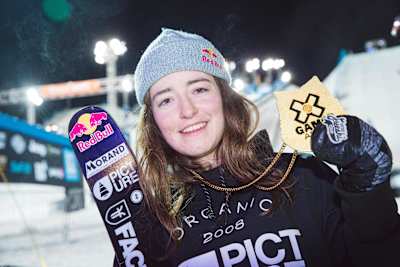
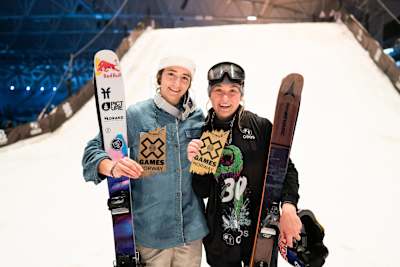
That year, 2017, truly was the start of something special, and Gremaud’s visibility as a woman in sport blew up with her now legendary leap to Big Air victory at the X Games in Norway, where the jury awarded her Switch Dub 10 a perfect 50 out of 50 possible points. “X Games was a key moment for me,” she says all these years later. “My first gold medal. Everything was so fast and intense – I didn’t expect that.”
04
Silver and sisterhood: PyeongChang 2018
Sharing more silverware with freestyle skiing's sisterhood
Gremaud might not have been expecting her X Games success, but she was arguably about to eclipse her performance there with a podium finish in the most high-profile sporting event in skiing: the 2018 Winter Games.
PyeongChang marked the debut of freestyle Big Air in the Olympics. To anyone else this might have added pressure. Not so for Gremaud. “I’m not the kind of person who always dreamed about the Olympic Games,” she admits. “The whole thing seems so cheesy to me. I’m more interested in the entire process. In that sense, I don’t really have a specific goal that I would like to achieve. I just want to continue to enjoy myself, feel comfortable, and experience new things – that’s what’s most important to me.”
Taking the Olympics in her stride, Gremaud put her best skis forward and casually bagged a Slopestyle silver just days after suffering a concussion during a training crash. On the podium she stood beside Sarah Höfflin who, at nine years older, had been an inspiration for Gremaud growing up.
“It’s funny, really. Sometimes I don’t think at all and just make my way while enjoying the moment,” Gremaud says, thinking back on the emotional impact of her first Olympic result and then sharing the podium with a hero. “Sometimes I think to myself: “Woah, what a cool situation to be in!” I think it takes time to understand and realise what this kind of success means. There are so many different ways to handle this, ranging from never thinking about it to making a huge deal about it. It’s pretty amusing to figure out how you intend to approach it.”
In other words, focus on the moment, and good things will come.
05
World first: Landing the Switch Double Cork 1440
Making history as she lands the Switch Double Cork 1440
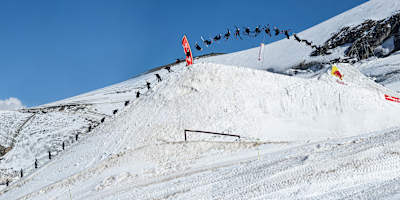
On September 14, 2020, Gremaud took female freeskiing to a new level when she landed the first-ever Switch Double Cork 1440 – a trick that consists of two rotations with four spins, all of which have to come with the athlete starting backside. The setting: the Swiss ski resort of Saas-Fee. The reaction: euphoria.
"I compare [freestyle tricks] to artistic paintings", Gremaud says. "Sometimes when they are first painted, people say 'it's a nice painting…' Then 10 years later, people will say 'Oh yeah! This is a nice painting!' It's a bit the same with tricks. I feel like it always takes one or two months, even a season, to notice that a certain trick is special.”
The reaction to the Switch Double Cork 1440 was a bit more instantaneous.
“I’d only made it once before this event,” Gremaud recalls. “No other female has ever managed to land such a trick. It was crazy.”
Like when a runner breaks a previously impossible record and opens the floodgates, Gremaud’s trick showed female skiers what was possible and served as an inspiration for her contemporaries and other rising stars in the sport like Kelly Sildaru and Tess Ledeux. The impact on Gremaud was huge, too.
Relive that world-first moment:
1 min
Mathilde Gremaud lands the world's first female Switch Double Cork 1440
Checkout the moment freeskier Mathilde Gremaud lands the world's first female Switch Double Cork 1440.
“It opened plenty of doors for my career,” she says. “It showed me what I was capable of, what’s possible. It also earned me a great deal of respect, which was cool.”
As for the impact ton the female skiing community, Gremaud says “I think it’s incredibly important for a female athlete, especially in this sport [to be respected]. It’s also important to me that others think a trick is cool; sometimes it’s pretty dope to know what others think.”
It’s a trick that’s had a lasting legacy. Gremaud says it’s “still relevant” over half a decade later. “The trick also reached audiences beyond Switzerland’s borders. Swiss TV filmed a documentary about the project. It was a really cool show – not merely for the skiing community, but also for a broader audience,” she says. “People started following my progress.”
The trick had a more immediate future: in January 2021, Gremaud took it to the contest slopes, landing it in competition for the very first time in the Ski Big Air finals at the X Games Aspen, earning her a well deserved gold medal which served as a pretty appropriate recognition of her individuality and groundbreaking flare in the sport.
The next year borough more gold, and more pressure, with Gremaud upping the ante to take the Olympic gold in Slopestyle.
“The less I think about pressure, the better I perform,” Gremaud says. “I just feel happy in the moment. When I started freestyle skiing, I wasn’t even aware of the competitions, let alone the fact that it's an Olympic sport. I honestly only immersed myself in the sport because I enjoyed it so much. It’s incredibly important to me to know why I’m doing it and why I’m enjoying it.”
Any Olympic performance is a risk, of injury, of humiliation and not being able to carry off your vision with the world watching, but Gremaud turned all of this into reward. It’s fair to say, as the Olympics’ official Instagram explained that “At #Beijing2022, Mathilde Gremaud owned the women’s freeski slopestyle final, posting 86.56 to claim Olympic gold.”
For Gremaud, staying cool in the moment might have been easy, but the comedown after such a high-stakes performance was slightly more difficult to deal with. “The time after the Olympic Games was very challenging due to the emotions it entailed,” she says. "It was too much, so I needed a break and went on vacation.”
The time after the Olympic Games was very challenging… It was too much, so I needed a break and went on vacation
But, even when she got back she found she wasn’t motivated to ski. At first she tried to ignore the feeling, but she found herself skipping competitions and knew something had to be done. She switched things up by working with the APC [Athlete Performance Center], and says the chance to work with people outside of her usual team was “Really exciting.”
It was the first time she really took her future into her own hands – a pattern that would come to redefine her next few years. “That week literally changed everything,” she says. “The priority was to do something new for the mental side, to spend time somewhere else with other people allowed me to start over and regain my motivation.”
After that she travelled to Japan for the first time – a lifelong dream. “The atmosphere was different, which was so much fun,” she says. “I spent two weeks in deep snow, without clocking any hours in the park. It really cleared my mind, so to speak. When I arrived in Georgia, I was ready to ski in the park again and actually enjoy it.”
Having skied since the age of two and, in many ways, having reached what anyone would consider the peak of a sporting career, Gremaud had to rediscover her passion. Time away helped that, and she continues to work with an “energy therapist” at home to help with her mental health. “I explain my struggles to her. I tell her that sometimes my body is doing something while my head is thinking about something else,” Gremaud explains. “She helps me to stay in the now. It makes me feel really good as a rider, but also as a human being. It’s beyond sport.”
For the first time, Gremaud was actually looking after herself, not just operating as an athlete, and it set her up for the perfect 2023.
07
Building the blueprint: 2023's perfect season
Mathilde Gremaud continued her fine 2023/24 season at Mammoth Mountain
Having swept the World Championship and X Games, Gremaud transcended being a mere mortal champion and became an architect of consistency.
“I’m very much a perfectionist when I’m training,” she says. “As we work a lot with videos, I always see details to improve. When my coaches feel satisfied, I’m usually not. It’s never enough. However, when I’m competing, I’m way less challenging with myself. I assume that you also have to play safe. I don’t want to put myself under high pressure.”
Going into 2023, Gremaud had been able to focus her mind and re-find her purpose. Along with a training schedule of three to four ski-focused gym sessions per week, Gremaud felt like she was hitting optimum performance.
The fact that the schedule adapts to my lifestyle is important to me, as I need the thrill of playing other sports
“I reached an agreement with my trainer that I don’t just lie around at home doing nothing,” she says. “The fact that the schedule adapts to my lifestyle is important to me, as I need the thrill of playing other sports. My trainer always makes sure that I still have enough time for biking or wake surfing. If I’m on the road alone for four or five days, I pick a local gym and follow the same routine without him. That’s mega cool!”
This far into her career, flexibility became key. The ability to play. If you’ve won the top medals, why are you continuing? It has to be because you enjoy it. “The whole process helped me grow as an individual,” Gremaud says. “It forced me to think differently and more expansively. I reached a growth moment in my life. I learned that I want to make my own decisions and really ask myself: “What is good for me, and what isn’t? What do I need?”
Alongside a better understanding of self, five FIS Freeski World Cup wins were the reward, and in 2024, Gremaud became the first woman to win three FIS crystal globes in one season. At just 25, the future, it seems, is wide open for an athlete who has already achieved so much, and has learned to know herself so well.
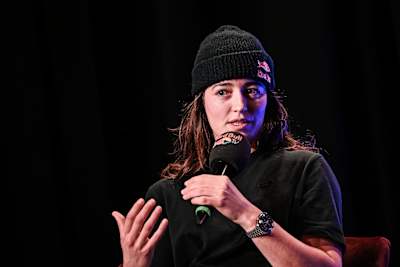
Gremaud doesn’t just stand out on her skis – she also speaks up about what matters to her. In an interview with Sports Illustrated [in German], she talked about how important community and support are in women’s sports, saying: “ I want to see women in sports connect more and really support each other. If I can use my experiences, the wins as well as the setbacks, to inspire others, that means a lot to me.”
In the same interview, she also pushed back against how women are constantly compared to men in sport: “Women in sports should stop being constantly compared to men. Men in sports are just seen as men in sports, without constant comparison. The fact is, we are different – that’s exactly why there are separate categories. Women’s sports are, in many disciplines, their own sport with their own demands and stories. There are positive developments, but it will take more time.”
The quiet competition machine
Gremaud found the motivation to keep competing after winning everything
At the top of women’s freeskiing, Mathilde Gremaud stands out not just for what she lands, but for how she carries herself. While some of her biggest rivals are highly visible personalities who thrive on media attention, Gremaud is a much quieter presence.
She rarely seeks the spotlight, speaks little in public and lets her skiing do the talking. Behind that calm exterior is a meticulous competitor and training beast, who does the hard work out of view, proving that you can shape a sport not only with big statements, but with consistent, world‑class performances.
09
The future: What Mathilde Gremaud represents for the next generation
Gremaud is already looking ahead to what comes next
What’s next for Gremaud? It’s hard to say – and that’s the way it should be. “I don’t set myself an ultimate goal in freestyle skiing. I take moments as they come,” Gremaud says. “I don’t target any kind of records. It’s not what motivates me. In my career, I don’t target any other goal than being happy.”
Growing up Gremaud used to compete with her older sister, while Anna Gasser and Sarah Höfflin inspired her. These days, she’s only competing with herself. And, having done so much for women in the sport, she certainly does’t compare herself to the boys.
“I hope this doesn’t come across as arrogant, but I always thought it was really funny that I was better than all the boys when I first started freestyle skiing,” she says. “I was always the only girl, in every sport I did – there were never any girls around, which I always thought was cool. Other girls used to tell me that they didn’t enjoy being alone among boys. They claimed the boys pulled them down instead of pushing them. I guess I was just mega lucky to be good from the outset, they always motivated and pushed me. It took me a while to realise how much they motivated and helped me.”
I have no clue about my future work, but I know a career in freestyle skiing doesn’t last 30 years
Now pursuing a Master of Business Administration degree alongside her sporting career, Gremaud proves that you really can do it all. You can be arguably the best female skier of all time and, in your mid-20s, be building a future career in a completely different field to ensure even more success.
“I figured I’d need more trophies and medals for it to be cool, you know?” Gremaud said of her mindset when she was younger. She’s moved away from that now. “I have no clue about my future work, but I know a career in freestyle skiing doesn’t last 30 years. I‘ll have to think about it one day,” she says. “For now, I’m focused on skiing with the goal to enjoy every single moment. Results are secondary.”
As for what she’d tell up and coming female skiers, and her younger self “Stay yourself,” she says. "I think that this state of mind has worked quite well for me so far.”