Beyond brave: Inside Molly Carlson’s iceberg dive in Canada
“The scariest thing I’ve ever done”: Professional cliff diver Molly Carlson is used to jumping from high places – but this challenge was truly ice-cold.
Canadian cliff diver Molly Carlson is no stranger to taking the plunge from extraordinary heights. But diving from an iceberg into the freezing Atlantic Ocean? That's a challenge unlike anything she'd faced before. With ice-climbing legend Will Gadd by her side, Carlson set out to make history off the coast of Canada.
Watch Molly Carlson launch herself from an iceberg in the video below, then read on to discover how she pulled off this historic feat.
Facing her fears
“Icebergs are incredibly dangerous,” Carlson explains in her new documentary video on YouTube, which captures her journey from training to diving. “They can split, collapse or roll without warning.”
Carlson is used to diving from high places. As one of the world’s top cliff divers – winning several Red Bull Cliff Diving competitions – she’s spent the last five years leaping from 21m platforms. But an iceberg was something entirely different. “This is definitely the scariest thing I’ve ever done,” she says.
Molly Carlson is used to facing her fears as a cliff diver
Fear has been part of Carlson's career from the beginning. She says she has learned that being brave doesn’t mean getting rid of it. “It’s about not letting it decide what you’re capable of.”
For her, the iceberg was a chance to find out just how far she could push herself.
“There’s something really powerful about an iceberg,” she says. “You only see the small part above the surface while so much is hidden underneath. I think in many ways the same is true for our anxieties and our fears.”
I'm doing this for all the people that might be scared to show what's under the surface
It's a message that also sits at the heart of Carlson's BraveGang community, which encourages people to face their fears and embrace vulnerability. For Carlson, the iceberg dive was about more than pushing her own limits: “I'm doing this for all the people that might be scared to show what's under the surface.”
Learning to climb ice
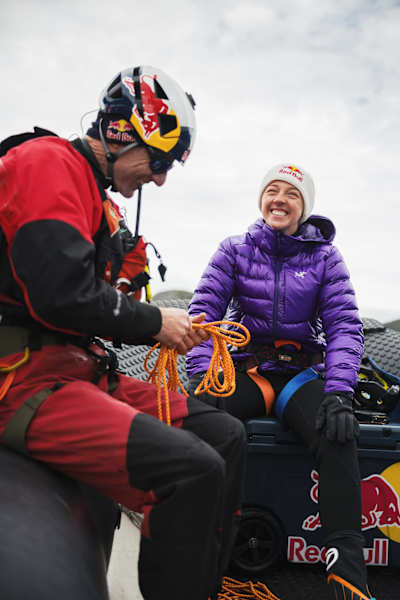
Will Gadd and Molly Carlson gear up to climb the 15m iceberg
Before Carlson could dive from an iceberg, she first had to learn how to climb one.
To prepare, she travelled to Canmore, Alberta, where she met professional ice climber Gadd. He's one of Canada’s most accomplished ice climbers, with more than 30 years of experience pushing the sport into unusual and challenging places, like climbing ice formations on Mount Kilimanjaro.
He taught Carlson the basics of ice climbing: how to use crampons and ice tools, how to move safely up a frozen wall and how to build confidence on ice.
Carlson began on a 10m training wall in Canmore. From there, she moved into more difficult conditions in Alberta’s Ghost River Wilderness Area.
Her final climbing test was a 20m pitch – roughly the height she would need to climb on the iceberg.
“It’s almost what I compete from,” she says.
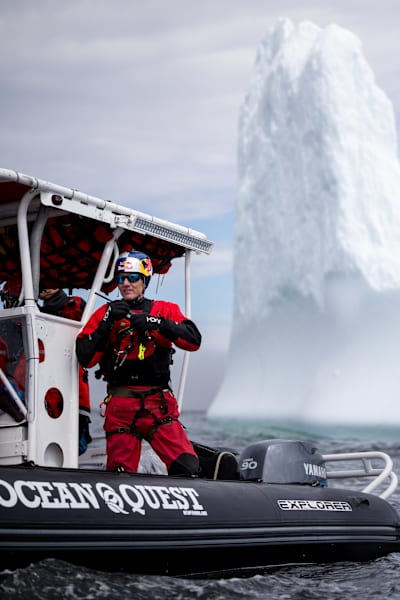
Will Gadd led the world-first iceberg dive mission
But climbing was only one part of the challenge for Carlson. She also needed to prepare for the cold water wearing a wetsuit – something cliff divers don’t usually wear in competition. In Montréal, she tested her wetsuit and began with lower jumps from an indoor platform before progressing to 15m, the approximate height of her planned iceberg dive.
Apart from the wetsuit, the conditions would also be very different from a normal cliff diving competition. The water would be close to freezing, the all-white surroundings would provide very little visual reference on the way down, and the ice beneath her feet could shift at any moment.
“The biggest hazard is that icebergs can roll over,” Gadd explains. “When they roll over, it’s super violent.”
The project eventually moved to Newfoundland, where thousands of icebergs drift down from the north each year. Carlson, Gadd and the support team scouted the coastline around Twillingate, looking for a berg that was safe enough to climb and suitable for a dive.
“It needs to have good boat access, a sheer edge to dive from, with a clear landing zone, and a climb that is actually doable for me without putting Will at risk,” Carlson says.
“If these boxes aren’t ticked, the dive wouldn’t be possible.”
After scouting dozens of icebergs and rejecting most of them, Carlson and the team chose one they called ‘No Name’. It was a free-floating iceberg off the coast of Newfoundland with the right shape, access and diving position.
There is only one thing you can count on with icebergs: their unpredictability
Rick Stanley, iceberg and marine specialist
Even then, the team could not simply assume it was safe. Ocean swells, wind and the iceberg’s movements had to be monitored constantly. Local specialists from Ocean Quest and Crosby Marine helped assess conditions and coordinate operations, while the Canadian Coast Guard supported safety planning and communications.
As Rick Stanley, one of the team’s experienced iceberg and marine specialists, explains, "there is only one thing you can count on with icebergs: their unpredictability."
The climb to the top of the iceberg
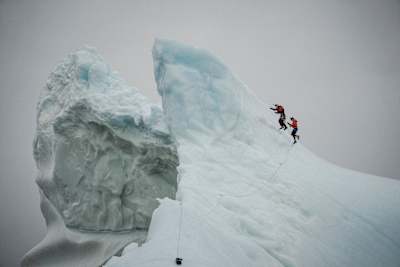
Once the iceberg was chosen, Gadd climbed onto it first and installed a temporary rigging system – a line and platform that would help Carlson reach the take-off point.
Carlson then put on her ice-climbing gear and climbed onto the berg. She followed the line Gadd had built, traversing across the uneven surface while the iceberg shifted beneath her.
Will Gadd and Molly Carlson climb their way to the top of the iceberg
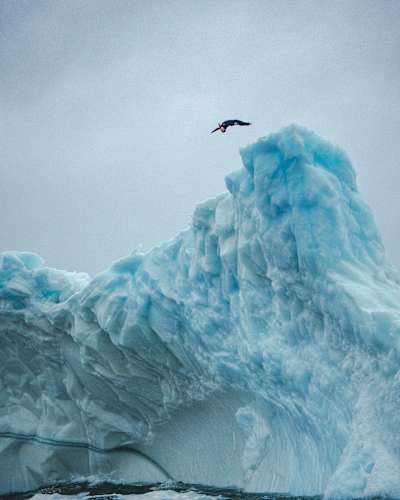
Carlson completed a near-15m backwards dive into the icy water, becoming the first woman to dive from a free-standing iceberg.
The shock of the freezing water hit instantly, but there was little time to celebrate, she recalls: “I remember coming up out of the water and thinking, ‘Swim! You've got to get away.’” Carlson quickly put some distance between herself and the iceberg before returning to the boat, where the emotion of the moment caught up with her.
“For sure, the best day of my life,” she said through tears.
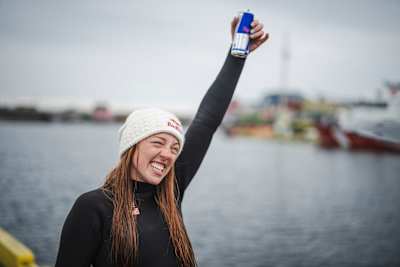
Molly Carlson celebrates after her world-first leap from an iceberg
Reflecting on the feat, Carlson says: “You have hard days, you might be anxious, you might be scared, you might have so much fear. But at the end of the day, to show yourself that you can do really cool things is really special, so I’m really proud.”