
Skydiving
Everything you need to know about Plane Swap
Find out everything there is to know about the people, the pilots, the planes and the physics it takes to swap planes in mid-air.
Part of this story


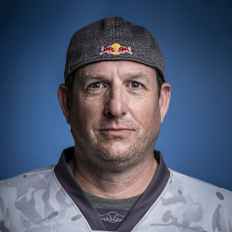
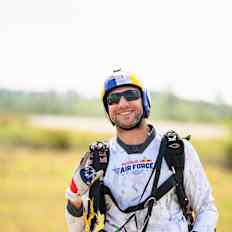
On Sunday, April 24, Luke Aikins and Andy Farrington will go down in history as the first pilots to take off in one aircraft and land in another after sending their planes into a nosedive and jumping out of them! Plane Swap is an audacious challenge taking place this weekend, and here are all the facts and figures you need to know on how it’s going to happen…
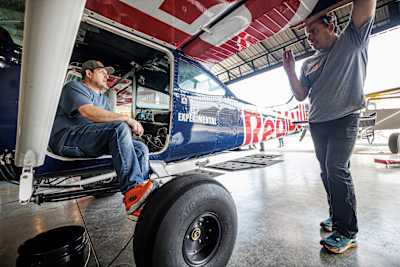
Luke Aikins and Paulo Iscold talk shop
© Chris Tedesco/Red Bull Content Pool
Who?
To say Luke Aikins and Andy Farrington were born to be skydivers and pilots is an understatement. Aikins and Farrington are cousins who put their aviation heritage down to their grandfather, Lenny, a World War II fighter pilot. Their grandfather was shot down and due to his canopy freezing, was unable to evacuate his P47. When he returned to the USA, he wondered what it would’ve been like to jump out of a plane, so he set up a skydiving school.
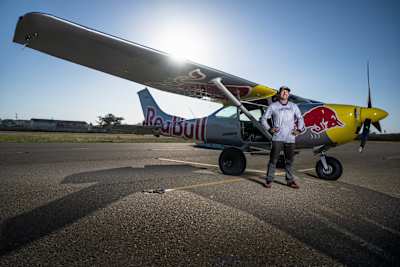
Andy Farrington and his plane are ready for Plane Swap
© Michael Clark/Red Bull Content Pool
Aikins and Farrington’s fathers also flew and jumped, so it was obvious that the boys would be doing the same thing – Aikins was still in the womb when he first jumped out of a plane. Both boys grew up on an airfield and jumped as much as possible. They also took up flying and both took their first solo flights at the age of 16.

Aside from being cousins, the pair are highly in-tune with each other, which is ideal for the Plane Swap challenge. They often fly in formation together and have completed more than 5,000 jumps together. This is why Aikins picked Farrington as his Plane Swap partner, the pair know instinctively what the other one is going to do, making it a more predictable and therefore safer challenge.
So, the pilots and jumpers are sorted, but it was going to take an aviation and aeronautical expert to step in and work on the aircraft to make sure all this could happen. This is where Dr Paulo Iscold steps in. Iscold is a professor of aircraft design, applied aerodynamics and is a pilot himself. Iscold met Aikins back in 2016 after the skydiver had just completed his 25,000ft (7,260m) parachute-less jump, landing into a giant net, so he knew what was in store when he was asked to help with the science on this project.
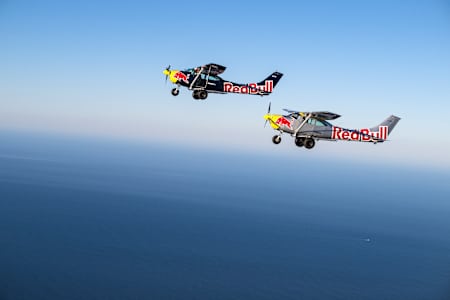
Although there are hundreds of people involved in making Sunday’s dream a reality, the last two stars of the challenge are the Cessna 182s being flown by Aikins and Farrington. The Cessna 182 is a workhorse that has been in production since 1956, and there have been more than 23,000 built. These planes are reliable and used for all sorts of tasks, from training aircraft to military operations. It’s the perfect companion for Plane Swap.
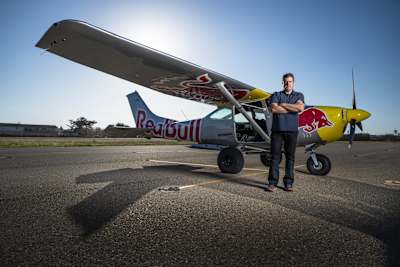
Paulo Iscold with one of the planes that his designs helped modify
© Michael Clark/Red Bull Content Pool
The swap
Plane Swap has been a year in the making with hours and hours put in by Aikins, Farrington, Iscold and Aaron Fitzgerald – the Aerial Coordinator – to ensure the plan goes off without a hitch.
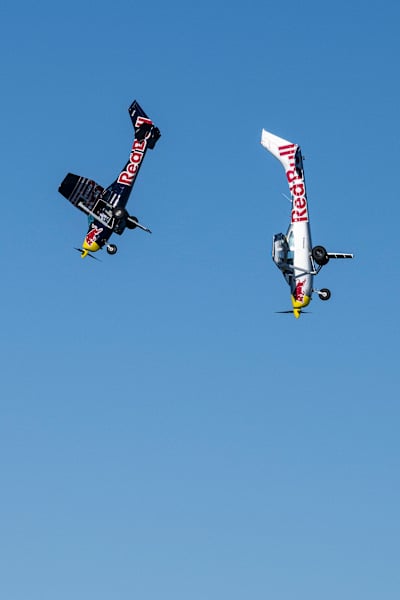
The two planes in a nosedive
© Michael Clark/Red Bull Content Pool
Much like a million flights before, the two planes will take off one at a time and ascend to 14,000ft (4,265m), where the pilots get into formation and complete their last checks – this is the last point where a ‘go’ or ‘no go’ call will be made.
When the ‘go’ call is made, both Aikins and Farrington will put their 182s into a tandem nosedive. For both aircraft to remain in a nosedive, they require a custom-built autopilot system to ensure they stay on the correct trajectory (more on the physics of the jump later). Each aircraft has also been fitted with a speed brake and larger than standard wheels to help create more drag and slow the rate of descent, as well as ensure the skydivers can catch up to them. The autopilot will activate once the pilots have manually entered the nosedive and switched the engines off to cause the planes to stall in mid-air.
With the planes holding their trajectory in the nosedive, Aikins and Farrington will then exit their planes and skydive to approximately 2,000ft (610m) above ground level before getting into the other aircraft.
Once back inside their new aircraft Aikins and Farrington will switch off the autopilot, retract the speed brake and restart the engines, whilst pulling level. They will then switch off the smoke to show everyone that the mission has been successful.
The science
To make Plane Swap a success there were several questions that needed to be answered. The first thing that needed to be done was to work out a way to slow down the descent of the planes whilst in the unmanned nosedive. A falling skydiver will reach a terminal velocity of around 130mph (209kph), whereas a falling Cessna 182 must not exceed a speed of 200-210mph (321-327kph), as it will start to break up mid-flight. This number is known as the Vne or the Never Exceed Speed.
The aircraft will also fall quicker than both Aikins and Farrington, so Paulo was tasked with a way of slowing down the 182s and came up with the speed brake. The speed brake is a large surface area that sits under the belly of the plane and is activated before the dive. This brake produces nine times more drag than the aircraft itself produces, which is the amount of drag needed to stabilise the plane to 125mph (200kph), which is Aikins and Farrington’s average speed. The speed brake solves the problem of the planes pulling away from the skydivers.
The next issue was keeping the aircraft on the correct trajectory whilst they were unmanned. The issue here is that there is no guarantee that the aircraft will stay on the same line without a pilot at the controls. The airflow around the aircraft can change the direction, so an autopilot was needed to ensure both the Cessnas stayed on target. However, there is no autopilot in the world designed to keep an aircraft flying straight down towards the ground, so the team had to develop their own.
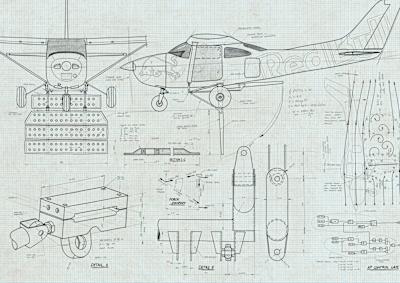
Design drawings for the air brake
© Red Bull Content Pool
In the freefall, the aircraft cannot produce any lift on the wing, so the pitch angle has to be slightly more than 90-degrees, so the wings are lining up with the ground.
Then there is the issue of Aikins and Farrington being able to get in and out of the aircraft. Not only that, but they also have to get into the pilot’s seat that is at a vertical angle. On one test flight, Farrington found a solution. He worked out that by holding onto the strut (the metal pole that connects the wing to the body of the plane), he could pull himself closer and closer to the cabin of the aircraft. He then placed his chest on the door frame. With one leg and arm inside the plane, he found he could deactivate the nosedive and then be able to sit back on the seat once the plane had begun to level out.
And finally, the target. Aikins and Farrington will be aiming for a moving target no bigger than a refrigerator door whilst diving at 130mph (209kph). That’s why 5,000-plus jumps together helps enormously!
Where and when
Aikins and Farrington have been training for Plane Swap in San Luis Obispo, California but the actual challenge will take place above the Arizona desert this Sunday.
The timing of the flight will largely depend on the air temperature. This is because if the temperature is too hot, the air is less dense and the aircraft will fall quicker. With Arizona having a warmer climate than where the team has been practising, Iscold has planned for Aikins and Farrington to be taking off in the late afternoon.
The entire event can be watched live and coverage begins at 4pm local time in Arizona, which is midnight (00:00GMT). For those watching in the US, it will be streamed exclusively on Hulu, outside of the US you can follow the entire event on Red Bull TV.
For more information on Plane Swap click HERE.
And if you want to visualise how it’s all going to happen have a look at our interactive infographic HERE.
Part of this story