Season by season, here is the history of Red Bull Street Style
Held since 2008 in cooperation with the World Freestyle Football Association, Red Bull Street Style is the pioneer and most prestigious of all freestyle football tournaments.
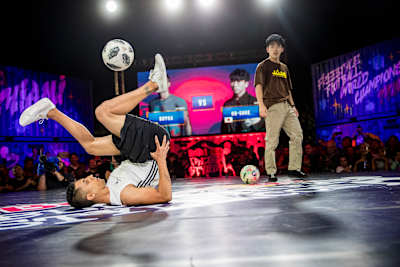
Freestyle football is the art of doing tricks with a football… but it’s not only the fancy moves which make this sport unique: freestyle is a lifestyle that transcends the sport to become a form of art.
The range of tricks a freestyler can do is simply endless. The roots of freestyle football as a global phenomenon date from back in the 1980s, when the Argentinian football legend Diego Armando Maradona started performing them in his famous warm-ups.
Red Bull Energy Drink is appreciated worldwide by top athletes, busy professionals, university students and travellers on long journeys.
During the 1990s, the sport gained popularity particularly thanks to two South Korean freestylers, Mr Woo and Kang Sung Min, but it was not until the dawn of the new millennium when freestyle football made a huge leap forward: TV commercials starring Ronaldinho and Mr Woo launched the sport towards a huge mainstream audience, and Soufiane Touzani’s YouTube videos helped it reach a new generation of players.
The newly created national and continental tournaments which appeared in the mid-2000s gave freestylers a boost of motivation to train and develop their own style. In 2008, freestyle football made a definitive step with the support of Red Bull, which organised the first major global competition: Red Bull Street Style. Its first champion was the Frenchman Séan Garnier, who won the title in Brazil with a unique approach that had never been seen before.
The History of Red Bull Street Style
Freestyle football has continued to explode in popularity over the years. However, newcomers and those unfamiliar with the sport altogether may not know about the history of the Red Bull Street Style tournament that brought freestyle football into the spotlight, taking things to the next level. Today it’s the official world championship of freestyle football.
Of course, doing tricks with a football had existed for quite some time. This is different though, a breathtaking combination of athleticism and creativity with the ball where sky’s the limit. This format of a global competition to showcase freestyle skills, with national representatives battling head-to-head for glory, was groundbreaking to say the least.
01
2008
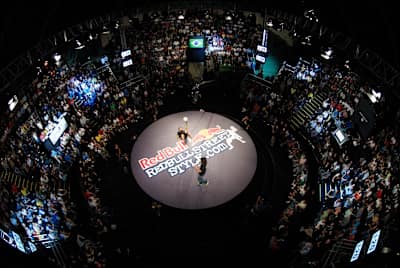
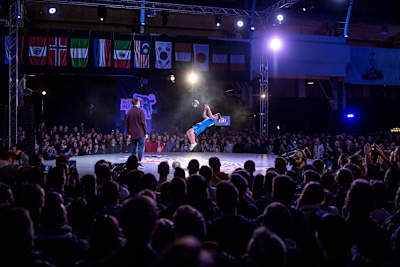
Overview of the stage at the Red Bull Street Style finals in Sao Paulo
The first-ever Red Bull Street Style World Finals took place in São Paulo, Brazil. All competitors had to use the Adidas F50 balls. The judging panel consisted of former Brazilian footballer ‘Bebeto’, Futsal legend Falcao, Bboy Crazy Legs and Edgar Davids, who had strong ties with freestlyle and street soccer at the time. The fifth judge was the crowd themselves, who were in awe at the amazing tricks on display, certainly original and fresh and new at the time. The overall winner and first-ever champion was Séan Garnier from France, who beat Yosuke (Japan) in the final while Brazil’s own Murilo Pitol took third place.
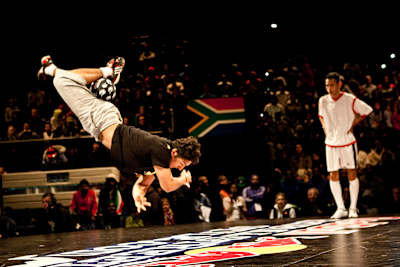
After another extensive period of national qualifiers, Red Bull Street Style returned in 2010, held this time at Cape Town, South Africa. With a lot of new faces in the competition, this was a great follow-up and highly anticipated. Competitors now switched to using the size 4.5 ‘Monta’ Street Soccer balls. Edgar Davids again joined the judging panel, this time alongside George Weah and freestyler Chris Njokwana. Ultimately the Norwegian giant Azun took home the gold, defeating the creative crowd favourite ‘Kamalio’ in the final. Meanwhile a heroic effort from Rocky of Colombia, competing with numerous injuries, managed to take the third-place prize.
03
2012
Kotaro Tokuda of Japan performs during Red Bull Street Style
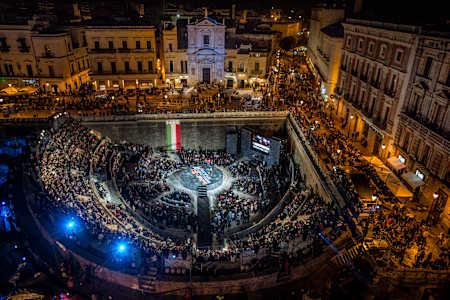
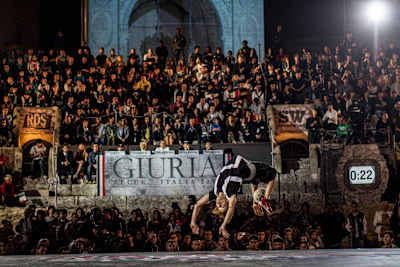
By now many are very familiar with the Red Bull Street Style competition format: three-minute battles between two players to try and win over the judges and advance to the next round. 2012 utilised one of the most iconic venues in Red Bull Street Style history with the amazing Anfiteatro Romano, an amphitheatre in Lecce, Italy. With former Italy international footballers Fabio Cannavaro and Felippo Inzaghi on the judging panel, this was the stage that saw Tokura from Japan and his signature 'Backflip Catch' come out on top over Ireland’s Daniel Dennehy (second place) and home darling Gunther Celi (third). 2012 was also a significant year in that it was the first time that women had their own competition in the World Finals. This debut was marked with a win for Hungary’s Kitti Szász.
04
2013
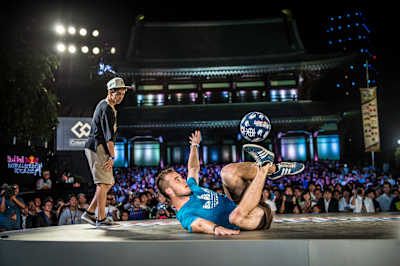
Soufiane El Marnissi competes against Szymon Skalski at Zojoji Temple
Red Bull Street Style really is a competition to bring the world together, highlighting not just the diversity of the incredibly talented players from all kinds of backgrounds, but also the amazing locations and cultures they get to experience by taking part. This time, the World Final setting was the ancient Zojo-ji Temple in the Japanese capital of Tokyo, where Italy World Cup winner Marco Materazzi joined the judging panel.
Coincidentally, this was the first time that nobody finishing in the top three was native to the host nation. Instead, a strong all-rounder from Poland, Szymon ‘Szymo’ Skalski, reigned victorious, while Charly Iacono of Argentina and the UK’s Andrew Henderson finished second and third, respectively. History was made when the Hungarian Kitti Szász successfully defended the women's world title, becoming the first athlete – of any gender – to capture the crown twice in a row.
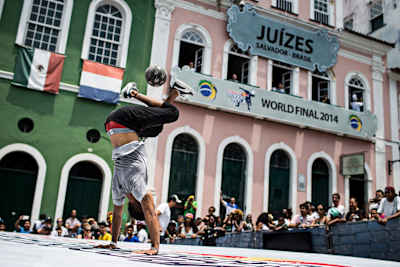
This year saw the World Final move back to Brazil, but this time Salvador would play the role of the host city. The use of the standard Red Bull Street Style Monta balls was no longer mandatory in this year’s edition; instead players could opt to use their regular size 5 matchballs, but with the Red Bull Street Style branding on them. Despite some troublesome weather, the competition put on another real spectacle. The celebrity judge watching over the high-octane action on this occasion was former Brazil international ‘Rai’. The UK's Andrew Henderson managed to take home the title, getting revenge on second-place Charly Iacono, the Argentinian who had eliminated him the previous year in Tokyo at the semi-final stage. Meanwhile, the up-and-coming Erlend Fagerli of Norway rounded out the podium in third place, and in the women's battles, Mélody Donchet (France) took the win, denying Kitti Szász a hat trick.
06
2016
Event winner Carlos Alberto Iacono during the Red Bull Street Style
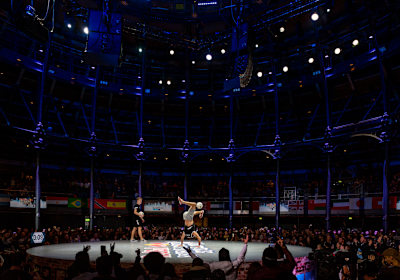
After a two-year hiatus, the Red Bull Street Style World Final returned, making its premiere in the English capital of London, where the packed Roundhouse in Camden saw faces old and new, all under the same roof for more action. Fittingly, the five-member judging panel also featured a former Manchester United and England international in Gary Neville. Once again, a long marathon of qualifiers behind closed doors the day before the event narrowed the field, from approximately 48 nations to only the best 16 for the World Finals; so from the word go, everyone expected and witnessed elite-level freestyle.
Always the bridesmaid and never the bride, Charly Iacono from Argentina finally claimed the title, wowing the crowds with his jaw-dropping acrobatic control. Kosuke (Japan) and MC Pro (Russia) completed the podium. The female battles once again saw a triumph for Mélody Donchet, who beat Poland's Aguska Mnich in the final.
07
2018
Jeffry Chacon Garcia competes against Bartlomiej 'Kala' Rak at Hala Gwardii
After another break, the hotly anticipated return of the competition did not disappoint – this time in a slightly colder setting, the Polish capital of Warsaw. During the break, the level and creativity of freestyle football had skyrocketed, becoming more technically focused and fluid than ever, with a margin for error so small that any drop or mistake could prove costly to players. This didn't make life any easier for the five judges, either, including the friendly face of former Brazil left back Roberto Carlos.
It had been a long time coming and somewhat expected, but Norway's Fagerli brothers – Erlend and Brynjar – set the stage alight, taking the first and third place, with Brazil’s Ricardinho securing the second spot. The women's battles once again saw old rivalries reignited, with Mélody Donchet and Aguska Mnich going head-to-head in a tightly contested final which saw the Polish star come out on top, much to the delight of the home crowd.
08
2019
Sebastian Ortiz competes against Kosuke Takahashi at Wynwood Marketplace
Jet-setting across continents took the competition to Miami, USA the following year. This one produced some memorable moments, controversy and probably some of the best battles in freestyle football history. Complete with former Manchester United and Portugal winger Nani as a judge for the men's battles, and former Mexico international Pavel Pardo for the women, fans were treated to another outrageous evening of freestyle football madness in the city's Wynwood neighbourhood.
This time, the tournament favourite Erlend Fagerli had to settle for third place after narrowly losing an epic encounter with Ricardinho (Brazil) who went on to win the whole competition by beating Boyka Ortiz (Colombia) in the final. The women's battles once again saw Aguska Mnich and Mélody Donchet locking horns. This time the French freestyler won the day, and in doing so made history as the first player, male or female, to win three Red Bull Street Style World Final titles.
09
2020
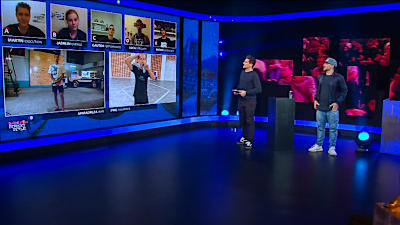
After months of competition featuring athletes from around the globe, the climax of the first freestyle football world championship to be held entirely online saw 24 players from 11 countries battling head-to-head, live online across thousands of miles. But in the final moments, the last two contenders were Norwegian brothers tricking just meters away from each other in the same gymnasium.
Ever since the first Red Bull Street Style tournament in 2008, the World Final battles have been held on stage in front of large crowds in global destinations – but this time, the participants, the judges and the spectators were all online across a range of time zones. Whether they were streaming from Japan or Iran, Colombia or the Philippines, the UAE, the USA, the UK or Europe, the structure was the same: two players answering each other’s challenges in three intense back-and-forth rounds of 30 seconds each.
In the unprecedented all-digital World Final, French legend Mélody Donchet became the first athlete of any gender to claim four wins in the official world championship of freestyle football, while Erlend Fagerli of Norway defeated his brother Brynjar in the final to achieve a long-awaited grail as the only freestyler in history to earn a second title in men’s competition. Best Trick honors judged by football superstar Cesc Fàbregas went to Norway’s Brynjar Fagerli and Hungary’s Kitti Szász.
10
2021
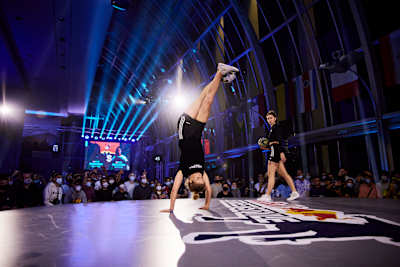
In 2021, the World Final was back in front of spectators, who – along with an expert judging panel of freestylers Javi Sanz (Spain), Tobias Becs (Norway), Michal Rycaj (Poland), Kitti Szász (Hungary) and Séan Garnier (France) – witnessed stunning developments at the Palau de la Música in Valencia, Spain.
Aguska Mnich (L) battles Lia Lewis in the women's final at Valencia
On the women’s side, the UK’s Lia Lewis – who had been training in the sport for only three short years – dazzled with tricks inspired by acrobatics. In an upset, the Brit defeated 2018 champion Aguska Mnich of Poland to claim the trophy and leave a disappointed Mnich in second. The battle for third saw another unexpected outcome, with the USA’s Caitlyn Schrepfer overcoming French legend Mélody Donchet.
Meanwhile, Norway’s Erlend Fagerli made history again in the men’s draw, outscoring Jesse Marlet of the Netherlands in a tough final battle to take an unprecedented third Red Bull Street Style men’s crown. Marlet had to settle for the runner-up spot, while Colombia’s Boyka Ortiz claimed third place.
Red Bull Street Style 2022
The next chapter in Red Bull Street Style history will be written when this year’s World Final takes place in Pula, Croatia on October 8, 2022 – and with the level of talent and skills higher than ever, it's not to be missed.
You can help to write that history by choosing your favourite male and female participant for the new People’s Choice Award: be sure to cast your vote between September 30 and October 7, 2022, right here.
To keep up with all the Red Bull Street Style news, stay tuned to the event page and the WFFA website, and follow #redbullstreetstyle on social.