





Skateboarding
Skateboarding
Strength training for skateboarding: exercises to improve your skills
Want to improve your skateboarding? Discover the strength-training exercises that can help you jump higher, skate longer and land tricks with greater control.
Strength training and skateboarding might not seem like an obvious combination, but bringing the two together can make a real difference to your performance. While you don't need to lift weights to become a better skateboarder, targeted strength training can help you develop skills and endurance that skateboarding alone might not provide.
Every skateboarder knows how much strength and energy it takes to get off the ground. The stronger your legs, the more power you can generate when jumping. Strength training can also improve muscular endurance, helping you skate for longer and reduce the risk of injuries caused by muscle fatigue.
Of course, the best way to improve your skateboarding is still to spend time practising on your board. However, if you want to boost your airs like Leticia Bufoni - one of the first pro skaters to work out like a world-class athlete - incorporating strength training into your routine is a great place to start.

5 min
Train Like a Pro: Leticia Bufoni's Insane Fitness Routine
Professional skateboarder Leticia Bufoni demonstrates her insane home fitness routine helping her build explosive power, while improving her balance and coordination.
01
Four essential strength training exercises for skateboarders
Strength training can help skateboarders build endurance, improve balance and develop greater control on their boards. The best strength training exercises for skateboarders include lateral leg raises, box jumps, single-leg squats and side planks. These exercises target key muscle groups used in skateboarding, helping you build a stronger foundation for better performance.
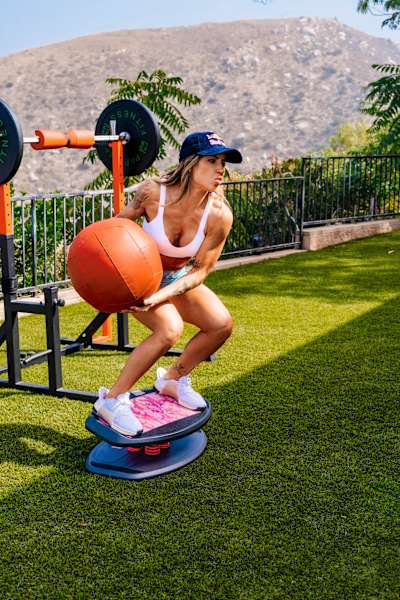
Leticia Bufoni felt the benefits of strength training during injury rehab
© Maria Jose Govea/The Red Bulletin
1. Lateral leg raises
To perform lateral leg raises, stand with your toes pointing forwards and your knees slightly bent. Shift your weight onto your right leg, then exhale as you raise your left leg out to the side as far as you comfortably can. Keep your pelvis stable throughout the movement. Inhale as you slowly lower your leg back to the starting position. Complete your repetitions, then switch legs.
If you're struggling to maintain your balance, try holding the back of a chair for support. As your muscles get stronger, your stability and balance should improve.
2. Box jumps
For this exercise, you'll need a sturdy box or raised surface to jump onto. If you don't have any equipment, a park bench may work, provided it's stable and suitable for the exercise.
Start by lowering yourself into a proper squat. Then exhale as you explosively push off the ground and jump onto the box. Jump or step back down, landing with control and returning to your starting squat position. Focus on smooth transitions and quiet landings, maintaining good technique throughout.
3. Single-leg squats
When you're first learning this exercise, use a chair or sofa for support. Position yourself a few inches in front of the seat, with your feet hip-width apart. Shift your weight onto your right leg, inhale and slowly lower yourself into a squat until your glutes lightly touch the seat behind you.
Exhale as you push back up to a standing position, keeping your left leg raised off the ground throughout the movement. Complete your repetitions, then switch legs. Once you've mastered the movement, you can increase the difficulty by removing the chair or adding weight.
4. Side plank
The side plank is an excellent exercise for strengthening your core, one of the key muscle groups used in skateboarding.
Start by lying on your left side, with your right foot stacked on top of your left or placed on the floor in front of your left leg. Exhale, engage your core and lift your hips off the ground, creating a straight line from your head to your feet. Support yourself on your left elbow or left hand, whichever feels more comfortable. Make sure your elbow or hand stays directly beneath your shoulder. Hold the position for at least 30 seconds, then switch sides.
02
The key muscle groups used in skateboarding
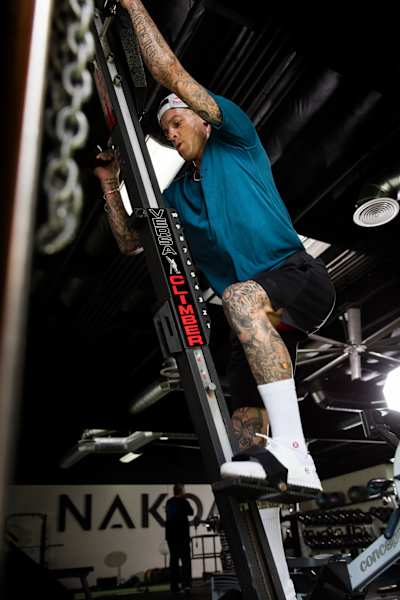
Ryan Sheckler hits the gym
© Seu Trinh
You might not realise just how many muscles are involved in skateboarding. Look more closely at the movements required to ride, jump and perform tricks, and you'll find that several major muscle groups work together to keep you balanced and in control.
Core muscles
Your core plays a crucial role in stabilising your body and maintaining balance while skateboarding. It includes the abdominal, hip and back muscles, all of which help you control your movements on the board. Developing a strong core can improve your stability and control, particularly when performing tricks.
Quadriceps and hamstrings
Your quadriceps and hamstrings do a lot of work when you're skateboarding. The quadriceps are a group of four muscles at the front of your thighs that help extend your knees and flex your hips. These movements are essential whenever you crouch down and push upwards to jump.
Your hamstrings are a group of muscles at the back of your thighs that help bend your knees and extend your hips. They're particularly important when lowering yourself into a crouched position on your skateboard.
Gluteus maximus
The gluteus maximus is one of the largest muscles in your body, extending across your buttocks and attaching to the thigh bone. It plays an important role in hip extension and helps you generate power when moving from a squat into a standing or jumping position. Strong glutes also contribute to stability and balance while skateboarding.
Lower leg muscles
The main muscles in your lower legs include your calves and the tibialis anterior, which runs along the front of your shin. Your calf muscles help you point your toes downwards, while the tibialis anterior allows you to lift your toes and control your foot position.
Both muscle groups contribute to the ankle movements and foot control needed to steer and manoeuvre your skateboard.
03
Strength exercises to take your skateboarding tricks to the next level
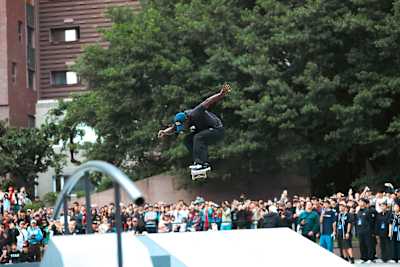
Zion Wright uses strength training to build his explosive power
© Yves Hou/Red Bull Content Pool
The following exercises focus on developing the strength and control needed for switch tricks and flicking movements.
1. Switch pop
Want to take your switch game to the next level? Try incorporating switch pops into your training routine.
You'll need a resistance band and a sturdy box or raised surface to jump onto. Place the resistance band just above your knees, making sure you maintain proper knee alignment throughout the exercise. Avoid allowing your knees to collapse inwards.
Position yourself with the box to one side so you can jump sideways onto it. Shift your weight onto the leg furthest from the box. For example, if the box is on your right, transfer your weight onto your left leg. Lower yourself into a squat, keeping your hips back, then explosively push upwards and sideways onto the raised surface. Land softly with control.
Step back down and repeat the movement, this time rotating your body as you jump so that you land facing forwards. Lower yourself carefully and reset before the next repetition. Aim for two to three sets of 10 jumps on each leg.
2. Kickflip
This exercise targets the muscles around your ankles and helps develop the strength and control needed for flicking movements. You'll need a chair and two resistance bands.
Start by placing one resistance band just above your knees and the other around the arches of your feet. Sit on the chair with your feet and knees approximately shoulder-width apart, maintaining steady tension in the band above your knees.
Keep your left foot flat on the floor while moving your right foot outwards in a flicking motion. Complete 20 repetitions, or continue until your muscles begin to feel fatigued. Switch feet and repeat. Aim for two sets on each side.
If you want to take your skateboarding to the next level and impress your friends at the skate park, try incorporating two to three strength training sessions into your weekly routine. With consistent training and plenty of practice, you'll be working towards bigger airs, stronger tricks and better overall performance in no time.
And finally, if skateboarders are training like athletes, does that mean skateboarding is a 'proper' sport? It's an interesting question, and one explored in full below:

10 min
Skateboarding vs sports
At the end of the day, what is it that makes skateboarding different from other sports?
04
Strength training for skateboarders FAQs
Frequently asked questions
