Get up to speed with all you need to know about track and field events
From the glamour of the 100m to the technical wizardry of pole vaulting, track and field has something for all tastes, whether you're just a fan or looking to get in on the action. Find out more here.
Track and field, or athletics as you might know it, encompasses the wide range of sporting disciplines that place on an athletics running track and its in-field area, whether that's at your local community sports centre or inside a cavernous stadium on the world's biggest sporting stages.
Running, jumping, throwing: that's essentially the three types of activities all track and field events fall under, from the short and spectacular sprint races on the track to highly technical field events like pole vault or discus throwing.
There truly is something for everyone in track and field, so read on find out more about each discipline and find which one really grabs your attention.
01
What are the track events?
Sprinting
The 100m sprint is the best known and most famous athletics event
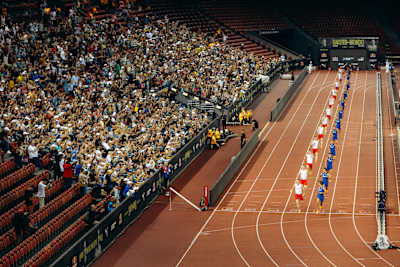
Sprinting involves running as fast as possible over a short distance and is the simplest event of all on the track: A to B in the quickest time possible. On the world stage, there are three main distances – 100m, 200m and 400m – and at the big global events like the Olympic Games and World Athletics Championships the sprint events, especially the 100m, are the most anticipated and viewed events.
The fastest man in history, Jamaican Usain Bolt, set both the 100m and 200m world record times at the 2009 World Athletics Championships, running 100m in 9.59s and finishing the 200m in 19.19s.
In women's sprinting, the late American Florence Griffith-Joyner also holds both the 100m and 200m records, having claimed both during a dominant 1988 season. Her 100m time of 10.49s and 200m record 21.34 are currently two of the longest-standing world records, although notable current sprinters are edging closer, including Sha’Carri Richardson, who achieved a personal best 100m of 10.71s in 2023; Elaine Thompson-Herah's 10.54s in 2024; and Shelly-Ann Fraser-Pryce, who registered 10.60s in 2021.
Middle-distance running
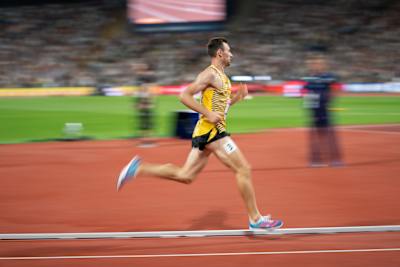
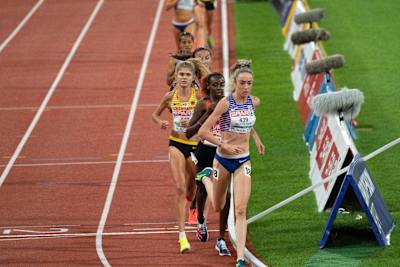
Middle-distance running covers track races of up to 3,000m, although the most well known and typical distances seen at events are 800m and 1,500m. They bridge to gap between outright sprint events and the draining endurance distances.
No discussion of middle distance running is complete without mentioning Moroccan Hicham El Guerrouj, who's generally considered the greatest middle-distance runner of all time. He set the 1,500m world record in 1998 in a time of 3m 26s and also holds the mile record of 3m 43.13s.
Middle distance racers tackle the 800m and 1,500m at incredible speeds
Middle distance running is hard to truly master, so if you want to try your hand at middle-distance running, focus on improving your running economy, which is the relationship between your running speed and the oxygen your body absorbs. Improving your Vo2 max (the maximum volume of oxygen your body uses while running) goes a long way in improving how your body handles the lactic acid build up that causes the cramping and shortness of breath 1,500m running especially is notorious for. You can also incorporate breathing exercises that can help boost stamina.
Long-distance running
Also called endurance running, long-distance running, involves distances over a minimum distance of three kilometers. In track and field, 5,000m and 10,000m events are common. Marathons and half-marathons are not run on a track, but they are sometimes referred to as track and field events in the United States especially.
Ugandan Joshua Cheptegai has held the world record time in both 5,000m and 10,000m distances since 2020, securing the 5,000m record with a time of 12m 35.36s and the 10,000m record in 26m 11.00s.
Events like the 10,000m test endurance and speed to the max
The world record times in the women's 5,000m and 10,000m are both held by one runner as well: Kenya's Beatrice Chebet, who beat the previous record times of Ethiopian Letesenbet Gidey in both cases. She first broke the 10,000m record at the renowned Prefontaine Classic in 2024 with a time of 28m 54.14s and then added the 5,000m record at the same event one year later in July 2025 with a 13m 58.06s performance. She also holds the 5km road running world record for good measure.
Long distance running is good for developing endurance, enhanced mental focus and your overall physical health. Training to go the distance involves breaking up your running routine with strength training and shorter recovery runs.
Hurdles
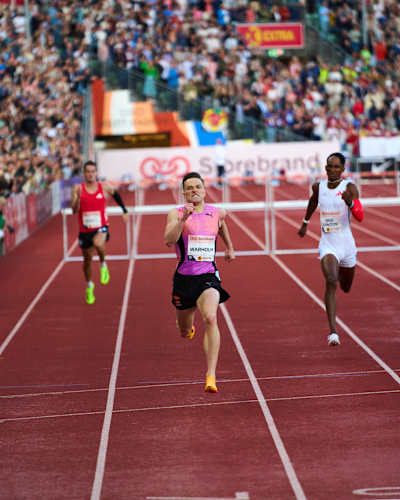
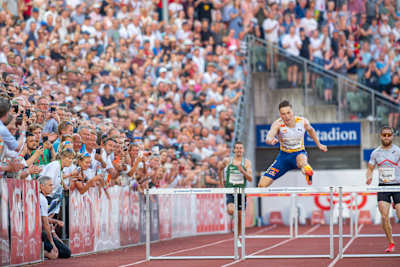
Karsten Warholm competes during Bislett Games in Oslo, Norway in 2023
Hurdle races involve jumping over identical flat-topped barriers known as hurdles while running at high speeds. There are different types of hurdles of varying heights, including low, intermediate and high hurdles. They measure anywhere from 68cm to 106cm tall, depending on the race.
The standard hurdle race lengths is 400m for both men and women, as well as 110m for men and 100m for women. Norway's Karsten Warholm ran the world’s first sub-46s 400m race at the Tokyo Games in 2021, where he won the gold medal in a barrier-breaking world record time of 45.94s
Steeplechase, a long-distance version of hurdles, involves runners leaping over two barriers during a race: one hurdle and one water jump. There are 3,000m and 4,000m steeplechase races and barrier height varies between men's and women's races. Inspired by the traditional steeplechase horse events, the race entered the world stage in 1900.
Relays
Relay races are sprint events run in teams of four, which each team member running a set distance before passing a baton to another team-mate. The two common relay setups are 4x100m and 4x400m relays. and teams can be male, female or mixed.
02
What are the field events?
Jumping
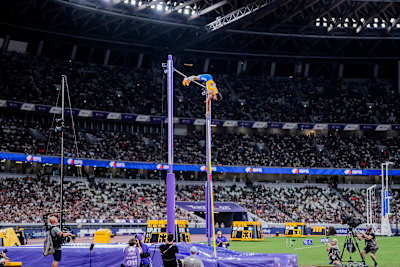
World record holder Armand Duplantis is the master of pole vault
A collection of four events make up the track and field jumping events. They're divided into two categories: horizontal jumping, where the goal is to jump as far as possible, and vertical jumping, where the goal is to jump as high as possible.
The four events are:
Long jump: In long jumping, you run down and approach track and leap as far as possible from a designated takeoff point into a sand pit. Jumps are measured from the take off point to the closet mark made in the sand by your body. The long jump world records are two of the longest-standing in track and field, with Mike Powell holding the men's 8.95m record since 1991, while and Galina Chistyakova set the women's record 7.52m in 1988.
Triple jump: Triple jump adds a hop and a skip before you make the leap into the sand pit. Notable triple jumpers include world record holders Jonathan Edwards (18.29m) and Yulimar Rojas (15.67), while current stars Jordan Diaz and Will Claye hold the third and fourth biggest triple jumps in history and are aiming to go even better.
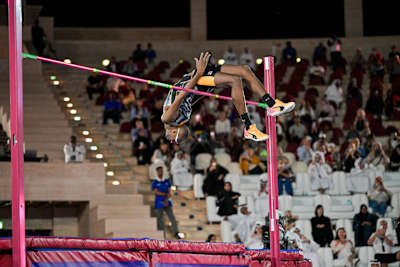
High jump: In high jumping, you leap unaided over a horizontal bar without dislodging it. Typically, you run toward the bar and leap over it with your back toward the bar in a method called the 'Fosbury Flop'. Athletes get three attempts to clear each height. Cuban legend Javier Sotomayor set the men's world record height of 2.45m back in 1993, while at the Tokyo 2020 Games for the first time ever Qatar's Mutaz Barshim and Italian Gianmarco Tamberi shared the gold medal.
Pole vault: In pole vaulting, athletes use a flexible pole to impulse themselves over a high horizontal bar. The goal is to vault over the bar at increasing heights until there's one athlete left standing. Like in the high jump, competitors get three attempts to clear each height. 14-time pole vault world record-breaker Armand Duplantis is perhaps the greatest track and field athlete on the planet right now and set a new record high of 6.30m on his way to winning a third consecutive gold medal at the 2025 World Athletics championships in Tokyo, Japan.
Jumping events of all kinds involve a combination of technical skill and strength. There’s a mental component as well, as athletes train their mind to focus on letting go and leaning into the jump to really go the distance. Training techniques that may be beneficial for you include single-leg training to perfect propelling your body forward and upwards, sprinting drills to increase in-run speed and working on core stability through strength training.
Throwing
At their core, throwing events involve tossing a weighted object as far as possible, albeit in very different ways. These events can trace their roots to ancient Greece and are still central disciplines today on the world stage.
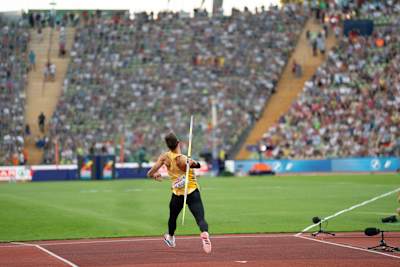
Javelin throwing goes all the way back to the Ancient Olympic Games
Shot put: This involves tossing a heavy ball as far as possible. Athletes retain a specific form that involves tucking their arm and the shot by their neck as you prepare to throw the ball and then launching it upwards and forward. Men use a 7.26kg shot, while in women's contests the shot weighs 4kg. American Ryan Crouser set the men’s outdoor record of 23.56m in 2023, but Natalya Lisovskaya’s female record of 22.63m has stood since 1987.
Discus: This ancient event involves throwing a flat, heavy disc long distances. The weight of the disc depends on who's throwing it, but in contemporary pro contests men use a 2kg disc and women a 1kg disc. The men's world record is held by Lithuanian Mykolas Alekna, who broke the record twice in one day in April 2025, when he threw 74.89m and then 75.56m. German Gabriele Reinsch has held the women’s record of 76.80m since in 1988.
Hammer: This involves throwing a weighted ball attached to a wire. To throw the hammer, you'll stand in a designated circle and swing the hammer around a few times to gain momentum before releasing it. Whoever throws the hammer farthest wins the competition. Men use a 7.26kg hammer and women 4kg, with maximum length wire of 122cm permitted for both classes. Noted hammer throwers include Poland's Anita Włodarczyk, who holds the six best throws of all time and was the first woman in history to break the 80m barrier.
Javelin: Another original of the Greek games, this involves throwing a spear called a javelin as far as you can, as long as it lands inside the limits of the zone at the end of the throwing area. You’ll accelerate on a runway that's at least 30 meters long, release the javelin and stop running before you reach the line marking the end of the runway. Javelin throwing technique is carefully controlled, too, making it a highly technical event. Czech throwers hold both men's and women's records. Jan Železný set the men's record in 1996 with a distance of 98.48m and it still the only athlete to break 98m to date, while Barbora Špotáková set the women's record in 2008 with 72.28m.
Training for throwing events
Throwing events require explosive power, so aside from improving your throwing skills, you can expect long warmups, strength training and weight lifting to be a big part of your training routine. Plyometrics are particularly good for perfecting your balance, so expect side-to-sides and high knees to be a part of your training. Other core stabilisers like planks and lunges help you keep form and propel the throwing object. Javelin throwers also need to have excellent speed and leg power, too, so sprinter-style training is a big benefit as well.
03
What are combined track and field events?
Two combined events bring all of track and field into a single, multi-day affair: the decathlon for men and the heptathlon for women. Both events are renowned for their difficulty and are widely regarded as among the hardest competitions you can attempt. You earn points for each activity and the person with the highest score is declared the winner. Nafissatou 'Nafi' Thiam is one of the only women in history to break the 7,000-point heptathlon barrier – a huge score that one history's best can get close to.
Decathlon encompasses 10 events performed in a specific order over two days and the events held in rapid succession with little time to recover in between. The first day of a decathlon covers a 100m race, long jump, shot put, high jump and a 400m. The second day involves a 110m hurdles, discus, pole vault, javelin and a final 1,500m race.
A heptathlon follows the same principle, but with seven events instead of 10. While there's a women's scoring system for a decathlon, heptathlon is still reserved for only female competitors. The first day starts off with a 100m hurdles, followed by high jump, shot put and a 200m. The second day consists of a long jump, javelin and a 800m final.